The Shepherd's Golden Helmet
A boy played with a golden crown for two weeks, using it to water chickens — not knowing he held a 2,400-year-old king's helmet in his hands.
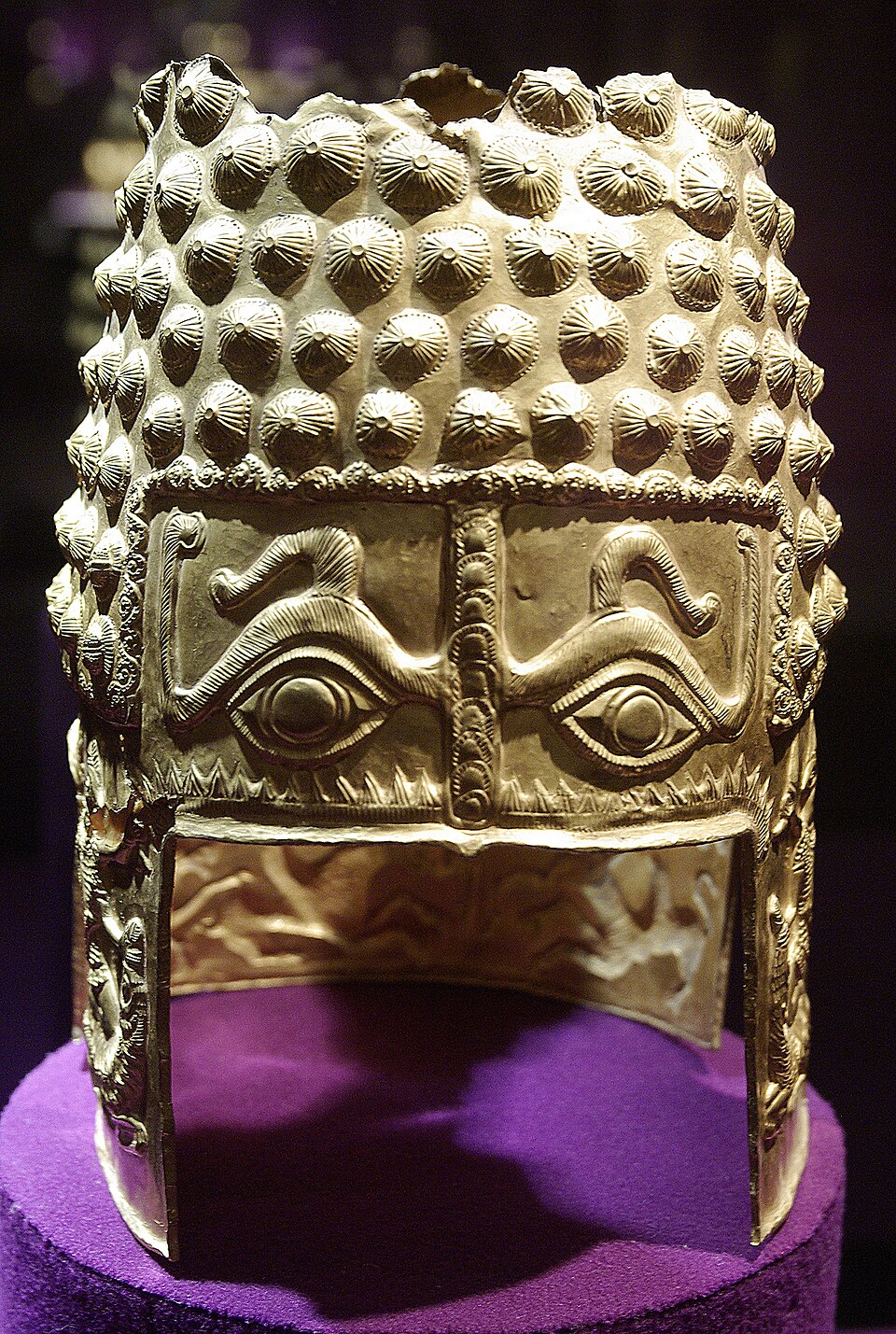
In 1926, in the small Romanian village of Poiana Coțofenești, a farmer's child named Traian Simion was herding sheep on a stretch of grassland called Vârful Fundăturii when he found something gleaming in the earth. It was a helmet, heavy and strange, made of a pale gold alloy called electrum. For two weeks the boy wore it as a plaything, and in the process some of its detached parts were lost or damaged — the top had already been struck or pulled while hanging from a tree branch. Eventually the helmet ended up as a watering trough for chickens, perched atop the family's coop, its true nature unrecognized.
Word of the strange golden object reached a Ploiești merchant, Ion (or Jean) Marinescu-Moreanu, who bought it — detached pieces included — for 30,000 lei, a sum equal to as much as thirty years' income for the farmer. Marinescu brought the helmet to the attention of Ion Marin Sadoveanu, head of the Ministry of Arts. In April 1929, the Ministry of Public Instruction and Cults purchased the piece for the National Museum of Antiquities, the institution that would later become the National History Museum of Romania.
Marinescu was initially praised as the man who had saved a national treasure. But after the landslide 1928 Romanian general election swept in a new government, and Marinescu — likely a sympathizer of the defeated Liberal Party — found himself accused instead of profiteering from the discovery.
Archaeologist Ioan Andrieșescu, a professor of prehistory at the University of Bucharest, later surveyed the find site. His team determined the helmet had not come from a burial or hoard, but was a stray find within a local Geto-Dacian settlement of the La Tène period; only scattered late Hallstatt pottery fragments, some wheel-made, turned up nearby.
The helmet itself, weighing nearly a kilogram, survives remarkably intact apart from part of its skull cap. Its surface is dense with meaning: large studs crown the top, and two enormous apotropaic eyes stare outward, meant to ward off the evil eye and hostile magic. Scholars believe it belonged to an unknown Geto-Dacian king or aristocrat, crafted in the second half of the 5th century BC.
More from Art

The Painting With No Foreground
A single robed figure stares out at an empty grey sea — and the emptiness itself became a scandal. When it was unveiled in Berlin in 1810, no one knew quite what to do with it.

The Painter Who Chased the Light
For a few purple minutes each evening, an American exile knelt in an English garden and raced the dying sun to paint two little girls lighting lanterns. It took him two years to finish.

When a President Became a God
Look straight up inside the U.S. Capitol dome and you will find George Washington enthroned among the clouds, surrounded by goddesses — the founding father transformed into myth.

Marble Brought Back to Life
A corpse asleep, a wing barely brushing her skin — and marble somehow learns to breathe. This is the moment Antonio Canova dared to carve.

The World Turned Upside Down
Look closely at a sixteenth-century Flemish village and you'll find a man biting a pillar, another carrying daylight in a basket, and a wife slipping a blue cloak over her husband's shoulders. Every gesture is a joke — if you know the language.

The Girl in the Glass Case
She stood two-thirds life size, dressed in a real tutu and human hair — and the critics who saw her in 1881 recoiled as if she were something obscene.