The Six-Year-Old Who Walked Past the Slur
A tiny girl in a white dress strides forward while a wall behind her screams hatred. Norman Rockwell painted the moment America could not look away from.
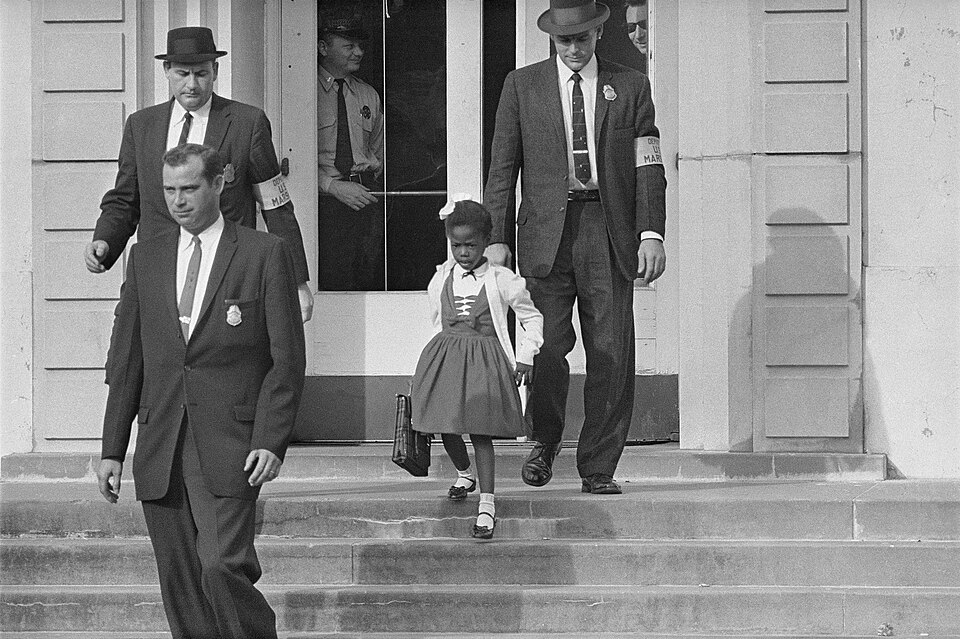
On November 14, 1960, in New Orleans, a six-year-old named Ruby Bridges walked into William Frantz Elementary School under armed escort. She was the only Black child entering that all-white public school, and the threats against her were serious enough that four deputy U.S. marshals were assigned to walk her there. Four years later, Norman Rockwell turned that walk into one of the most confronting paintings of his career.
Rockwell had ended his contract with the Saturday Evening Post the previous year, frustrated by the magazine's refusal to let him engage with political subjects. Look magazine gave him the freedom he wanted, and he used it to take on civil rights directly, producing works like Murder in Mississippi and New Kids in the Neighborhood alongside The Problem We All Live With. For the first time in his career, Black people appeared not as background figures or servants but as the central protagonists of his paintings.
The painting itself is a study in framing. Rockwell cropped the marshals at the shoulders, so their heads are never seen — only Bridges is fully visible, small and upright, walking forward. Behind her, scrawled on the wall, is a racial slur and the letters KKK, along with a smashed, splattered tomato that had clearly been thrown. The white protesters who threw it are never shown; the viewer stands in their place, looking at the girl from their point of view.
Rockwell did not use Ruby Bridges herself as his model. Instead he painted a local girl, Lynda Gunn, with her cousin Anita Gunn also posing for reference, while one of the marshals was modeled by William Obanhein. The painting measures 36 by 58 inches, oil on canvas, and it first reached the public as a centerfold in the January 14, 1964, issue of Look.
The response was immediate and hostile in some quarters. Rockwell received sacks of disapproving mail, including a letter accusing him of being a race traitor. Ruby Bridges herself never met Rockwell, but decades later she spoke admiringly of what he had done — a man known for gentle family scenes who suddenly decided to declare, in paint, that something was wrong, and did so with real courage.
More from Art

The Painting With No Foreground
A single robed figure stares out at an empty grey sea — and the emptiness itself became a scandal. When it was unveiled in Berlin in 1810, no one knew quite what to do with it.

The Painter Who Chased the Light
For a few purple minutes each evening, an American exile knelt in an English garden and raced the dying sun to paint two little girls lighting lanterns. It took him two years to finish.

When a President Became a God
Look straight up inside the U.S. Capitol dome and you will find George Washington enthroned among the clouds, surrounded by goddesses — the founding father transformed into myth.

Marble Brought Back to Life
A corpse asleep, a wing barely brushing her skin — and marble somehow learns to breathe. This is the moment Antonio Canova dared to carve.

The World Turned Upside Down
Look closely at a sixteenth-century Flemish village and you'll find a man biting a pillar, another carrying daylight in a basket, and a wife slipping a blue cloak over her husband's shoulders. Every gesture is a joke — if you know the language.

The Girl in the Glass Case
She stood two-thirds life size, dressed in a real tutu and human hair — and the critics who saw her in 1881 recoiled as if she were something obscene.