The Sky He Turned to Face the Stars
A short walk from his rented Yellow House, Vincent van Gogh set up his easel by a river at night — and quietly rearranged the heavens to make his painting true.
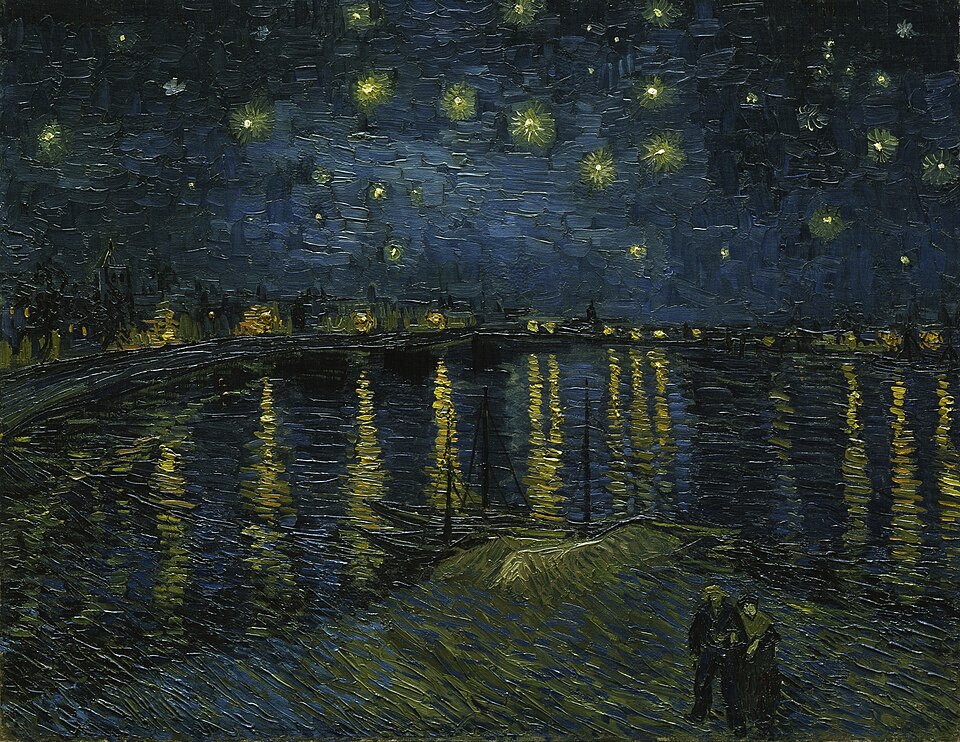
In September 1888, in the town of Arles, Vincent van Gogh carried his canvas down to the banks of the Rhône, just a minute or two from the Yellow House he was renting on the place Lamartine. The gas lamps of the town were lit, and he wanted to paint the night as it actually glimmered before him — not by daylight memory, but under the gas jet itself, working in the dark.
He described the scene in a letter to his brother Theo: the sky aquamarine, the water royal blue, the ground mauve, the town blue and purple, the gas lamps yellow with reflections of russet gold fading into green-bronze. Against the aquamarine sky, he placed the Great Bear — Ursa Major — rendered in sparkling green and pink, its pale glow set against the harsher gold of the gaslight. In the foreground he placed two small figures, a pair of lovers strolling the riverbank.
The view itself can be traced with unusual precision: looking from the eastern wharf toward the river's bend, with the towers of Saint-Julien and Saint-Trophime to the left and the iron bridge to Trinquetaille on the right, the vantage point corresponds to a view from place Lamartine toward the southwest.
But there is a strange discrepancy built into the painting. Ursa Major, a circumpolar constellation, could never actually have been visible looking southwest from that spot — it would only appear if van Gogh turned his head north. In effect, he merged two impossible views into one: a terrestrial plane looking toward Arles, and a celestial plane looking toward the stars behind him. The result is a scene where the stars seem to hang directly above the gaslights, so that the river appears lit as much by starlight as by the town's lamps.
Van Gogh's foreground shows signs of heavy reworking, painted wet-in-wet soon after the first version was finished, and the sketches he made in his letters around this time likely preserve something closer to that original composition. His technique for the stars themselves was distinctive for this period — he painted them to resemble flowers scattered across the dark sky, a method he would later refine into concentric dotted circles to symbolize their brightness, seen in his 1889 painting The Starry Night, made after he moved to Saint-Rémy.
More from Art

The Painting With No Foreground
A single robed figure stares out at an empty grey sea — and the emptiness itself became a scandal. When it was unveiled in Berlin in 1810, no one knew quite what to do with it.

The Painter Who Chased the Light
For a few purple minutes each evening, an American exile knelt in an English garden and raced the dying sun to paint two little girls lighting lanterns. It took him two years to finish.

When a President Became a God
Look straight up inside the U.S. Capitol dome and you will find George Washington enthroned among the clouds, surrounded by goddesses — the founding father transformed into myth.

Marble Brought Back to Life
A corpse asleep, a wing barely brushing her skin — and marble somehow learns to breathe. This is the moment Antonio Canova dared to carve.

The World Turned Upside Down
Look closely at a sixteenth-century Flemish village and you'll find a man biting a pillar, another carrying daylight in a basket, and a wife slipping a blue cloak over her husband's shoulders. Every gesture is a joke — if you know the language.

The Girl in the Glass Case
She stood two-thirds life size, dressed in a real tutu and human hair — and the critics who saw her in 1881 recoiled as if she were something obscene.