The Sleepers Paris Tried to Hide
A painting so scandalous it was locked away for over a century — commissioned by an Ottoman diplomat and inspired by a poem about forbidden love.
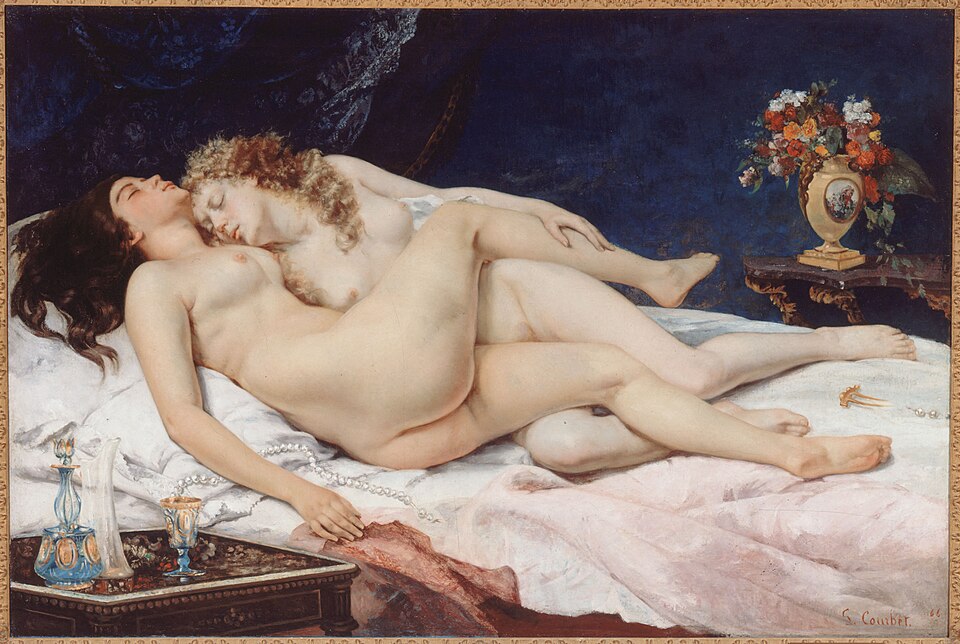
In 1866, in a Paris studio, Gustave Courbet finished a canvas that would not be allowed to hang in public for 122 years. It showed two naked women asleep in bed, limbs entwined, their bodies rendered with the same unflinching realism Courbet applied to rock and flesh alike. He called it Le Sommeil — Sleep — though it would also become known as The Two Friends and Indolence and Lust.
The painting was commissioned by Halil Şerif Paşa, a Turkish diplomat and art collector of the late Ottoman era who had settled in Paris after 1860. He was a man of considerable appetite for the transgressive; Courbet's equally notorious L'Origine du monde was made for the same patron. Le Sommeil was never accepted for exhibition in respectable Parisian venues of the time, and remained officially unshowable until 1988.
In 1872, a picture dealer dared to display the work, and the exhibition became the subject of a police report — proof of how dangerous the image was considered even six years after its completion.
One of the two models was Joanna Hiffernan, an Irish woman who was at the time the mistress of the American-born painter James Abbott McNeill Whistler, a friend and rival of Courbet's. Soon after the painting was made, Whistler and Hiffernan's relationship ended, and Whistler's friendship with Courbet soured along with it — a quiet human cost behind a canvas remembered mostly for its audacity.
The scene itself is spare and intimate: a bedroom with dark blue velvet curtains, a table bearing a flower vase in one corner, and in the foreground a smaller table holding a colored flacon, a crystal vase, and a cup. Little else competes with the two women — one redhead, one brunette — whose contrasting coloring Courbet used to trace curves between their bodies. A broken pearl necklace and a stray hairpin scattered on the sheets hint wordlessly at what came before the sleep.
More from Art

The Painting With No Foreground
A single robed figure stares out at an empty grey sea — and the emptiness itself became a scandal. When it was unveiled in Berlin in 1810, no one knew quite what to do with it.

The Painter Who Chased the Light
For a few purple minutes each evening, an American exile knelt in an English garden and raced the dying sun to paint two little girls lighting lanterns. It took him two years to finish.

When a President Became a God
Look straight up inside the U.S. Capitol dome and you will find George Washington enthroned among the clouds, surrounded by goddesses — the founding father transformed into myth.

Marble Brought Back to Life
A corpse asleep, a wing barely brushing her skin — and marble somehow learns to breathe. This is the moment Antonio Canova dared to carve.

The World Turned Upside Down
Look closely at a sixteenth-century Flemish village and you'll find a man biting a pillar, another carrying daylight in a basket, and a wife slipping a blue cloak over her husband's shoulders. Every gesture is a joke — if you know the language.

The Girl in the Glass Case
She stood two-thirds life size, dressed in a real tutu and human hair — and the critics who saw her in 1881 recoiled as if she were something obscene.