The Sleeping Woman Who Vanished for Sixty Years
A masterpiece nearly sold for $140. A grandmother refused to spend £50 on it. And for decades, nobody knew where it had gone.
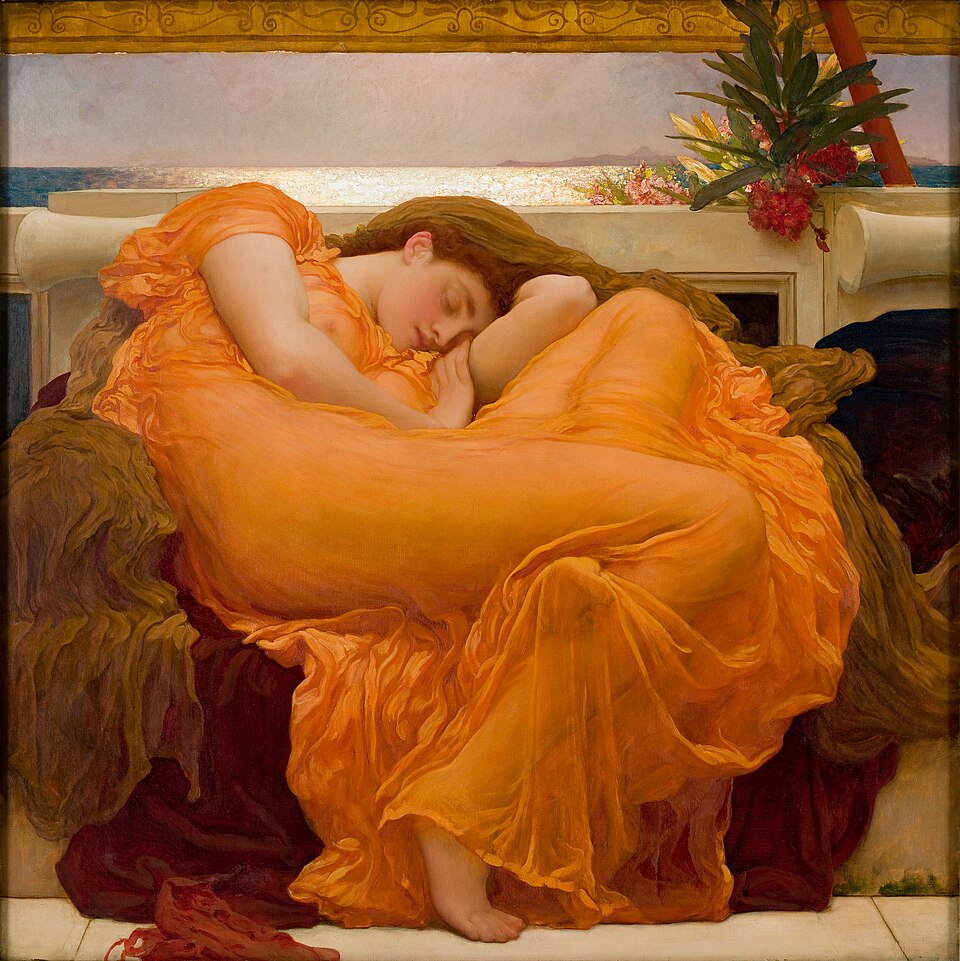
In 1895, Frederic Leighton painted a woman asleep in a square of golden light, her body coiled beneath a diaphanous saffron robe, a sprig of poisonous oleander glowing at the edge of the canvas. He called it Flaming June, and it would become the single image most people picture when they think of his name — reproduced on posters, calendars, and coffee mugs for a century, though almost no one knew the real painting's whereabouts for most of that time.
The work began almost by accident, as a decorative motif meant for a marble bath in another of Leighton's paintings, Summer Slumber. He grew so attached to the figure that he pulled her free and gave her a canvas of her own. Getting her right took him through at least four evolving sketches — four nude studies and one draped — because the angle of her right arm simply would not look natural. The draped version, tellingly, looked the least alive; Leighton insisted he needed a naked model before the fabric could feel true.
Art historian Andrew Graham-Dixon has traced her pose back to Michelangelo's Night in the Medici Tombs, a sculpture Leighton revered as one of the summits of Western art. Samuel Courtauld, who founded the institute that bears his name, later called Flaming June simply 'the most wonderful painting in existence' — high praise for a picture whose fate would soon turn shockingly ordinary.
The Graphic magazine bought it first, intending only to produce a fine reproduction to give away as a Christmas gift in 1895. When Leighton died the following January, the painting was hung in the magazine's office window as his funeral procession passed below. It was later lent to the Ashmolean Museum in the early 1900s — and then it simply disappeared from the historical record.
It resurfaced decades later in the most unglamorous way imaginable: boxed in above a chimney in a house in Battersea, in the early 1960s. A young Andrew Lloyd Webber spotted it soon after in a shop on the Kings Road, but his grandmother refused to put up the £50 asking price, declaring she would not have 'Victorian junk' in her flat. It was, at the time, genuinely unfashionable — Victorian painting was deeply out of favor and hard to sell.
More from Art

The Painting With No Foreground
A single robed figure stares out at an empty grey sea — and the emptiness itself became a scandal. When it was unveiled in Berlin in 1810, no one knew quite what to do with it.

The Painter Who Chased the Light
For a few purple minutes each evening, an American exile knelt in an English garden and raced the dying sun to paint two little girls lighting lanterns. It took him two years to finish.

When a President Became a God
Look straight up inside the U.S. Capitol dome and you will find George Washington enthroned among the clouds, surrounded by goddesses — the founding father transformed into myth.

Marble Brought Back to Life
A corpse asleep, a wing barely brushing her skin — and marble somehow learns to breathe. This is the moment Antonio Canova dared to carve.

The World Turned Upside Down
Look closely at a sixteenth-century Flemish village and you'll find a man biting a pillar, another carrying daylight in a basket, and a wife slipping a blue cloak over her husband's shoulders. Every gesture is a joke — if you know the language.

The Girl in the Glass Case
She stood two-thirds life size, dressed in a real tutu and human hair — and the critics who saw her in 1881 recoiled as if she were something obscene.