The Stone-Born King Who Defied Heaven
Long before he swung between temples and demons, he was just a stone egg on a mountaintop — until the wind touched it, and something impossible opened its eyes.
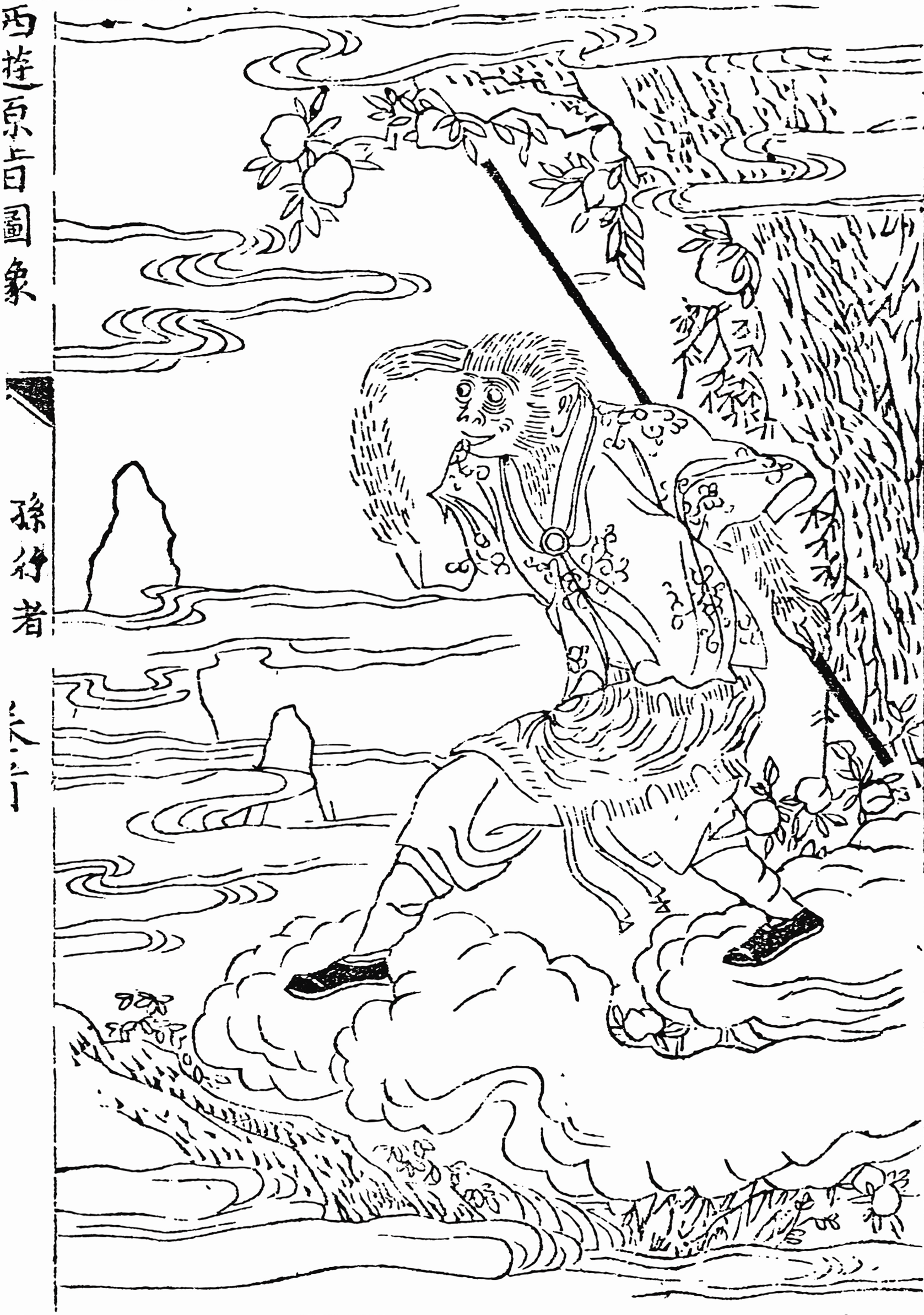
On the summit of a mountain that had stood since the beginning of time, a stone absorbed the essence of heaven and earth until it became pregnant with itself. Thirty-six feet and five inches tall, its height echoed the degrees of heaven; its twenty-four-foot circumference matched the divisions of the solar calendar; nine hollows in its surface corresponded to the nine trigrams. Inside this magical womb, the stone slowly hardened into an egg the size of a ball. When the wind finally touched it, the egg cracked open, and a stone monkey emerged, already possessing five senses and four limbs, already able to crawl and walk.
The newborn creature moved its eyes, and golden beams shot from them toward the Pole Star, startling the Jade Emperor and the immortal ministers seated beside him in the celestial court. It was an unlikely entrance for a being who would become one of the most enduring figures in Chinese storytelling — not born of mother and father, but of stone, wind, and the accumulated appetite of heaven and earth for something new.
This monkey, later known as Sun Wukong, would grow into an intelligent creature — most likely modeled after a rhesus macaque or a golden snub-nosed monkey — who acquired supernatural power through Taoist practice. He became a fighter capable of matching heaven's finest generals, strong enough to carry two mountains on his shoulders while running with the speed of a meteor. In a single somersault he could cover 108,000 li, roughly 54,000 kilometers. His memory was vast enough to recall every monkey ever born, a duty befitting his role as their king and protector.
His body carried strange gifts. He mastered the seventy-two Earthly Transformations, letting him become animals, objects, almost anything he wished. Each strand of his hair could turn into a copy of himself, or into a weapon, an animal, or some other useful thing. He commanded partial power over weather, could freeze living beings in place, and could vanish from sight entirely. To readers of the era when Journey to the West was written, these were simply 'magic powers,' rarely separated by the different religious traditions that had shaped them.
Wukong's rebellion against heaven — and his eventual imprisonment beneath a mountain by the Buddha, followed five hundred years later by his release to protect the monk Tang Sanzang on a journey to obtain Buddhist sutras — sits at the center of his legend. Alongside the White Dragon Horse and fellow disciples Zhu Bajie and Sha Heshang, he escorted the monk toward the Western Paradise where Buddha and his followers dwelled, on a journey west to India in search of the sacred Buddhist scriptures.
More from Mythology

The Doctor Who Sang a Nation Into Being
A country doctor rode into the forests of Karelia armed with nothing but a notebook — and rode out with the soul of a nation.

The Boat That Carried the Sun
Every sunset, the ancient Egyptians believed, the sun climbed into a boat and sailed straight into the realm of the dead — only to fight a monstrous serpent before dawn could return.

The Wild Man of the Snows
At 21,000 feet, a colonel found tracks in the snow that he blamed on a wolf — but his guides knew better, and gave the world a name that would echo for a century.

The Knight Who Went Mad for Love: Orlando Furioso
A hero so devoted to duty he was Charlemagne's greatest paladin loses his mind—not to a sword wound, but to heartbreak. To cure him, a friend must ride a flying horse to the Moon.

The Book That Turned the World Into Myth
A poet condemned to exile spent his final years in Rome finishing a poem that would outlive empires—a poem about nothing standing still, not gods, not lovers, not even the shape of a man.

Paradise Lost: Milton's Rebel Angel
A blind poet, dictating verses in the dark, dared to explain the ways of God to men — and in doing so, made Hell's ruler unforgettable.