The Stone Faces That Watched Over an Island
They have no legs, their heads are absurdly oversized, and yet for centuries hundreds of enormous stone ancestors stood guard over a tiny island in the middle of the Pacific — until, one by one, they all fell.
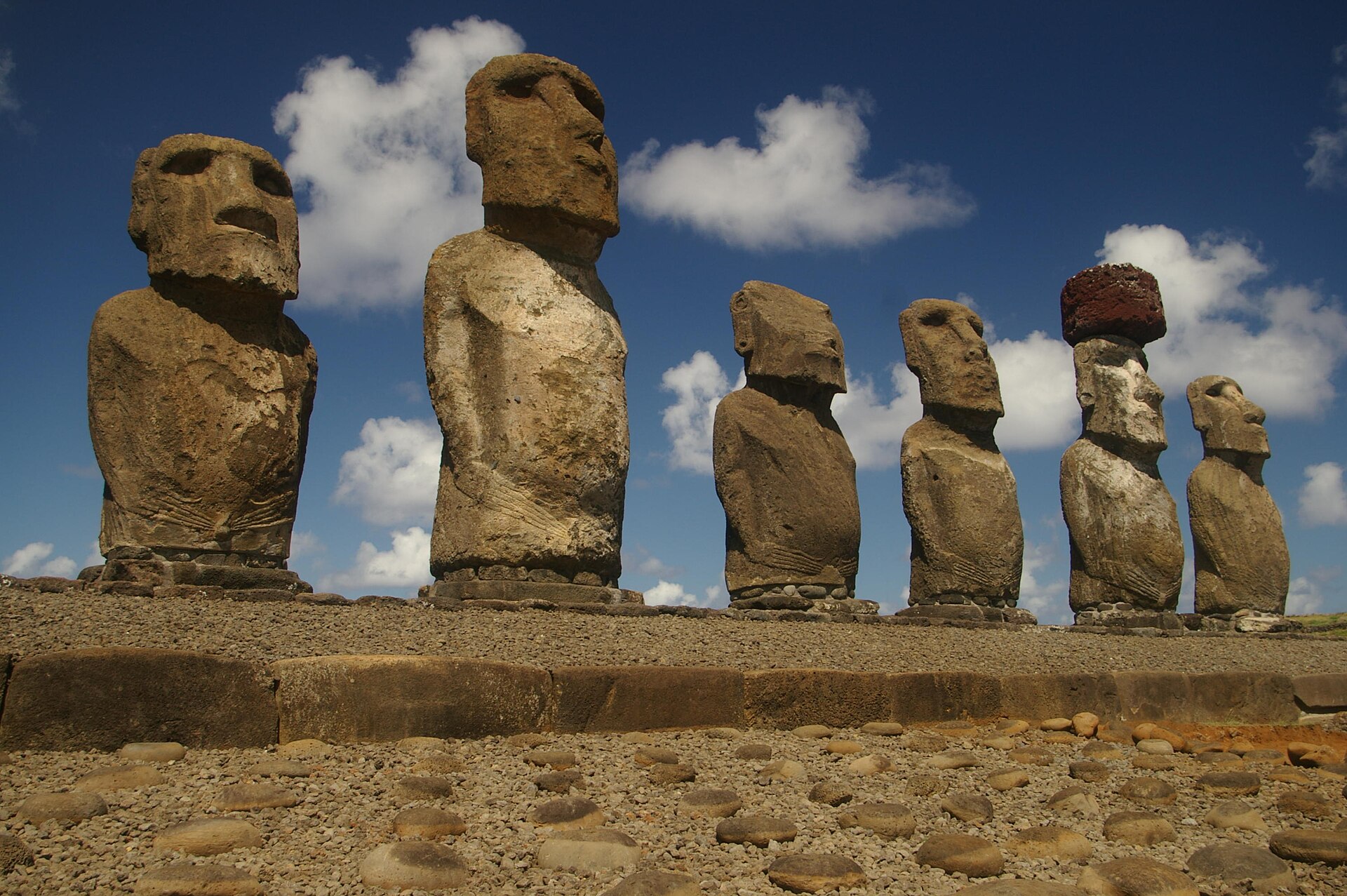
When the first Europeans reached the remote island the Rapa Nui called home in 1722, they found something almost impossible to believe: hundreds of monolithic human figures, some standing ten meters tall, gazing inland over the land of their descendants. These were the moai, carved by the Rapa Nui people between roughly 1250 and 1500, and by the time outsiders arrived they were already ancient, already mysterious, already astonishing.
Carved from volcanic tuff — compressed volcanic ash — at a quarry called Rano Raraku, the moai were shaped with a distinctive style: heavy brows, elongated fish-hook-curled noses, thin pouting lips, oblong ears, and torsos whose arms rest in bas-relief along the hips, fingers meeting at a carved loincloth. Their heads make up three-eighths of their total height, an exaggeration rooted in the Polynesian belief that the head held particular sanctity. Almost none of the moai have visible legs — only one kneeling figure is an exception.
Of the more than 900 moai identified, nearly half remain at Rano Raraku itself, some still emerging from the rock, others buried to their shoulders in accumulated soil — a detail that gave rise to the popular myth that they were merely 'heads' with no bodies at all. Excavations proved otherwise: buried torsos, protected from erosion, still bear carved markings. The rest of the moai were transported from the quarry and raised on stone platforms called ahu that ring the island's coastline, an engineering and logistical feat historians still marvel at given the era's lack of machinery.
Most moai average about 4 meters in height and 1.6 meters at the base, weighing around 12.5 tonnes. But the extremes are staggering. Paro, the tallest moai ever erected, stood almost 10 meters and weighed 82 tonnes. The heaviest erected moai, a shorter but stockier figure at Ahu Tongariki, weighed 86 tonnes. And one unfinished statue at the quarry, had it ever been completed, would have reached roughly 21 meters and weighed as much as 145 to 165 tonnes — a scale that dwarfs nearly every other statue in the ancient world.
In 1979, archaeologist Sergio Rapu Haoa and his team made a discovery that changed how the moai were understood: many of the statues' deep eye sockets were designed to hold inlaid eyes of white coral, with pupils of black obsidian or red scoria. Painstakingly reassembling fragments found scattered at various sites, and re-examining objects long mislabeled in the island's museum, the team realized the moai were not meant to stare with hollow sockets — they were meant to see. Statues fitted with these eyes appear to have been reserved for the most important ceremonial platforms, hinting at a hierarchy among the moai themselves.
More from Art

The Painting With No Foreground
A single robed figure stares out at an empty grey sea — and the emptiness itself became a scandal. When it was unveiled in Berlin in 1810, no one knew quite what to do with it.

The Painter Who Chased the Light
For a few purple minutes each evening, an American exile knelt in an English garden and raced the dying sun to paint two little girls lighting lanterns. It took him two years to finish.

When a President Became a God
Look straight up inside the U.S. Capitol dome and you will find George Washington enthroned among the clouds, surrounded by goddesses — the founding father transformed into myth.

Marble Brought Back to Life
A corpse asleep, a wing barely brushing her skin — and marble somehow learns to breathe. This is the moment Antonio Canova dared to carve.

The World Turned Upside Down
Look closely at a sixteenth-century Flemish village and you'll find a man biting a pillar, another carrying daylight in a basket, and a wife slipping a blue cloak over her husband's shoulders. Every gesture is a joke — if you know the language.

The Girl in the Glass Case
She stood two-thirds life size, dressed in a real tutu and human hair — and the critics who saw her in 1881 recoiled as if she were something obscene.