The Stones That Broke and Were Reborn
Two tablets of stone, written by the finger of God, shattered in a moment of rage — and what came next changed the very meaning of covenant.
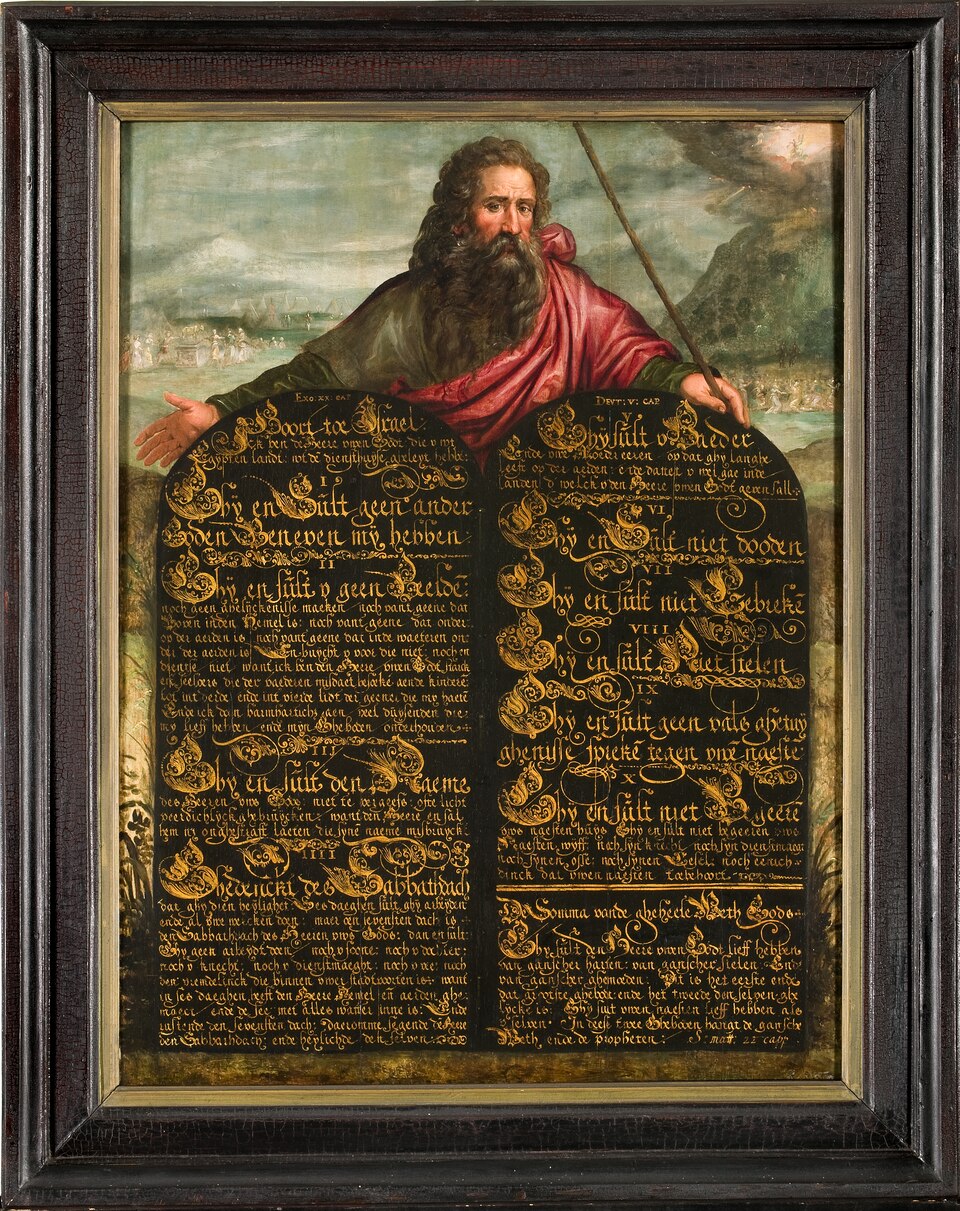
On Mount Sinai, according to the Book of Exodus, Moses received two stone tablets inscribed with the Ten Commandments, written by the finger of God himself. These were no ordinary stones. The Talmud describes them as carved from blue sapphire, a color meant to evoke the sky, the heavens, and the throne of God. Later scholars have suggested that this legendary sapphire may actually have been lapis lazuli, the deep blue stone mentioned in Exodus as the pavement beneath God's feet when he revealed his plan for the tablets.
The tablets carried several names in the Hebrew Bible, each capturing a different dimension of their meaning. They were called luhot ha-berit, tablets of the covenant, emphasizing their role as the physical seal of the bond between God and the Israelites. They were also called luhot ha-edut, tablets of testimony, framing them as a witness to a sacred obligation. These were not simply religious souvenirs; in the interpretation of Nachmanides, they functioned much like ancient Near Eastern treaty documents, formalizing the terms of a covenant much as a suzerain king would set stipulations for his people.
But before that covenant could settle into permanence, it was broken — literally. When Moses descended the mountain and saw the Children of Israel worshiping a golden calf, he smashed the tablets in fury, as recorded in Exodus 32:19. Rabbinic tradition insists this was not simply an outburst of temper. The Talmud in Shabbat 87a records God himself affirming the act, saying 'Well done for breaking them.' Rashi explained Moses' reasoning through a legal analogy: if a single Israelite who avoided idolatry was still forbidden from eating the Passover offering alongside sinners, how much more should the entire nation be barred from receiving a covenant it had already violated.
Exodus Rabbah pushes the metaphor further, comparing the shattered tablets to a marriage contract torn up after infidelity. The physical destruction, in this reading, did not cause the rupture between God and Israel — it merely acknowledged a rupture that had already happened. The stone could not remain a symbol of a covenant that had, in that moment, ceased to exist.
What followed was renewal. In Exodus 34:1, God instructs Moses to carve two new tablets himself, saying he would inscribe upon them the same words that had been on the first. This time, the process was different: rather than being entirely a divine artifact, the second tablets involved human labor. Moses had to hew the stone with his own hands before God would write on it. Medieval commentators saw this as a profound shift — from a covenant handed down through pure miracle, to one sustained through human responsibility and effort.
More from Art

The Painting With No Foreground
A single robed figure stares out at an empty grey sea — and the emptiness itself became a scandal. When it was unveiled in Berlin in 1810, no one knew quite what to do with it.

The Painter Who Chased the Light
For a few purple minutes each evening, an American exile knelt in an English garden and raced the dying sun to paint two little girls lighting lanterns. It took him two years to finish.

When a President Became a God
Look straight up inside the U.S. Capitol dome and you will find George Washington enthroned among the clouds, surrounded by goddesses — the founding father transformed into myth.

Marble Brought Back to Life
A corpse asleep, a wing barely brushing her skin — and marble somehow learns to breathe. This is the moment Antonio Canova dared to carve.

The World Turned Upside Down
Look closely at a sixteenth-century Flemish village and you'll find a man biting a pillar, another carrying daylight in a basket, and a wife slipping a blue cloak over her husband's shoulders. Every gesture is a joke — if you know the language.

The Girl in the Glass Case
She stood two-thirds life size, dressed in a real tutu and human hair — and the critics who saw her in 1881 recoiled as if she were something obscene.