The Stranger Who Was Almost Missed
An arm bursts out of the canvas, a shell hangs from a pilgrim's shoulder, and a basket of fruit teeters on the edge of a table — the instant before a stranger is recognized as something else entirely.
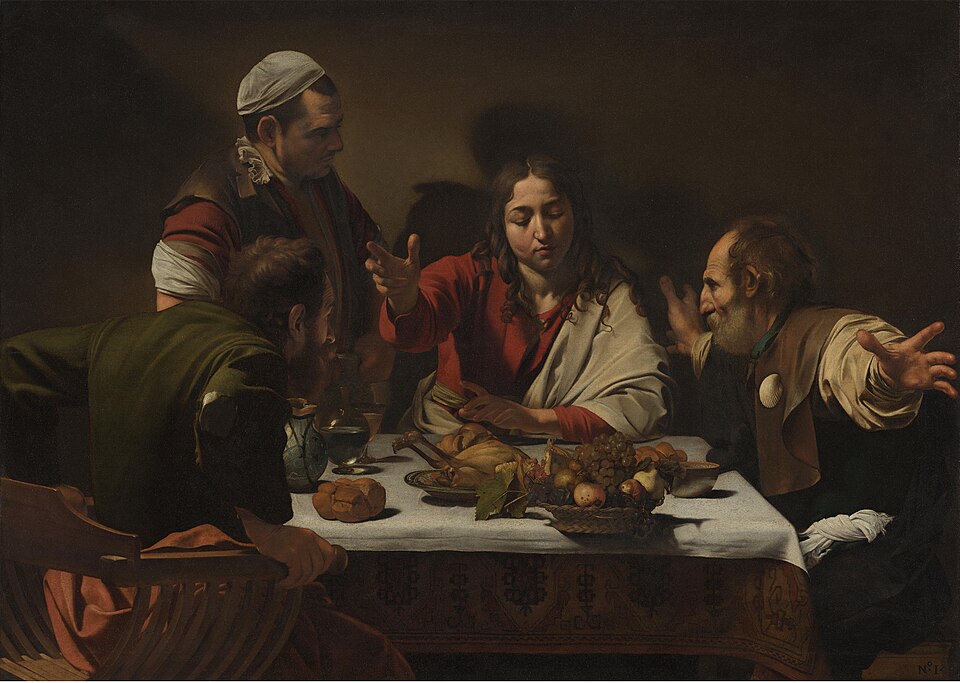
In 1601, Caravaggio completed a painting for Ciriaco Mattei, brother of Cardinal Girolamo Mattei, that captures a single suspended moment from the Gospel of Luke: the resurrected Jesus, unrecognized by two of his followers, sitting down to eat with them in the town of Emmaus — only to vanish the instant they realize who he is.
The two men at the table are presumed to be Luke and Cleopas. Cleopas wears the scallop shell of a pilgrim, a small but telling detail identifying him as a traveler on a sacred road. His companion wears torn clothes, humble and worn. Cleopas's arms are flung wide in a gesture so extreme it seems to strain against the edges of the frame itself, one arm reaching toward the viewer as if breaking through the picture plane.
Standing behind the table is an innkeeper or groom, his forehead smooth, his face sunk in darkness, entirely unaware of the extraordinary thing happening in front of him. It is a quiet, human detail: the sacred erupting in the middle of an ordinary evening, witnessed by someone too distracted to notice. Caravaggio was drawn again and again to this kind of scene — the sublime breaking into the daily routine, as he had done years earlier in The Calling of Saint Matthew, where Christ interrupts a group of money counters.
Unusually for the artist, the figures are life-sized, set against a background that is dark and nearly blank, stripping away any distraction from the encounter itself. Jesus here is beardless, a striking departure from the bearded Christ of Caravaggio's other works. The choice may echo the Gospel of Mark, which says Jesus appeared to his followers 'in another form' — unrecognizable, ordinary, easy to overlook.
On the table sits a still-life meal, arranged with Caravaggio's characteristic precision, the basket of fruit balanced so precariously it seems ready to fall into the viewer's lap. Within that basket, two stray strands of wicker cross to form an ichthys, the ancient Christian fish-symbol for Christ — hidden in plain sight, much like Jesus himself in the scene. The fruit's shadow falls across the tablecloth in the shape of a fish and its tail, a second quiet signature of what is really taking place.
More from Art

The Painting With No Foreground
A single robed figure stares out at an empty grey sea — and the emptiness itself became a scandal. When it was unveiled in Berlin in 1810, no one knew quite what to do with it.

The Painter Who Chased the Light
For a few purple minutes each evening, an American exile knelt in an English garden and raced the dying sun to paint two little girls lighting lanterns. It took him two years to finish.

When a President Became a God
Look straight up inside the U.S. Capitol dome and you will find George Washington enthroned among the clouds, surrounded by goddesses — the founding father transformed into myth.

Marble Brought Back to Life
A corpse asleep, a wing barely brushing her skin — and marble somehow learns to breathe. This is the moment Antonio Canova dared to carve.

The World Turned Upside Down
Look closely at a sixteenth-century Flemish village and you'll find a man biting a pillar, another carrying daylight in a basket, and a wife slipping a blue cloak over her husband's shoulders. Every gesture is a joke — if you know the language.

The Girl in the Glass Case
She stood two-thirds life size, dressed in a real tutu and human hair — and the critics who saw her in 1881 recoiled as if she were something obscene.