The Sun Sets on a Ghost Ship
A ghostly warship glides up the Thames one last time, towed by the very machine that made her obsolete. Turner watched an empire change hands and painted its eulogy.
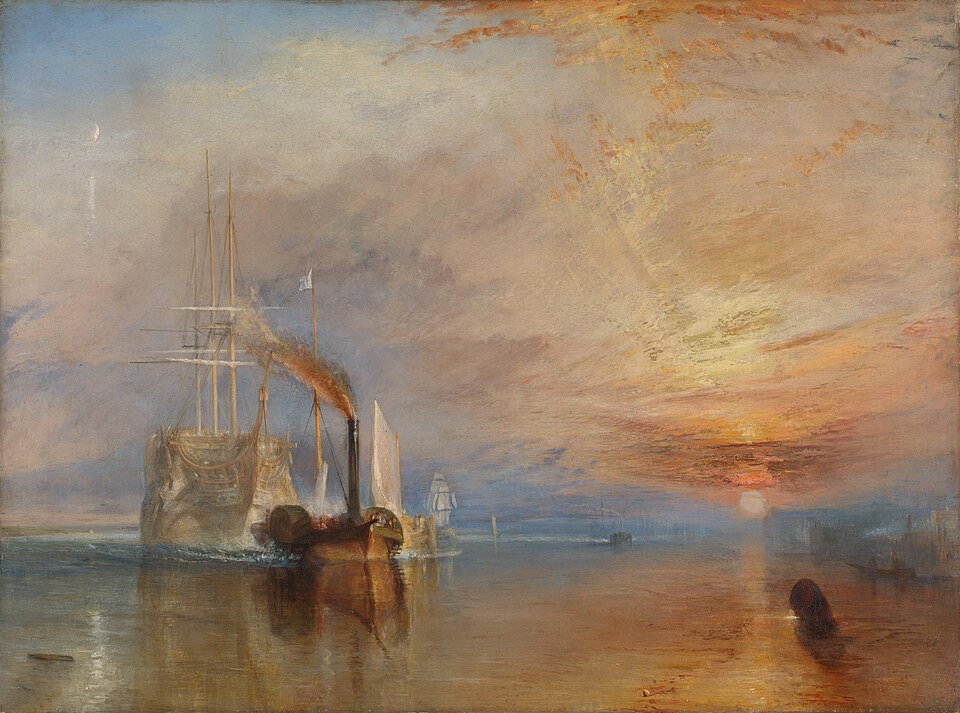
In 1838, a battered old warship made her final voyage up the River Thames. She was not sailing under her own power — no wind filled her sails, for she had none left. Instead, a small, dirty steam tug hauled the once-mighty HMS Temeraire toward a shipbreaker's yard in Rotherhithe, where she would be dismantled for scrap.
Joseph Mallord William Turner, then at the height of a forty-year career exhibiting at the Royal Academy, turned this unremarkable industrial errand into one of the most beloved paintings in British history. He called it The Fighting Temeraire, tugged to her last berth to be broken up, 1838. Whether he actually saw the towing himself remains uncertain to scholars, though older accounts claimed he watched from various points along the river.
The Temeraire was no ordinary vessel. A 98-gun ship of the line, she had played a heroic role at the Battle of Trafalgar. By the time of her final journey, her sale by the Admiralty to a private shipbreaker had already attracted considerable press attention — likely what drew Turner's eye to the subject in the first place. Notably, in the painting the tug flies a plain white flag rather than the Union Jack, a quiet reminder that the old ship now belonged to private hands, not the Crown.
Turner composed the scene with striking asymmetry. The Temeraire, pale and almost ghostlike, rises on the left against a triangle of blue sky and mist. Opposite her, on the far side of the canvas, the sun sets over the estuary, its red glow reflected in the water and echoed in the smoke pouring from the tug's blackened stack. Behind the ship, a sliver of moon casts its own beam across the river — a quiet suggestion of the new age dawning even as the old one fades.
Scattered across the water, becalmed sailing vessels drift without wind, a visual reminder that the age of sail was ending. The old warship's dignified, spectral beauty stands in deliberate contrast to the squat, smoke-belching tug that drags her forward. Turner called the finished work his 'darling.'
More from Art

The Painting With No Foreground
A single robed figure stares out at an empty grey sea — and the emptiness itself became a scandal. When it was unveiled in Berlin in 1810, no one knew quite what to do with it.

The Painter Who Chased the Light
For a few purple minutes each evening, an American exile knelt in an English garden and raced the dying sun to paint two little girls lighting lanterns. It took him two years to finish.

When a President Became a God
Look straight up inside the U.S. Capitol dome and you will find George Washington enthroned among the clouds, surrounded by goddesses — the founding father transformed into myth.

Marble Brought Back to Life
A corpse asleep, a wing barely brushing her skin — and marble somehow learns to breathe. This is the moment Antonio Canova dared to carve.

The World Turned Upside Down
Look closely at a sixteenth-century Flemish village and you'll find a man biting a pillar, another carrying daylight in a basket, and a wife slipping a blue cloak over her husband's shoulders. Every gesture is a joke — if you know the language.

The Girl in the Glass Case
She stood two-thirds life size, dressed in a real tutu and human hair — and the critics who saw her in 1881 recoiled as if she were something obscene.