The Tapestry That Waited in the Dark
For decades a unicorn stared out from a crumbling castle wall, forgotten by everyone but the mould. Then a writer walked in and gave it back its name.
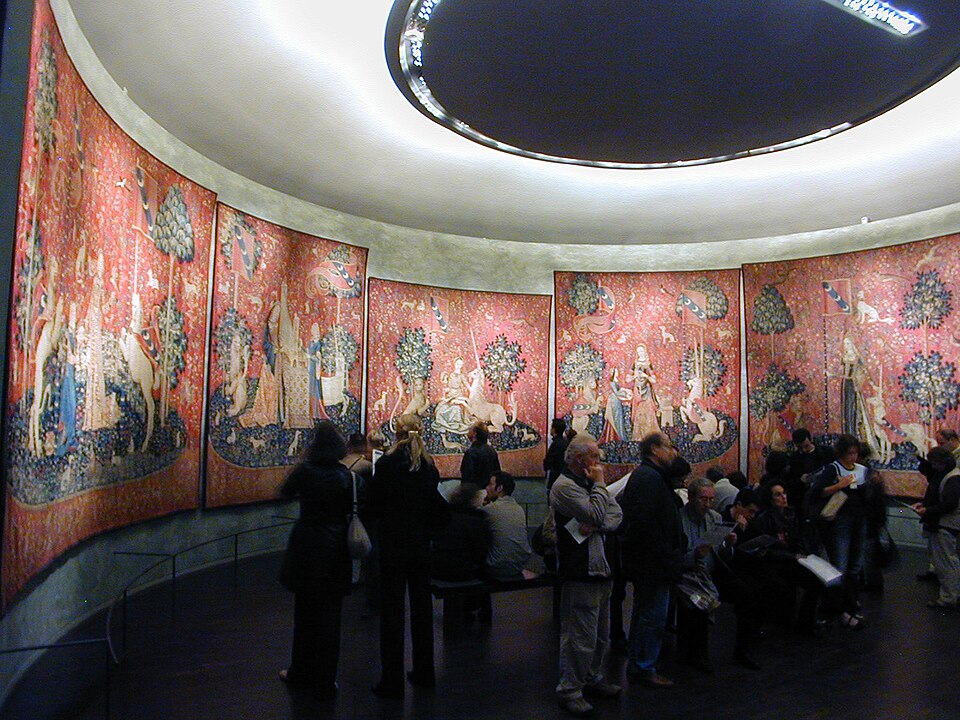
In 1841, the French inspector of historical monuments Prosper Mérimée entered Boussac Castle, then owned by the town's subprefect, and found something extraordinary hanging in disrepair: six vast tapestries, damp-stained and half-eaten by mildew, depicting a noble lady flanked always by a lion on her right and a unicorn on her left. No one at the castle seemed to know their worth. They had simply been there, decaying quietly, for who knows how long.
Three years later, in 1844, the novelist George Sand saw them and understood immediately that this was no ordinary decoration. In her novel Jeanne, she described the tapestries and, by studying the ladies' costumes, dated them accurately to the late fifteenth century. Her attention turned obscurity into fame. Word spread of the mysterious hangings at Boussac, woven from wool and silk in the mille-fleurs style — a thousand tiny flowers scattered like stars across every background.
Even with new admirers, the tapestries remained physically at risk for decades, exposed to damp walls and indifferent caretakers. It wasn't until 1882 that Edmond Du Sommerard, curator of the Musée de Cluny in Paris, purchased the set outright. Only then did serious conservation begin, work that would eventually restore the tapestries nearly to their original brilliance. They have hung in the Musée de Cluny — now the Musée national du Moyen Âge — ever since.
The designs were drawn in Paris around 1500, then sent to Flanders to be woven by artisans skilled in wool and silk. Scholars believe the tapestries were commissioned by a member of the Le Viste family — possibly Jean IV Le Viste, Baron of Montreuil, or, according to more recent heraldic study, Antoine II Le Viste, a courtier under Charles VIII, Louis XII and François I. The pennants and armor in each scene bear arms associated with that family, though oddly, the heraldry breaks the standard rules of French color combinations.
Five of the six tapestries are generally read as an allegory of the senses. In 'Touch', the lady rests her hand on the unicorn's horn while a lion looks on. In 'Taste', she takes sweets from a dish held by her maidservant, her eyes on a parakeet perched on her upheld hand, while a monkey eats a stolen sweetmeat at her feet. In 'Smell', she weaves a flower wreath as the monkey sniffs a stolen blossom — the detail scholars point to as the clearest key to the allegory. In 'Hearing', she plays a portative organ while her maid works the bellows. In 'Sight', she holds up a mirror while the unicorn kneels with its front legs resting in her lap, gazing at its own reflection.
More from Art

The Painting With No Foreground
A single robed figure stares out at an empty grey sea — and the emptiness itself became a scandal. When it was unveiled in Berlin in 1810, no one knew quite what to do with it.

The Painter Who Chased the Light
For a few purple minutes each evening, an American exile knelt in an English garden and raced the dying sun to paint two little girls lighting lanterns. It took him two years to finish.

When a President Became a God
Look straight up inside the U.S. Capitol dome and you will find George Washington enthroned among the clouds, surrounded by goddesses — the founding father transformed into myth.

Marble Brought Back to Life
A corpse asleep, a wing barely brushing her skin — and marble somehow learns to breathe. This is the moment Antonio Canova dared to carve.

The World Turned Upside Down
Look closely at a sixteenth-century Flemish village and you'll find a man biting a pillar, another carrying daylight in a basket, and a wife slipping a blue cloak over her husband's shoulders. Every gesture is a joke — if you know the language.

The Girl in the Glass Case
She stood two-thirds life size, dressed in a real tutu and human hair — and the critics who saw her in 1881 recoiled as if she were something obscene.