The Twelve Labours of a Man Who Would Not Break
He killed his own children in a madness the goddess Hera sent upon him — and the price he paid for it became the most famous string of trials in Greek myth.
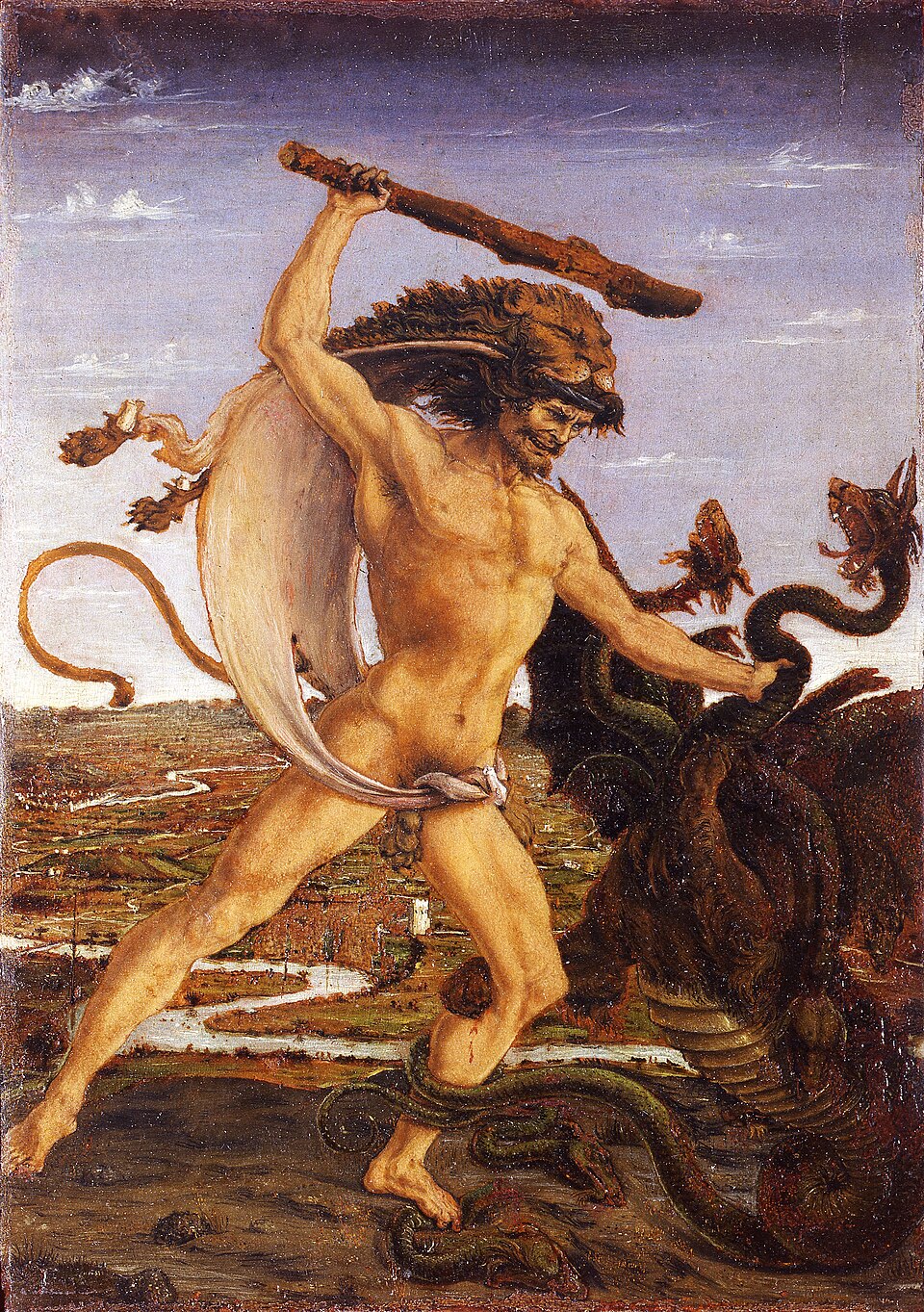
Heracles was born under a curse before he ever drew breath. Zeus, wishing to lie with the mortal woman Alcmene, stretched a single night into three by ordering the sun god Helios not to rise for three days, and disguised himself as her husband Amphitryon to father the child. Alcmene, through what myth calls heteropaternal superfecundation, bore twins to two fathers in one night: Heracles to Zeus, and Iphicles to Amphitryon. Hera, furious at her husband's infidelity, would spend the hero's whole life trying to destroy him for it.
Hera's first stroke of vengeance came before Heracles was even born. Learning that Zeus had sworn a descendant of Perseus born that night would become High King, and knowing that both Heracles and Eurystheus were descended from Perseus, she delayed Alcmene's labour just long enough for Eurystheus to be born first and claim the throne meant for Heracles. It was a bitter irony that would return later: the very Eurystheus whose birth Hera engineered would become the king who commanded Heracles's Twelve Labours.
As an infant, Heracles was already marked by the divine. Hera sent two giant serpents into his nursery; while his twin brother Iphicles wept in terror, eight-month-old Heracles seized a snake in each fist and strangled them, found afterward playing with the corpses as though they were toys. Amphitryon, astonished, summoned the seer Teiresias, who prophesied the boy would defeat countless monsters — an unusual future for any child.
His youth was one of raw, sometimes violent talent. He killed his music tutor Linus with a lyre and was sent to tend cattle on a mountain, where, according to a later allegory invented by the sophist Prodicus, he was visited by two figures — Vice and Virtue — and chose the harder, more glorious path. At eighteen he killed a notorious beast living in the forests of Cithaeron. He grew into a peerless archer, horseman, and wrestler, and in Thebes he married Megara, daughter of King Creon, with whom he had three sons.
Then Hera struck again. In a fit of madness she inflicted upon him, Heracles killed his own children and his wife Megara. Cured of his frenzy with hellebore by Antikyreus, founder of Antikyra, he understood at last what he had done and fled to Delphi. There, guided by an oracle secretly steered by Hera, he was told he must serve King Eurystheus for ten years, completing whatever tasks were demanded of him as penance.
More from Mythology

The Doctor Who Sang a Nation Into Being
A country doctor rode into the forests of Karelia armed with nothing but a notebook — and rode out with the soul of a nation.

The Boat That Carried the Sun
Every sunset, the ancient Egyptians believed, the sun climbed into a boat and sailed straight into the realm of the dead — only to fight a monstrous serpent before dawn could return.

The Wild Man of the Snows
At 21,000 feet, a colonel found tracks in the snow that he blamed on a wolf — but his guides knew better, and gave the world a name that would echo for a century.

The Knight Who Went Mad for Love: Orlando Furioso
A hero so devoted to duty he was Charlemagne's greatest paladin loses his mind—not to a sword wound, but to heartbreak. To cure him, a friend must ride a flying horse to the Moon.

The Book That Turned the World Into Myth
A poet condemned to exile spent his final years in Rome finishing a poem that would outlive empires—a poem about nothing standing still, not gods, not lovers, not even the shape of a man.

Paradise Lost: Milton's Rebel Angel
A blind poet, dictating verses in the dark, dared to explain the ways of God to men — and in doing so, made Hell's ruler unforgettable.