The Warrior Who Never Stops Falling
He has been dying for over two thousand years, propped on one arm, sword and shield abandoned in the dust — and no one has ever managed to look away.
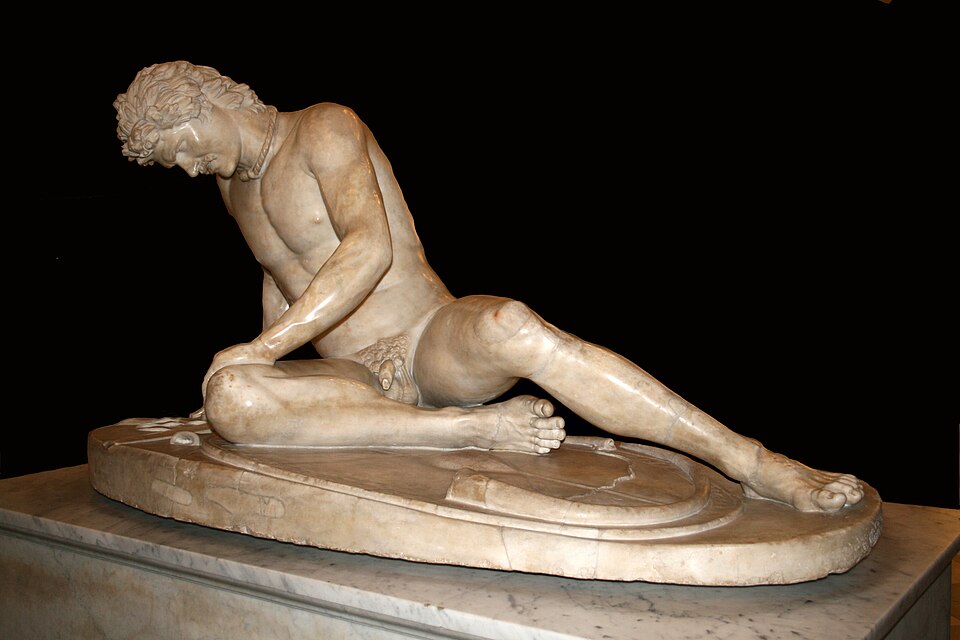
A naked man kneels on the floor of a Roman gallery, blood seeming to drain from a wound just below his ribs. A torc still circles his neck. His hair is thick and matted, his moustache heavy, his brow furrowed in a way that ancient viewers would have instantly read as foreign, un-Roman, other. He is not falling. He is caught in the last moment before falling, propped on one arm, staring at nothing. This is the Dying Gaul, and it has been arresting people since before anyone could agree on who he was.
The marble figure now in Rome's Capitoline Museums is a Roman copy, likely made in bronze originally, of a Greek Hellenistic sculpture believed to have been commissioned between 230 and 220 BC by Attalus I of Pergamon. Attalus had just defeated the Galatians, Celtic peoples who had settled in parts of Anatolia, and the sculpture — attributed to the Pergamene court sculptor Epigonus — was meant to memorialize that victory. But it does something stranger than simple triumph: it dignifies the enemy. The Gaul is rendered with careful, almost tender realism, a defeated man given weight and presence rather than mockery.
For centuries, nobody knew this was a Gaul at all. The statue surfaces in the historical record in a 1623 inventory of the Ludovisi family, who likely unearthed it while building Villa Ludovisi on the site of the ancient Roman Gardens of Sallust. It had already been restored by that time, in 1623, probably by the sculptor Ippolito Buzzi with the assistance of a young Gian Lorenzo Bernini. For generations afterward it was known simply as the Dying Gladiator, assumed to portray a wounded fighter from a Roman arena.
It took the scholar Ennio Quirino Visconti to look past that assumption. He noticed the neck torc, the coarse hair, the heavy moustache, the distinctive eyebrows and wide nose — all markers, to Hellenistic and Roman eyes, of a 'barbarian.' By the mid-19th century the identification as a Gaul or Galatian had taken hold, and the name Dying Gaul stuck.
The statue's own journey after 1623 was almost as turbulent as the battle it commemorates. Giambattista Ludovisi once valued it at 70,000 scudi, an enormous sum. It was seized twice by Livio Odescalchi as debt payment before being returned to the last Ludovisi heir. In the early 1730s, Pope Clement XII funded the Marquis Capponi to build the Capitoline Museum's collection, and after Ippolita Ludovisi's death in 1733, negotiations brought the sculpture there, its price talked down from 12,000 to 6,000 scudi. It was placed then in the gallery at the top of the museum's stairs, where it still sits today.
More from Art

The Painting With No Foreground
A single robed figure stares out at an empty grey sea — and the emptiness itself became a scandal. When it was unveiled in Berlin in 1810, no one knew quite what to do with it.

The Painter Who Chased the Light
For a few purple minutes each evening, an American exile knelt in an English garden and raced the dying sun to paint two little girls lighting lanterns. It took him two years to finish.

When a President Became a God
Look straight up inside the U.S. Capitol dome and you will find George Washington enthroned among the clouds, surrounded by goddesses — the founding father transformed into myth.

Marble Brought Back to Life
A corpse asleep, a wing barely brushing her skin — and marble somehow learns to breathe. This is the moment Antonio Canova dared to carve.

The World Turned Upside Down
Look closely at a sixteenth-century Flemish village and you'll find a man biting a pillar, another carrying daylight in a basket, and a wife slipping a blue cloak over her husband's shoulders. Every gesture is a joke — if you know the language.

The Girl in the Glass Case
She stood two-thirds life size, dressed in a real tutu and human hair — and the critics who saw her in 1881 recoiled as if she were something obscene.