The Warriors Who Slept Beneath the Sea
A chemist on holiday reached down expecting to touch a corpse — instead his fingers found bronze, and the sea gave up two warriors it had kept for over two thousand years.
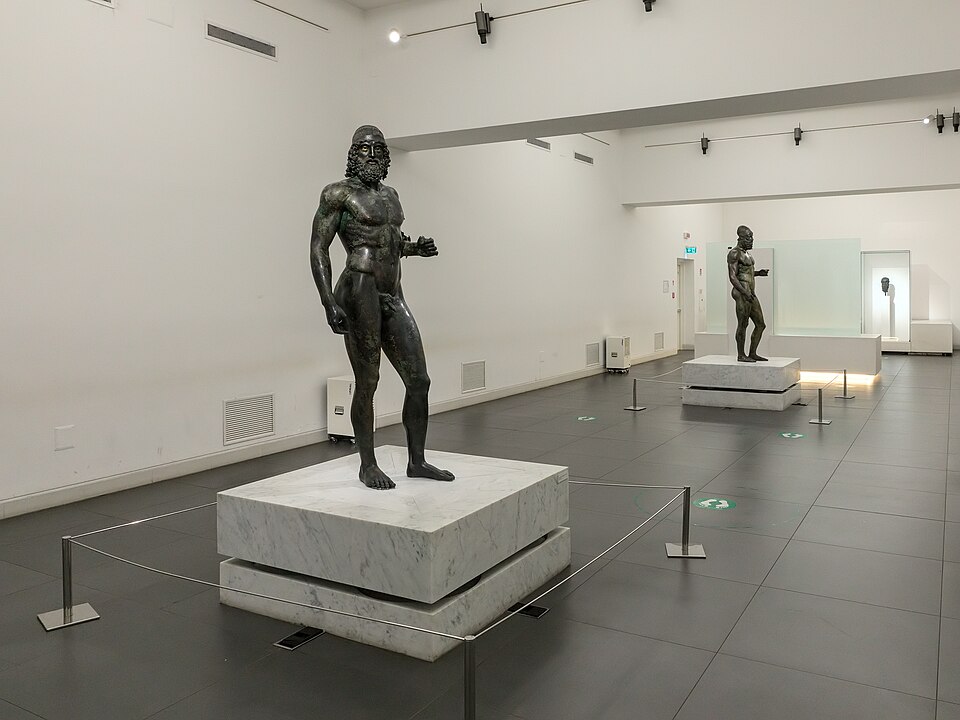
In August 1972, Stefano Mariottini, a chemist from Rome, was snorkeling near the end of a vacation at Monasterace, close to Riace on Calabria's coast. About 200 metres offshore, at a depth of six to eight metres, he noticed something pale emerging from the sand — a left arm. At first he thought he had stumbled on a dead body. When he touched it, he realized it was bronze. He cleared away sand from the rest of the figure, then spotted a second bronze nearby, and reported his find to the cultural department in Reggio Calabria.
A rival account exists too, though less widely accepted: that four young people from Riace itself found the statues underwater and reported them to the government finance office in nearby Monasterace. Whoever first laid eyes on them, the two bronzes were pulled from the sea within days of each other — Statue B on August 21, Statue A two days later. No shipwreck was ever found nearby, though sunken architectural remains have turned up along that subsiding stretch of coast.
The recovery, however, was not as clean as official records suggest. In his 2008 book Facce di Bronzo, bronze expert Giuseppe Braghò revealed that the original 1972 findings, based on Mariottini's own statements, described not only a helmet and a shield but a third bronze statue with open arms — none of which was ever brought up from the water. These objects are believed to have been stolen before the official recovery and sold abroad to a private collector. Evidence also suggests the two statues had been moved from their original positions before being officially retrieved, hinting that someone had tried to remove them earlier. In 2019, the Italian program Le Iene reopened the mystery and pressed Mariottini for answers; he declined to comment.
The bronzes themselves are known simply as Statue A and Statue B — the younger warrior and the more mature one. Both were cast using the lost-wax technique, and most scholars believe they were made by two different Greek sculptors roughly thirty years apart: Statue A around 460–450 BC, Statue B around 430–420 BC. Some credit Statue A to the sculptor Myron, and Statue B to Alkamenes, a pupil of Phidias.
Statue A carries himself with pride, a young hero or god aware of his own beauty and strength. Statue B, older and calmer, gazes out with a gentler, more relaxed expression. Both exemplify the transitional moment between archaic Greek sculpture and the early Classical style — idealized geometry hidden beneath deceptively lifelike surfaces. Their weight rests on their back legs in true contrapposto, their musculature soft yet defined, their turned heads and asymmetrical limbs lending them startling movement for bronze.
More from Art

The Painting With No Foreground
A single robed figure stares out at an empty grey sea — and the emptiness itself became a scandal. When it was unveiled in Berlin in 1810, no one knew quite what to do with it.

The Painter Who Chased the Light
For a few purple minutes each evening, an American exile knelt in an English garden and raced the dying sun to paint two little girls lighting lanterns. It took him two years to finish.

When a President Became a God
Look straight up inside the U.S. Capitol dome and you will find George Washington enthroned among the clouds, surrounded by goddesses — the founding father transformed into myth.

Marble Brought Back to Life
A corpse asleep, a wing barely brushing her skin — and marble somehow learns to breathe. This is the moment Antonio Canova dared to carve.

The World Turned Upside Down
Look closely at a sixteenth-century Flemish village and you'll find a man biting a pillar, another carrying daylight in a basket, and a wife slipping a blue cloak over her husband's shoulders. Every gesture is a joke — if you know the language.

The Girl in the Glass Case
She stood two-thirds life size, dressed in a real tutu and human hair — and the critics who saw her in 1881 recoiled as if she were something obscene.