The Weary Hero: Heracles and the Price of Glory
Before he became a god, he was a man broken by grief, sentenced to labor for a crime not fully his own. His story is one of exhaustion earning immortality.
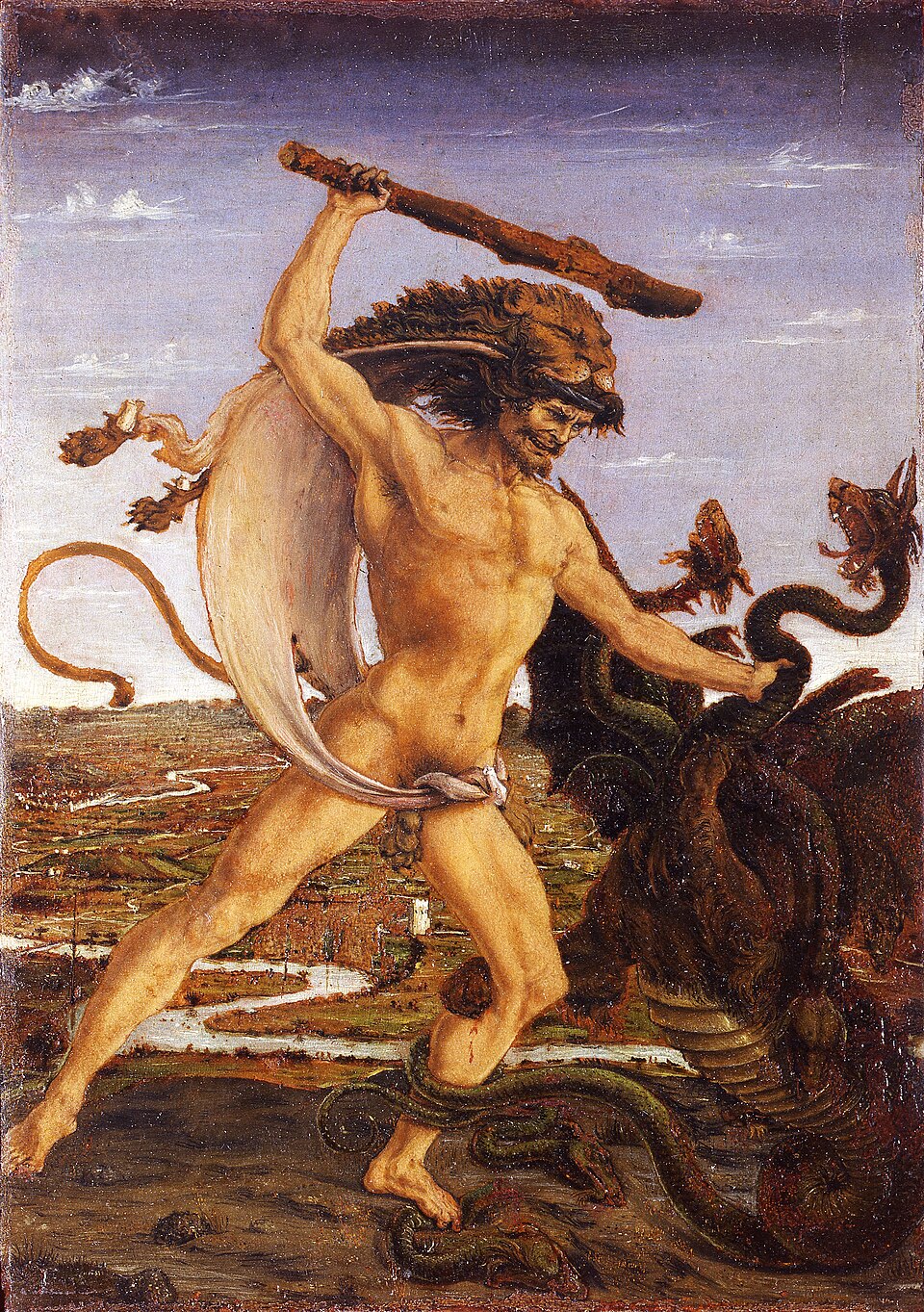
Long before statues would show him slumped and spent, leaning on his club after impossible tasks, Heracles's exhaustion was written into the very bones of his myth. He was born Alcaeus, son of Zeus and the mortal Alcmene, raised by her husband Amphitryon after a night the gods themselves stretched to three times its length so that Zeus could be with her. From birth he was marked by Hera's fury, jealous of yet another proof of her husband's infidelities, and that fury would shape every chapter of his life.
As an infant, Hera sent two serpents into his cradle. While his twin brother Iphicles wept in terror, the baby Heracles strangled a snake in each fist, found afterward playing with their bodies as though they were toys. It was an early sign of a strength that would prove both a gift and a curse — a power that could crush monsters but also, in a fit of madness sent by Hera, turn against those he loved most.
His youth was one of rigorous training: archery, horsemanship, wrestling, all mastered to excellence. At eighteen he killed a notorious beast living in the forests of Cithaeron. He married Megara, daughter of King Creon of Thebes, and had three sons with her. But Hera's hatred had not relented, and in a madness she inflicted upon him, Heracles killed his own children and his wife.
When sanity returned, horror followed. He fled to Delphi, where the Oracle — secretly guided by Hera — ordered him to serve King Eurystheus for ten years, completing whatever tasks the king demanded as penance for the deaths he had caused. Eurystheus assigned ten labors, then, through trickery, added two more, giving rise to the Twelve Labours for which Heracles is still remembered worldwide.
The labors, brutal and unending, became the defining trial of his existence — a life of combat against monsters in service of atonement, not glory. Ancient poets and Alexandrian writers later elevated this suffering into something close to tragedy, framing Heracles not merely as a strongman but as a figure whose pain carried meaning: sacrifice, mourning, and eventual redemption through relentless toil.
More from Art

The Painting With No Foreground
A single robed figure stares out at an empty grey sea — and the emptiness itself became a scandal. When it was unveiled in Berlin in 1810, no one knew quite what to do with it.

The Painter Who Chased the Light
For a few purple minutes each evening, an American exile knelt in an English garden and raced the dying sun to paint two little girls lighting lanterns. It took him two years to finish.

When a President Became a God
Look straight up inside the U.S. Capitol dome and you will find George Washington enthroned among the clouds, surrounded by goddesses — the founding father transformed into myth.

Marble Brought Back to Life
A corpse asleep, a wing barely brushing her skin — and marble somehow learns to breathe. This is the moment Antonio Canova dared to carve.

The World Turned Upside Down
Look closely at a sixteenth-century Flemish village and you'll find a man biting a pillar, another carrying daylight in a basket, and a wife slipping a blue cloak over her husband's shoulders. Every gesture is a joke — if you know the language.

The Girl in the Glass Case
She stood two-thirds life size, dressed in a real tutu and human hair — and the critics who saw her in 1881 recoiled as if she were something obscene.