The Woman in the Well
A naked woman climbs out of a stone well, whip in hand, ready to punish humanity. Why did a 19th-century master paint her at least four times?
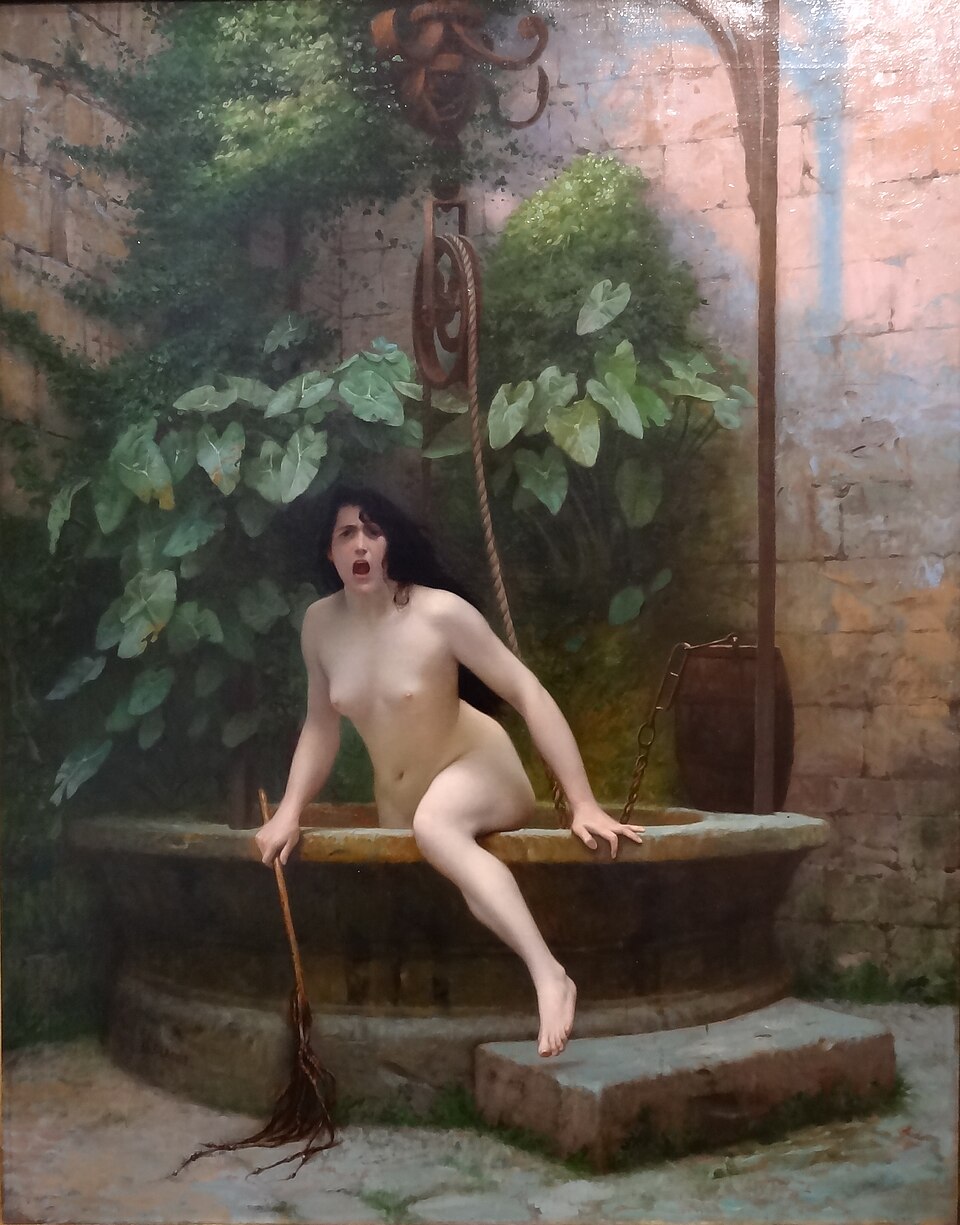
In 1896, at the Paris Salon, visitors stopped before a canvas with a startling, almost violent title: Truth Coming Out of Her Well, Armed with Her Whip to Chastise Humanity. Painted by Jean-Léon Gérôme, one of the most technically accomplished French academic painters of his era, the image showed a nude woman climbing out of a stone well, gripping a martinet — a small whip — as though she meant to punish the world waiting above ground.
The painting was not a singular idea but the culmination of an obsession. Starting in the mid-1890s, during the final decade of his life, Gérôme returned again and again to the same motif: Truth personified as a nude woman, thrown into a well, lying at its bottom, or climbing out of it. He made at least four such works.
The imagery traces back to a saying attributed to the ancient philosopher Democritus: 'Of truth we know nothing, for truth is in a well.' The original Greek phrase spoke more starkly of an abyss than a well, but the translated aphorism gave Gérôme his central symbol. The nudity of his figure, meanwhile, likely nodded to the French idiom la vérité nue — 'the naked truth.'
Gérôme was not the first to paint this scene. Jules-Arsène Garnier, who had studied under him, showed a nude woman emerging from a well at the Paris Salon of 1883, with a crowd fleeing in horror, under the simple title La Vérité. The Salon catalogue paired it with a line from a fable by Florian: 'The naked Truth one day came out of her well; everyone fled at the sight of her.' Even earlier, in about 1879, Paul Baudry had painted a calmer version — Truth sitting placidly atop a well, holding a mirror, attended by an infant.
Gérôme's own path to the 1896 painting ran through a darker predecessor. At the 1895 Salon, he had exhibited a work with a Latin title translating to 'The nurturer Truth lies in a well, having been killed by liars and actors' — showing Truth murdered by Falsehood, her body and her mirror flung into the well, flashes of light escaping the darkness. A year later came the painting of her emergence and vengeance.
More from Art

The Painting With No Foreground
A single robed figure stares out at an empty grey sea — and the emptiness itself became a scandal. When it was unveiled in Berlin in 1810, no one knew quite what to do with it.

The Painter Who Chased the Light
For a few purple minutes each evening, an American exile knelt in an English garden and raced the dying sun to paint two little girls lighting lanterns. It took him two years to finish.

When a President Became a God
Look straight up inside the U.S. Capitol dome and you will find George Washington enthroned among the clouds, surrounded by goddesses — the founding father transformed into myth.

Marble Brought Back to Life
A corpse asleep, a wing barely brushing her skin — and marble somehow learns to breathe. This is the moment Antonio Canova dared to carve.

The World Turned Upside Down
Look closely at a sixteenth-century Flemish village and you'll find a man biting a pillar, another carrying daylight in a basket, and a wife slipping a blue cloak over her husband's shoulders. Every gesture is a joke — if you know the language.

The Girl in the Glass Case
She stood two-thirds life size, dressed in a real tutu and human hair — and the critics who saw her in 1881 recoiled as if she were something obscene.