Theseus and the Minotaur: Into the Labyrinth
Every nine years, a black-sailed ship carried Athens's finest youth to a monster's door. Only a thread and a stranger's courage stood between them and the dark.
On the island of Crete, King Minos once asked Poseidon, god of the sea, to send him a snow-white bull as proof of divine favor, promising to sacrifice it in return. When the bull arrived, Minos found it too magnificent to kill and substituted another animal on the altar instead. Poseidon, insulted by the deception, enlisted Aphrodite to make Minos's wife, Pasiphaë, fall in love with the very bull her husband had spared.
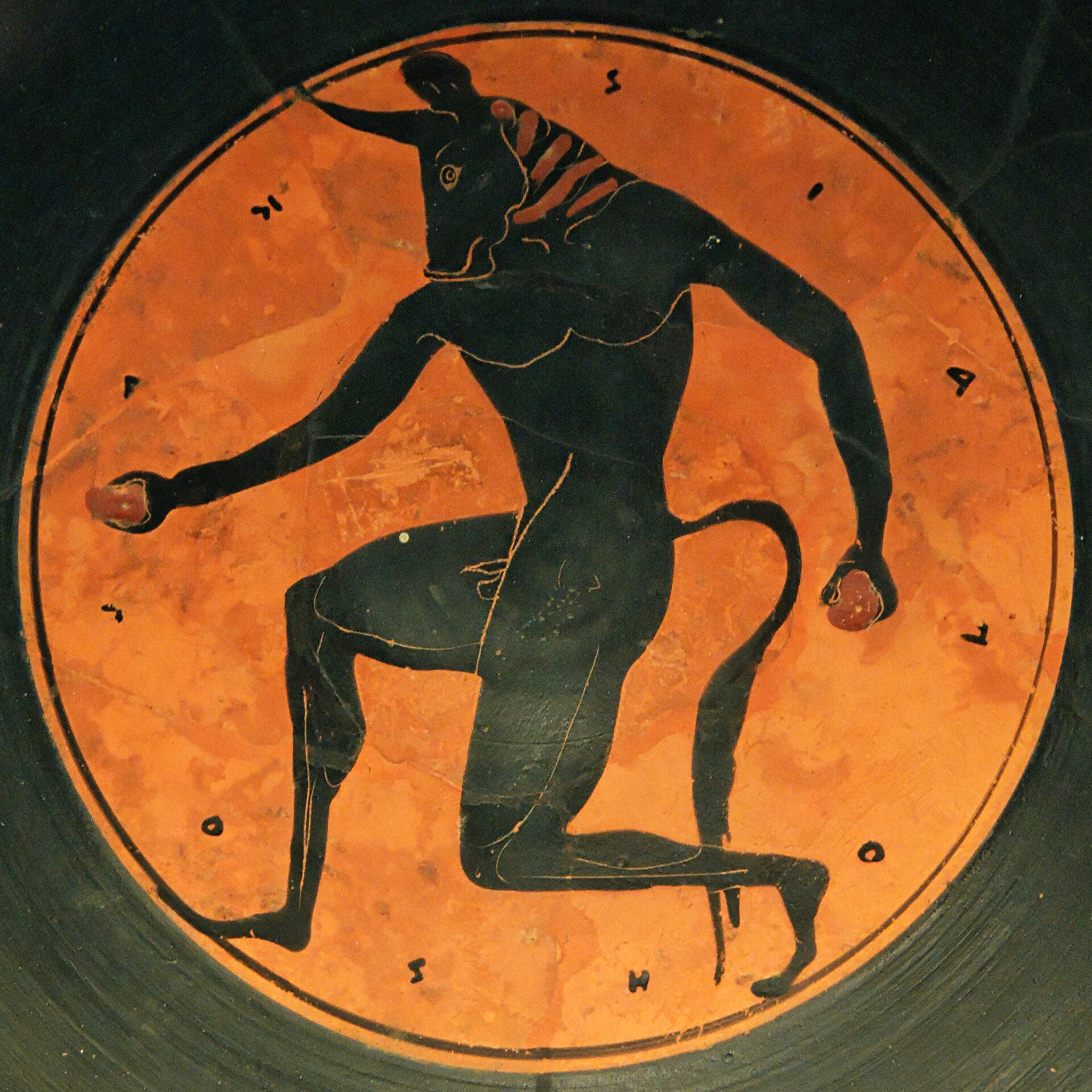
Pasiphaë's longing was so consuming that she had the master craftsman Daedalus build her a hollow wooden cow, into which she climbed so the bull could mate with her. From this unnatural union came Asterion — the Minotaur — a creature with the head and tail of a bull and the body of a man. Nursed by Pasiphaë as an infant, he grew monstrous and violent, and because he was neither fully human nor fully animal, he could only be sustained by devouring people.
On the advice of the oracle at Delphi, Minos commanded Daedalus to build a structure vast and confounding enough to contain the beast: the Labyrinth, a maze near the royal palace at Knossos from which no one could find their way out. There the Minotaur was sealed away, but he still needed to be fed.
The price of that feeding fell on Athens. Tradition held that Minos's son Androgeus had died at Athenian hands, and in retribution, Minos forced Athens to send fourteen young nobles — seven men and seven women — every nine years, to be delivered into the Labyrinth as sacrifices to the Minotaur. The ship that carried them each time sailed under black sails, a mark of the grim errand it performed.
Among those determined to end this cycle was Theseus, son of King Aegeus of Athens. Raised by his mother Aethra after Aegeus returned to Athens without waiting for his birth, Theseus had proven his royal blood by lifting a great stone under which his father had hidden a sword and sandals as tokens. Grown into a young man capable of overcoming bandits and monsters on his journey to Athens, Theseus resolved to sail with the doomed youths to Crete and kill the Minotaur himself. His father tried to dissuade him, but relented on one condition: if Theseus succeeded, he was to raise white sails on the return voyage instead of black, so Aegeus would know his son lived.
More from Mythology

The Doctor Who Sang a Nation Into Being
A country doctor rode into the forests of Karelia armed with nothing but a notebook — and rode out with the soul of a nation.

The Boat That Carried the Sun
Every sunset, the ancient Egyptians believed, the sun climbed into a boat and sailed straight into the realm of the dead — only to fight a monstrous serpent before dawn could return.

The Wild Man of the Snows
At 21,000 feet, a colonel found tracks in the snow that he blamed on a wolf — but his guides knew better, and gave the world a name that would echo for a century.

The Knight Who Went Mad for Love: Orlando Furioso
A hero so devoted to duty he was Charlemagne's greatest paladin loses his mind—not to a sword wound, but to heartbreak. To cure him, a friend must ride a flying horse to the Moon.

The Book That Turned the World Into Myth
A poet condemned to exile spent his final years in Rome finishing a poem that would outlive empires—a poem about nothing standing still, not gods, not lovers, not even the shape of a man.

Paradise Lost: Milton's Rebel Angel
A blind poet, dictating verses in the dark, dared to explain the ways of God to men — and in doing so, made Hell's ruler unforgettable.