Thirty Metres of Steel Horse: The Kelpies of Falkirk
Two horse heads, each taller than a nine-story building and heavier than a jumbo jet, rear up beside a Scottish motorway. They look ready to gallop off toward the canal.
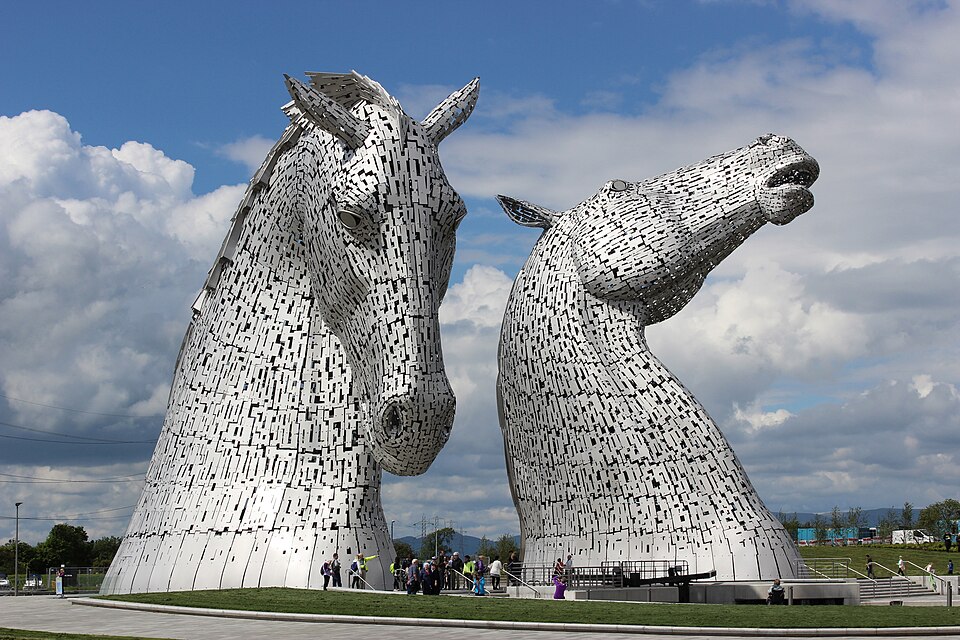
Drivers on the M9 between Falkirk and Grangemouth sometimes slow down without meaning to. Rising from the flat parkland beside the road are two colossal steel horse heads, each 30 metres high and weighing roughly 300 tonnes. They stand where the Forth and Clyde Canal meets the River Carron, forming a kind of gateway — one that seems to belong more to myth than to infrastructure.
The sculptures are called The Kelpies, a name chosen by Scottish Canals back in 2005 when the wider Helix park project began. In Scottish folklore, kelpies are shape-shifting water spirits said to have the strength and endurance of ten horses. That legend gave the project its name and its first spark of inspiration, even as the finished work moved in a different direction.
Sculptor Andy Scott, who designed the piece, later explained that the original mythological concept was 'a valid starting point' but that he steered the work toward something more grounded: a tribute to the heavy horses of Scottish industry. For generations, such horses had pulled the wagons, ploughs, barges, and coalships that shaped the Falkirk area's economy and geography. Scott described his intention as creating 'proud equine guardians' — water-borne gateways into the Helix, the canal, and Scotland itself.
The forms themselves were modeled on Clydesdale horses, Scotland's own breed of powerful draught animal. In 2008, Scott built three-metre miniature versions in his Glasgow studio. These maquettes were then laser-scanned so that steel fabricators could recreate their exact proportions at monumental scale.
Construction of the full-size Kelpies began in June 2013. Built from structural steel with a stainless steel cladding, the heads took shape quickly and were complete by October 2013. A topping-out ceremony followed on 27 November 2013. They stand on either side of a specially built lock and basin, part of what became known as the Kelpies Hub. An official unveiling followed in April 2014.
More from Art

The Painting With No Foreground
A single robed figure stares out at an empty grey sea — and the emptiness itself became a scandal. When it was unveiled in Berlin in 1810, no one knew quite what to do with it.

The Painter Who Chased the Light
For a few purple minutes each evening, an American exile knelt in an English garden and raced the dying sun to paint two little girls lighting lanterns. It took him two years to finish.

When a President Became a God
Look straight up inside the U.S. Capitol dome and you will find George Washington enthroned among the clouds, surrounded by goddesses — the founding father transformed into myth.

Marble Brought Back to Life
A corpse asleep, a wing barely brushing her skin — and marble somehow learns to breathe. This is the moment Antonio Canova dared to carve.

The World Turned Upside Down
Look closely at a sixteenth-century Flemish village and you'll find a man biting a pillar, another carrying daylight in a basket, and a wife slipping a blue cloak over her husband's shoulders. Every gesture is a joke — if you know the language.

The Girl in the Glass Case
She stood two-thirds life size, dressed in a real tutu and human hair — and the critics who saw her in 1881 recoiled as if she were something obscene.