This Is Not a Pipe
A painter draws a pipe so precisely you could almost pack it with tobacco — then writes underneath that it is not a pipe at all. Which one is lying?
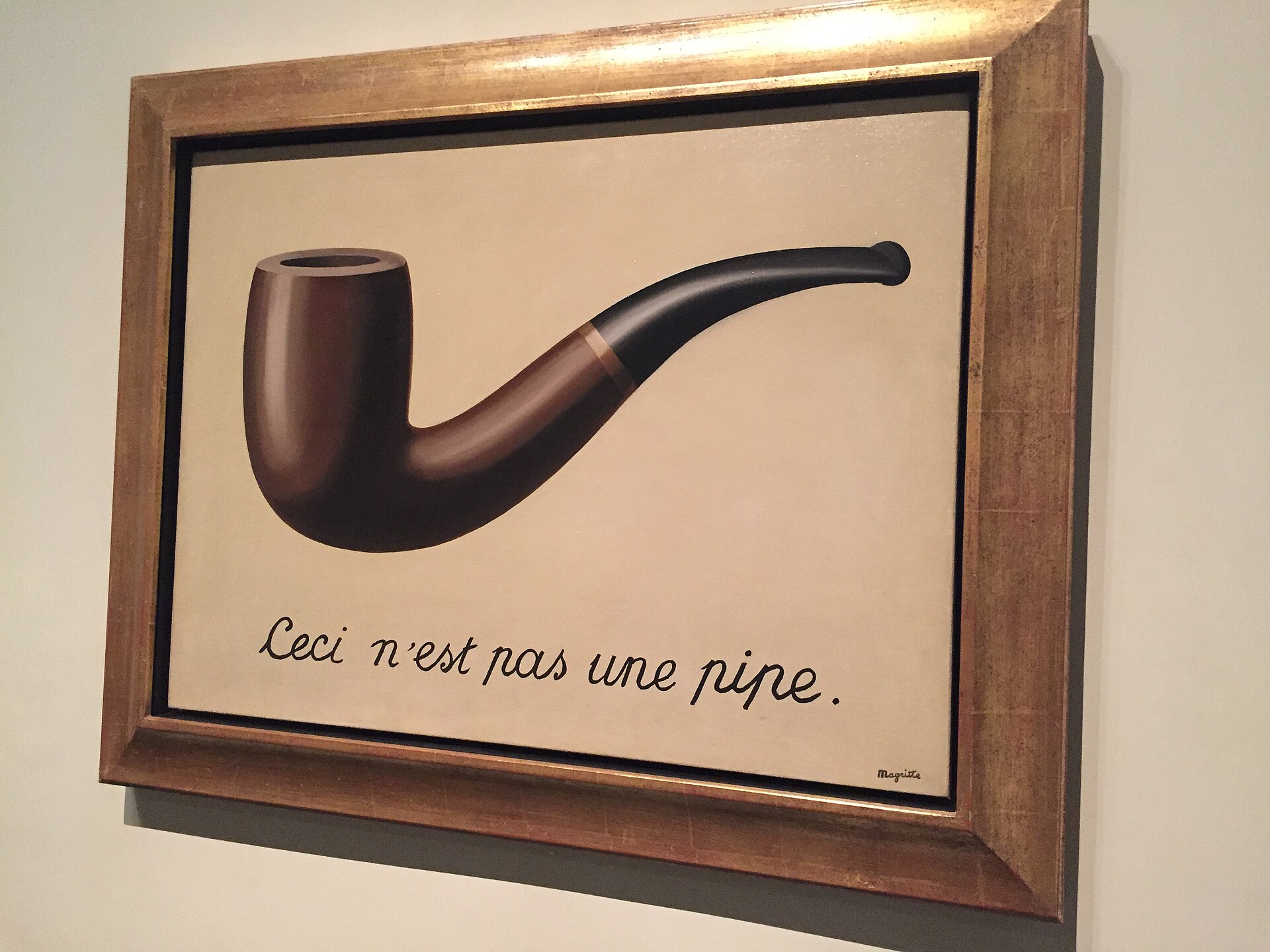
Between 1928 and 1929, René Magritte, a Belgian surrealist in his thirties, finished a small canvas that would outlast almost everything else he painted. It shows a wooden tobacco pipe, rendered with the calm precision of a tradesman's catalogue illustration. Beneath it, in a schoolteacher's cursive, runs a single sentence: Ceci n'est pas une pipe. This is not a pipe.
The painting carries several names — The Treachery of Images, This Is Not a Pipe, The Wind and the Song — and today it hangs in the Los Angeles County Museum of Art. Magritte himself explained the joke plainly: could you fill that painted pipe with tobacco? No — it is only a representation. Had he written 'This is a pipe' instead, he said, he would have been lying.
The picture did not appear from nowhere. Magritte had been circling this idea since 1926, when he sketched a pipe in three forms — an abstract shape, a pictorial image, and a written word — probing the gap between a thing, its picture, and its name. In 1927's The Key of Dreams, he painted four boxed images each paired with a mismatched word, so that only one label actually described its picture. By 1928, in The Living Mirror, he had gone further still, replacing images entirely with words naming shapes too vague to draw. The Treachery of Images, completed in 1928-1929, was the moment this line of thought crystallized into its most famous form, and Magritte returned to variants of it for years afterward.
The idea reached far beyond his own studio. On December 15, 1929, in the surrealist journal La Révolution surréaliste, André Breton and Paul Éluard mocked poet Paul Valéry's claim that 'Poetry is a survival' by countering, 'Poetry is a pipe' — a direct nod to Magritte's canvas. In that same issue, Magritte published his own essay, Les Mots et les Images, laying out his thinking on how words and pictures play against one another.
The philosophical resonance kept growing. Scholars have linked the painting to Alfred Korzybski's dictum that 'the word is not the thing' and 'the map is not the territory,' and to Denis Diderot's earlier observation that a story is not the events it describes. Decades later, the French philosopher Michel Foucault devoted an entire essay, published in 1973, to unpacking the painting's paradox — arguing that Magritte's simple image forces viewers to confront a much deeper, thornier question about how any representation relates to reality.
More from Art

The Painting With No Foreground
A single robed figure stares out at an empty grey sea — and the emptiness itself became a scandal. When it was unveiled in Berlin in 1810, no one knew quite what to do with it.

The Painter Who Chased the Light
For a few purple minutes each evening, an American exile knelt in an English garden and raced the dying sun to paint two little girls lighting lanterns. It took him two years to finish.

When a President Became a God
Look straight up inside the U.S. Capitol dome and you will find George Washington enthroned among the clouds, surrounded by goddesses — the founding father transformed into myth.

Marble Brought Back to Life
A corpse asleep, a wing barely brushing her skin — and marble somehow learns to breathe. This is the moment Antonio Canova dared to carve.

The World Turned Upside Down
Look closely at a sixteenth-century Flemish village and you'll find a man biting a pillar, another carrying daylight in a basket, and a wife slipping a blue cloak over her husband's shoulders. Every gesture is a joke — if you know the language.

The Girl in the Glass Case
She stood two-thirds life size, dressed in a real tutu and human hair — and the critics who saw her in 1881 recoiled as if she were something obscene.