Three Nights in a Furnace of Color
He stayed awake for three straight nights just to paint a room he called one of the ugliest things he'd ever made — and it became a masterpiece.
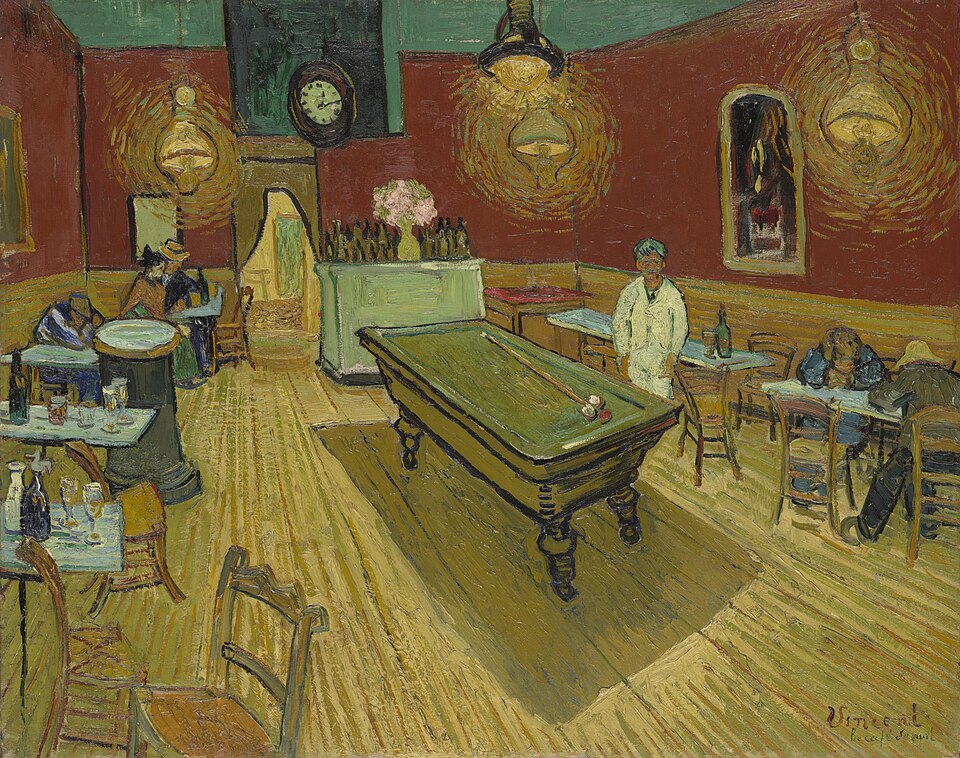
In September 1888, in the southern French town of Arles, Vincent van Gogh set up his easel inside a café where he happened to be renting a room. The Café de la Gare stood at 30 Place Lamartine, run by Joseph-Michel Ginoux and his wife Marie. Van Gogh, in a jocular letter to his brother Theo, joked that Ginoux had taken so much of his money that it was time for revenge: he would paint the place.
The café itself was what locals called a 'café de nuit' — a night café, open all hours, a refuge for those too poor or too drunk to find a bed elsewhere. Van Gogh described it to Theo in August 1888 as a place where night prowlers could take shelter. To capture it under gaslight, he sat up for three consecutive nights at the start of September, sleeping through the days instead.
What emerged was a scene of a half-curtained doorway at the back, a billiard table at the center, and five customers slouched at tables along the walls — described by observers as drunks and derelicts huddled in sleep or stupor. Ginoux himself stands near the billiard table, facing the viewer, dressed in white.
The colors are what make the painting unforgettable: a green ceiling, blood-red upper walls, and four lemon-yellow gas lamps glowing with halos of orange and green. Van Gogh applied the paint thickly, with the room's lines converging toward the back door, and the perspective tilted downward toward the floor.
More from Art

The Painting With No Foreground
A single robed figure stares out at an empty grey sea — and the emptiness itself became a scandal. When it was unveiled in Berlin in 1810, no one knew quite what to do with it.

The Painter Who Chased the Light
For a few purple minutes each evening, an American exile knelt in an English garden and raced the dying sun to paint two little girls lighting lanterns. It took him two years to finish.

When a President Became a God
Look straight up inside the U.S. Capitol dome and you will find George Washington enthroned among the clouds, surrounded by goddesses — the founding father transformed into myth.

Marble Brought Back to Life
A corpse asleep, a wing barely brushing her skin — and marble somehow learns to breathe. This is the moment Antonio Canova dared to carve.

The World Turned Upside Down
Look closely at a sixteenth-century Flemish village and you'll find a man biting a pillar, another carrying daylight in a basket, and a wife slipping a blue cloak over her husband's shoulders. Every gesture is a joke — if you know the language.

The Girl in the Glass Case
She stood two-thirds life size, dressed in a real tutu and human hair — and the critics who saw her in 1881 recoiled as if she were something obscene.