Three Swords, One Oath
Three brothers raise their arms toward their father's blades, swearing to die for Rome — while the women beside them already know how much it will cost.
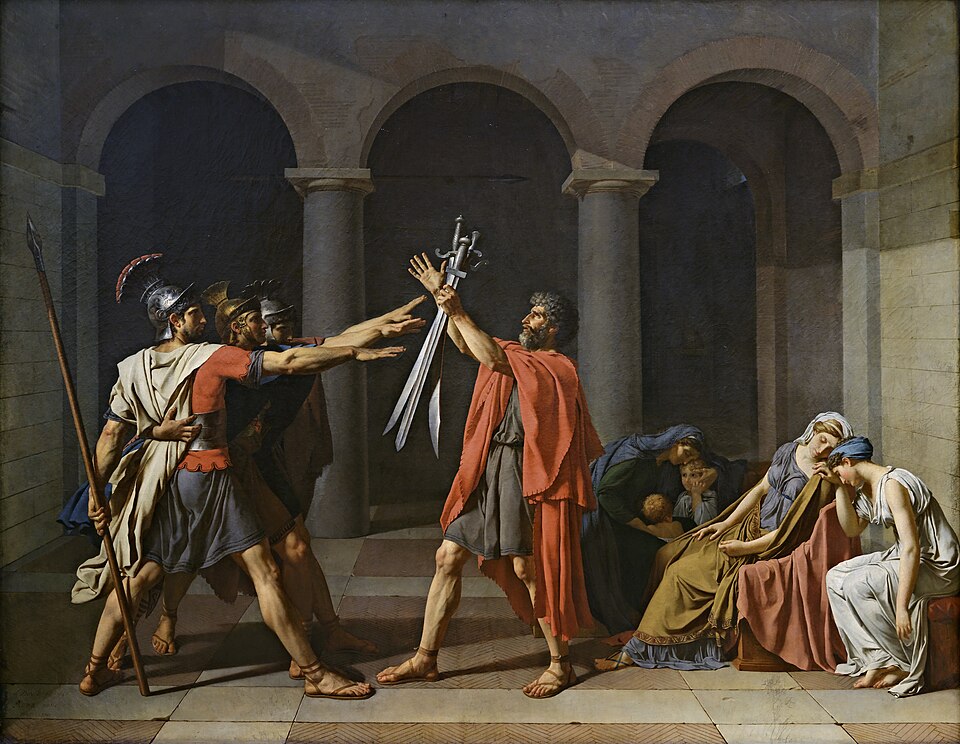
In 1784, in a Roman studio far from the French court that had commissioned it, Jacques-Louis David began painting a scene that never actually appears in any ancient text. The moment he chose to depict — three brothers stretching their hands toward their father, who holds out their swords — was David's own invention, distilled from a legend whose principal source is the first book of Livy.
The story behind the image comes from a seventh-century BC dispute between two warring cities, Rome and Alba Longa. Rather than send full armies to slaughter each other, the cities agreed to settle the conflict through champions: three brothers from a Roman family, the Horatii, would fight three brothers from an Alba Longan family, the Curiatii. Whichever side's men survived would decide the war.
David's painting captures the instant before that battle — the brothers pledging themselves entirely to Rome, their father supporting their resolve. All three appear willing to die for their city, and in fact only one of them, Publius, survives the fight. He wins by a trick: allowing the three Curiatii to chase him until they separate, then killing each one in turn.
In the corner of the composition sits Camilla, sister of the Horatii, weeping. She was betrothed to one of the Curiatii brothers, so victory for Rome means devastation for her — she loses someone she loves no matter the outcome. When Publius returns home and finds her cursing Rome over her dead betrothed, he kills her for it. David originally planned to paint this darker scene — a surviving drawing shows Publius standing over his sister's body, sword raised — but decided it was too gruesome for the message he wanted to send about duty triumphing over private feeling.
The commission itself came from Charles-Claude Flahaut de la Billaderie, an assistant to King Louis XVI, who intended the work as an allegory of loyalty to the state and, by extension, to the monarchy. David had earned royal favor after returning from five years in Rome as a Prix de Rome student, a triumph that let him lodge in the Louvre itself — a privilege few artists received. There he met Pecoul, a building contractor, and married his daughter.
More from Art

The Painting With No Foreground
A single robed figure stares out at an empty grey sea — and the emptiness itself became a scandal. When it was unveiled in Berlin in 1810, no one knew quite what to do with it.

The Painter Who Chased the Light
For a few purple minutes each evening, an American exile knelt in an English garden and raced the dying sun to paint two little girls lighting lanterns. It took him two years to finish.

When a President Became a God
Look straight up inside the U.S. Capitol dome and you will find George Washington enthroned among the clouds, surrounded by goddesses — the founding father transformed into myth.

Marble Brought Back to Life
A corpse asleep, a wing barely brushing her skin — and marble somehow learns to breathe. This is the moment Antonio Canova dared to carve.

The World Turned Upside Down
Look closely at a sixteenth-century Flemish village and you'll find a man biting a pillar, another carrying daylight in a basket, and a wife slipping a blue cloak over her husband's shoulders. Every gesture is a joke — if you know the language.

The Girl in the Glass Case
She stood two-thirds life size, dressed in a real tutu and human hair — and the critics who saw her in 1881 recoiled as if she were something obscene.