Typhon: The Monster Who Made the Gods Flee
A hundred fire-breathing snake heads, a hiss that shook mountains, and a body vast enough to brush the stars — this was the creature born to end Zeus's reign.
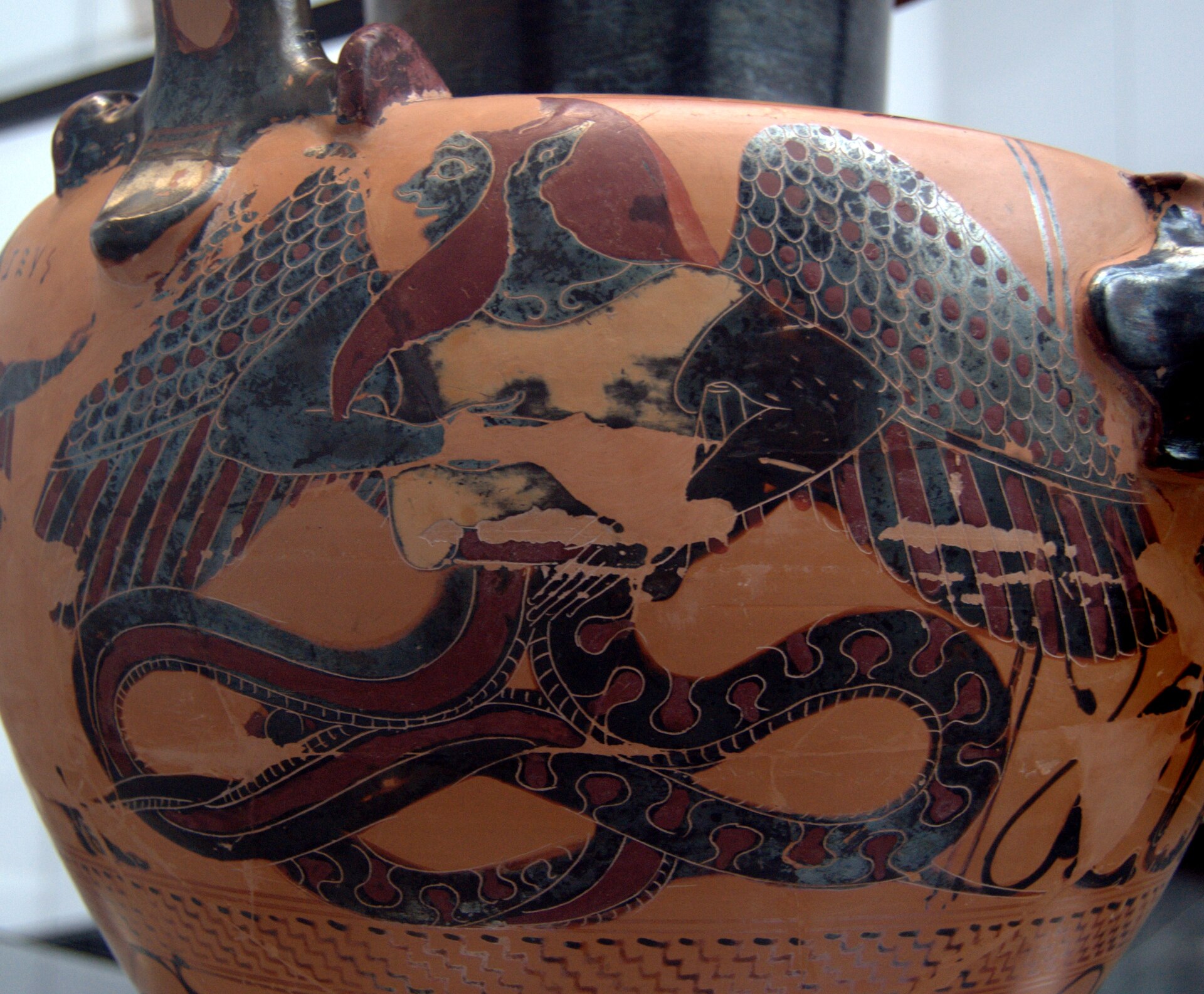
When Gaia looked upon the ruin of her children, the Giants, crushed by the Olympian gods, her fury did not fade quietly into the earth. According to Hesiod's Theogony, she turned to Tartarus, and from their union came Typhon, her youngest and most terrible child — a being meant, in some tellings, to avenge what the gods had done.
Other traditions disagree on his parentage. The Homeric Hymn to Apollo insists Typhon belonged to Hera alone, born after she prayed to Gaia, Uranus, and the Titans for a son stronger than Zeus, then struck the ground and conceived. She entrusted the infant to the serpent Python to raise, and Typhon grew into a scourge upon mortals. Still another account, preserved in scholia to the Iliad, makes him the son of Cronus, born from eggs smeared with the old Titan's seed and buried by Hera in Cilicia.
Cilicia recurs again and again as Typhon's birthplace. The poet Pindar calls him 'Cilician,' nursed in a famous cave — almost certainly the real Corycian cave near the ancient coastal city of Corycus, today's Kızkalesi in Turkey. Aeschylus and Apollodorus place him there too, and the poet Nonnus agrees. It is a rare case of Greek myth rooting a cosmic monster in an actual, walkable landscape.
What did Typhon look like? Hesiod describes a creature of staggering menace: a hundred serpent heads sprouting from his shoulders, dark flickering tongues, fire flashing from beneath his brows, and voices that shifted from sounds the gods themselves could understand to the bellowing of a bull, the roar of a lion, the whimper of pups, or a hiss loud enough to make high mountains echo. Later poets mostly kept the hundred heads, though one tradition gave him only fifty.```
Apollodorus, writing centuries later, painted him on an even grander scale: human in shape from the waist up but so immense his head brushed the stars, one hand stretching to the west and the other to the east, each sprouting dragon heads. Below the waist, coils of vipers replaced legs, hissing loudly whenever he moved, while his whole body was feathered with wings and his loose hair streamed fire-lit in the wind.
More from Mythology

The Doctor Who Sang a Nation Into Being
A country doctor rode into the forests of Karelia armed with nothing but a notebook — and rode out with the soul of a nation.

The Boat That Carried the Sun
Every sunset, the ancient Egyptians believed, the sun climbed into a boat and sailed straight into the realm of the dead — only to fight a monstrous serpent before dawn could return.

The Wild Man of the Snows
At 21,000 feet, a colonel found tracks in the snow that he blamed on a wolf — but his guides knew better, and gave the world a name that would echo for a century.

The Knight Who Went Mad for Love: Orlando Furioso
A hero so devoted to duty he was Charlemagne's greatest paladin loses his mind—not to a sword wound, but to heartbreak. To cure him, a friend must ride a flying horse to the Moon.

The Book That Turned the World Into Myth
A poet condemned to exile spent his final years in Rome finishing a poem that would outlive empires—a poem about nothing standing still, not gods, not lovers, not even the shape of a man.

Paradise Lost: Milton's Rebel Angel
A blind poet, dictating verses in the dark, dared to explain the ways of God to men — and in doing so, made Hell's ruler unforgettable.