Wanderer above the Sea of Fog
A man stands with his back to us, staring into a fog that hides the world. Is he lost, or exactly where he means to be?
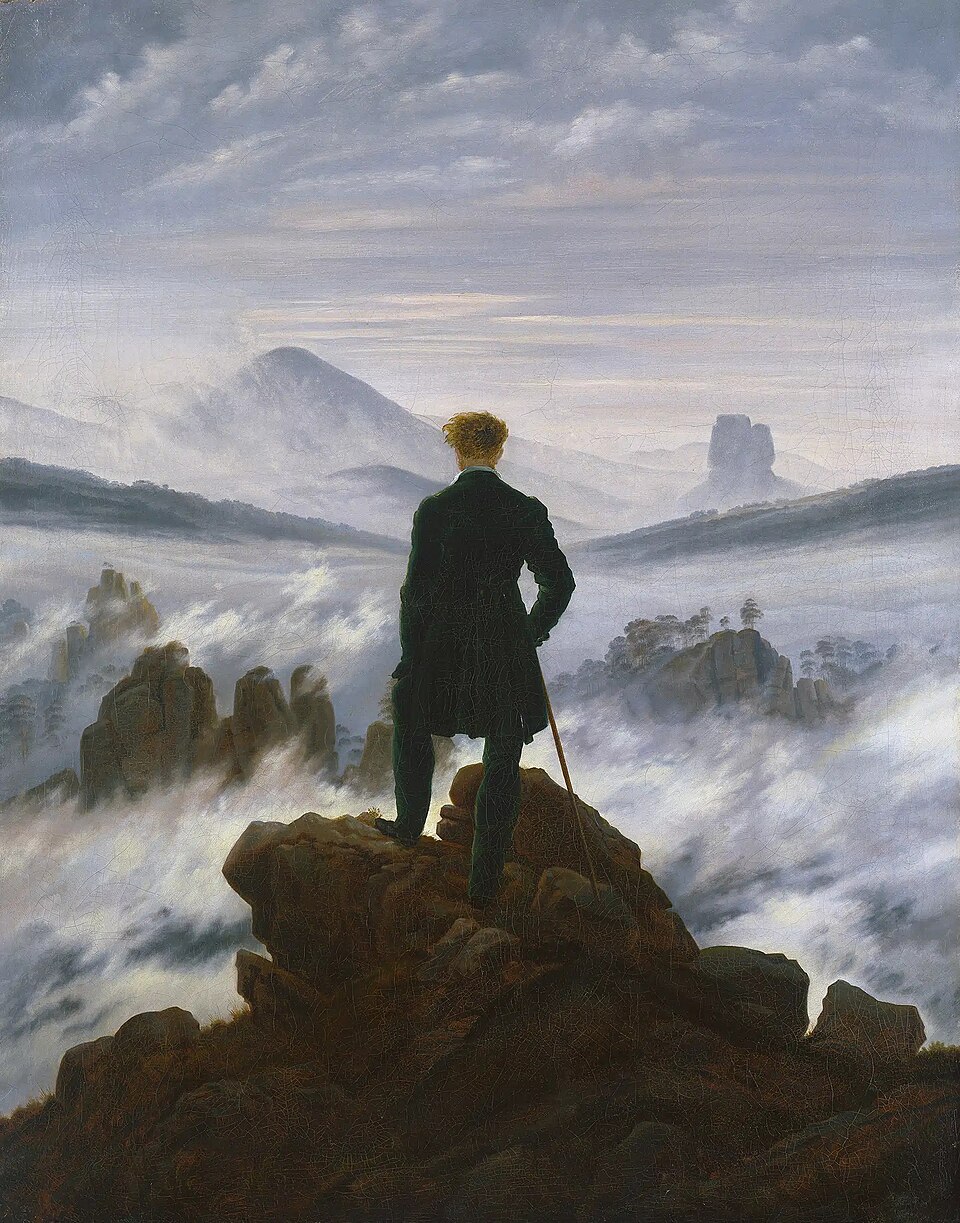
In 1818, a German painter named Caspar David Friedrich completed a canvas that would become one of the most recognizable images in Western art: a lone figure atop a rocky outcrop, wrapped in a dark green overcoat, gripping a walking stick, his hair caught in the wind, his back turned entirely to the viewer. Below and around him spreads a sea of fog so vast it swallows the landscape whole, broken only by the jagged tips of ridges, forests, and distant mountains that pierce through like islands in a white ocean.
The painting was not invented from a single view. Friedrich built it from sketches made in the Elbe Sandstone Mountains of Saxony and Bohemia, then rearranged the pieces in his studio, as was his usual method. The rocks beneath the wanderer's feet belong to a group on the Kaiserkrone; the peak to the right is the Zirkelstein; the mountain to the left is either the Rosenberg or the Kaltenberg; and the rocky cluster before it represents the Gamrig near Rathen. Nature, for Friedrich, was raw material to be reassembled into something truer than any single view could offer.
The timing of the work overlapped with real turns in Friedrich's life. In 1817 he had formed a friendship with the scientist Carl Gustav Carus and the Norwegian painter Johan Christian Dahl. In January 1818, he married Caroline Brommer, and the couple spent their honeymoon in his hometown of Greifswald. Whether the painting reflects this personal chapter is unknown, but its creation sits squarely within this period of new companionship and domestic change.
The identity of the wanderer himself remains unresolved. Some have proposed it is a self-portrait, pointing to details like the reddish hair matching Friedrich's own. This reading has encouraged interpretations of the painting as an act of self-reflection, a man measuring himself against forces larger than his own understanding. Friedrich himself wrote that mist makes a landscape seem 'larger and more sublime, elevating the imagination,' comparing it to the allure of a veiled girl — a rare glimpse into how deliberately he pursued this effect of mystery.
The device of turning a central figure away from the viewer, known as Rückenfigur, was not new to art, but Friedrich used it more insistently than almost anyone before him. By denying us the man's face, he invites us to stand where he stands, to see the fog as he sees it, rather than to watch him seeing it. Art historian Werner Hofmann noted that this openness — the wanderer's uncertainty about what lies ahead — set Friedrich apart even from other Romantics, contrasting the painting's ambiguity with the resolute forward motion of Delacroix's Liberty Leading the People.
More from Art

The Painting With No Foreground
A single robed figure stares out at an empty grey sea — and the emptiness itself became a scandal. When it was unveiled in Berlin in 1810, no one knew quite what to do with it.

The Painter Who Chased the Light
For a few purple minutes each evening, an American exile knelt in an English garden and raced the dying sun to paint two little girls lighting lanterns. It took him two years to finish.

When a President Became a God
Look straight up inside the U.S. Capitol dome and you will find George Washington enthroned among the clouds, surrounded by goddesses — the founding father transformed into myth.

Marble Brought Back to Life
A corpse asleep, a wing barely brushing her skin — and marble somehow learns to breathe. This is the moment Antonio Canova dared to carve.

The World Turned Upside Down
Look closely at a sixteenth-century Flemish village and you'll find a man biting a pillar, another carrying daylight in a basket, and a wife slipping a blue cloak over her husband's shoulders. Every gesture is a joke — if you know the language.

The Girl in the Glass Case
She stood two-thirds life size, dressed in a real tutu and human hair — and the critics who saw her in 1881 recoiled as if she were something obscene.