Zenobia's Desert Empire and the Fires That Ended It
For three brief years, a queen ruled from Syria to Egypt in defiance of Rome. Then a legion returned — and this time, it did not spare the city.
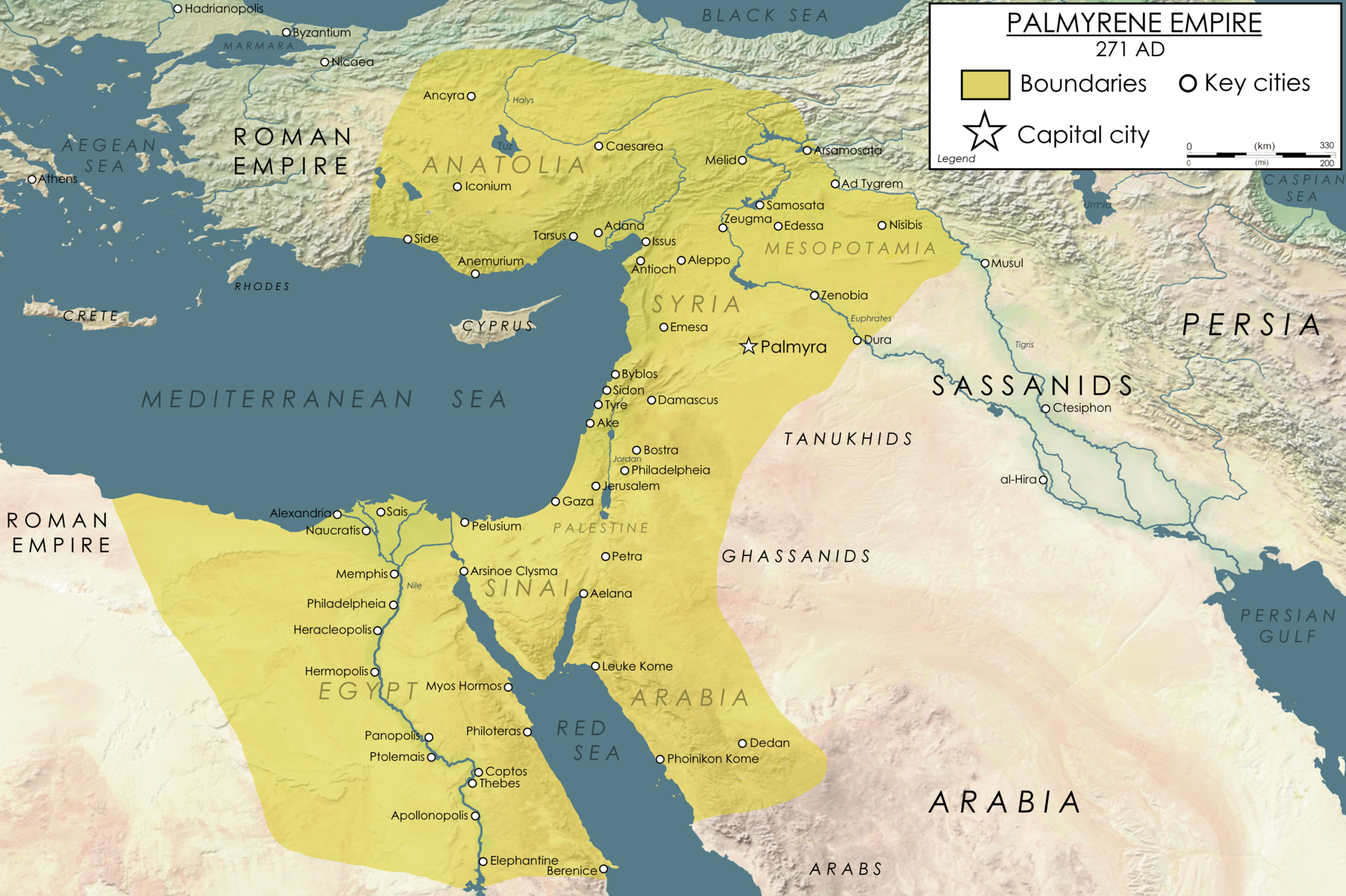
In 267, a Palmyrene ruler named Odaenathus was assassinated along with his son Hairan, reportedly by his own cousin, Maeonius. He left behind a ten-year-old heir, Vaballathus, and a widow determined not to let power slip away: Zenobia. Officially she ruled as regent for her son, careful at first not to provoke Rome, keeping the titles her husband had held while quietly consolidating control over Syria.
That caution did not last. In the spring of 270, during the reign of Emperor Claudius Gothicus, Zenobia launched a campaign against the Tanukhid tribes, aided by her generals Septimius Zabbai and Septimius Zabdas. Zabdas sacked Bosra, killed the Roman governor there, and secured Roman Arabia. By October 270, a Palmyrene army of 70,000 had invaded Egypt and declared Zenobia queen. The Roman general Tenagino Probus briefly retook Alexandria but was besieged in the fortress of Babylon and took his own life after capture.
The following spring, Zabbai and Zabdas turned north into Asia Minor, subduing Galatia and occupying Ancyra — the farthest reach of Palmyrene power, though Chalcedon held out against them. Throughout this expansion, Zenobia maintained a careful fiction of loyalty to Rome, issuing coins in the name of Emperor Aurelian while depicting Vaballathus as king. Aurelian, for his part, tolerated the Palmyrene coinage and titles. But by late 271, the pretense broke: Vaballathus took the title of Augustus alongside his mother, an open claim to imperial power.
Aurelian could not ignore this. In 272 he crossed the Bosphorus and swept through Anatolia. At Tyana, legend holds that he was moved by a dream of the philosopher Apollonius, who urged him toward mercy, and he spared the city — a decision that reportedly encouraged other towns to submit rather than resist. Advancing through Issus toward Antioch, Aurelian defeated Zenobia at the Battle of Immae. She retreated to Antioch, then fled to Emesa as Aurelian took the city behind her.
The Romans destroyed a Palmyrene garrison at Daphne, moved through Apamea, and caught up with Zenobia again at the Battle of Emesa, defeating her a second time and forcing her retreat all the way to Palmyra itself. Aurelian pursued her across the desert, harassed along the way by Bedouins loyal to the queen, until he reached the city and laid siege. Zenobia, attempting to flee toward Sassanid Persia with her son, was captured alive and taken prisoner to be brought back to Italy.
More from Art

The Painting With No Foreground
A single robed figure stares out at an empty grey sea — and the emptiness itself became a scandal. When it was unveiled in Berlin in 1810, no one knew quite what to do with it.

The Painter Who Chased the Light
For a few purple minutes each evening, an American exile knelt in an English garden and raced the dying sun to paint two little girls lighting lanterns. It took him two years to finish.

When a President Became a God
Look straight up inside the U.S. Capitol dome and you will find George Washington enthroned among the clouds, surrounded by goddesses — the founding father transformed into myth.

Marble Brought Back to Life
A corpse asleep, a wing barely brushing her skin — and marble somehow learns to breathe. This is the moment Antonio Canova dared to carve.

The World Turned Upside Down
Look closely at a sixteenth-century Flemish village and you'll find a man biting a pillar, another carrying daylight in a basket, and a wife slipping a blue cloak over her husband's shoulders. Every gesture is a joke — if you know the language.

The Girl in the Glass Case
She stood two-thirds life size, dressed in a real tutu and human hair — and the critics who saw her in 1881 recoiled as if she were something obscene.