A Balcony Full of Friends
On a sun-flooded terrace above the Seine, Renoir gathered his whole world into one canvas — while a collector, Duncan Phillips, would spend a decade of his own life chasing it down.
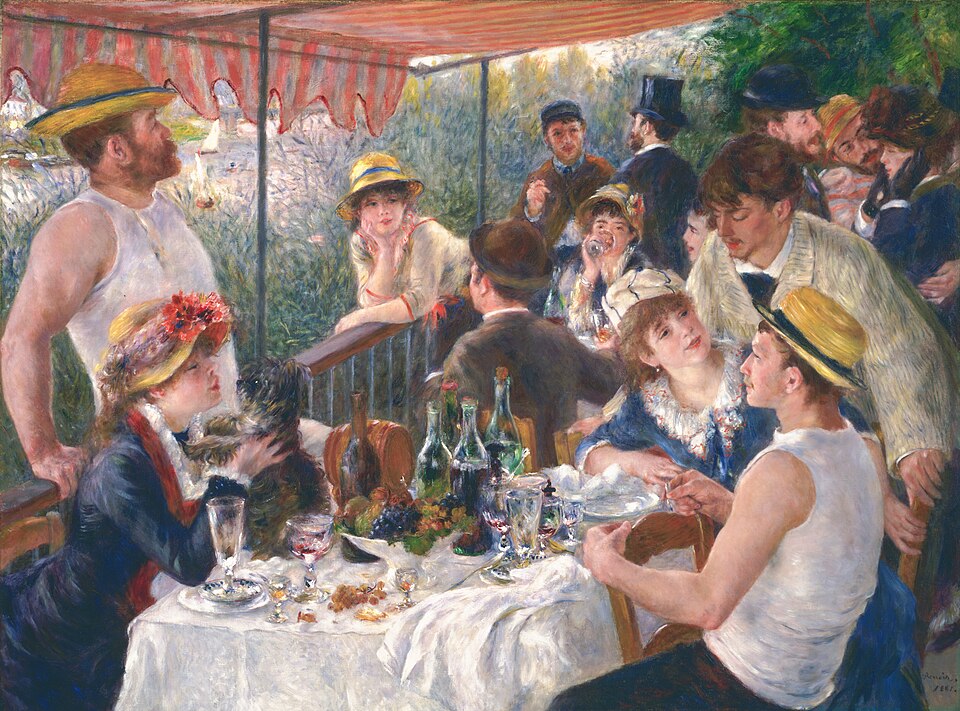
In 1880 and 1881, Pierre-Auguste Renoir set up his easel on the balcony of the Maison Fournaise, a restaurant perched along the Seine at Chatou, and began assembling a crowd of friends into a single, radiant afternoon. The painting that emerged, Luncheon of the Boating Party, would combine figures, still life, and landscape with a richness of form and a flickering light that critics would still be arguing about a century later.
The cast was not invented — it was Renoir's actual circle. Gustave Caillebotte, painter and patron, sits backwards in his chair in the right foreground, wearing a white boating shirt and flat-topped straw hat, near actress Angèle Legault and journalist Adrien Maggiolo. In the foreground, a young woman plays with a small affenpinscher dog: Aline Charigot, a seamstress who would become Renoir's wife in 1890 and the mother of his three sons. She had replaced an earlier model with whom Renoir had grown annoyed.
Behind them, in a top hat, stands Charles Ephrussi, a wealthy amateur art historian and editor of the Gazette des Beaux-Arts, apparently in conversation with a younger man in a brown coat and cap — who may be his secretary Jules Laforgue, himself a poet and critic. Actress Ellen Andrée drinks from a glass at the composition's center, facing Baron Raoul Barbier, the former mayor of colonial Saigon. In the upper right corner, Renoir's close friends Eugène Pierre Lestringez, a bureaucrat, and fellow artist Paul Lhote flirt with actress Jeanne Samary, all sporting the straw boaters that gave the painting its name.
Even the restaurant's own family made it into the frame. Louise-Alphonsine Fournaise, the proprietor's daughter, leans smiling on the railing, while her brother Alphonse Fournaise, Jr., who ran the boat-rental business, appears as the leftmost figure. The diagonal line of that railing splits the canvas — one half dense with figures, the other nearly empty save for the two Fournaise siblings, thrown into relief by the contrast.
Renoir was working, art historians believe, under the spell of Paolo Veronese's The Wedding Feast at Cana, a Louvre favorite of his that similarly staged a crowded banquet. Light pours through a large opening in the balcony beside a large man in a hat and singlet, then bounces off tablecloth and shirts to wash across the whole composition — fruit, wine, faces, all caught in that same glow.
More from Art

The Painting With No Foreground
A single robed figure stares out at an empty grey sea — and the emptiness itself became a scandal. When it was unveiled in Berlin in 1810, no one knew quite what to do with it.

The Painter Who Chased the Light
For a few purple minutes each evening, an American exile knelt in an English garden and raced the dying sun to paint two little girls lighting lanterns. It took him two years to finish.

When a President Became a God
Look straight up inside the U.S. Capitol dome and you will find George Washington enthroned among the clouds, surrounded by goddesses — the founding father transformed into myth.

Marble Brought Back to Life
A corpse asleep, a wing barely brushing her skin — and marble somehow learns to breathe. This is the moment Antonio Canova dared to carve.

The World Turned Upside Down
Look closely at a sixteenth-century Flemish village and you'll find a man biting a pillar, another carrying daylight in a basket, and a wife slipping a blue cloak over her husband's shoulders. Every gesture is a joke — if you know the language.

The Girl in the Glass Case
She stood two-thirds life size, dressed in a real tutu and human hair — and the critics who saw her in 1881 recoiled as if she were something obscene.