A Dying General Dressed as a Saint
He was shot down on the Plains of Abraham in fifteen bloody minutes — but the painting that made him immortal invented almost everything around him.
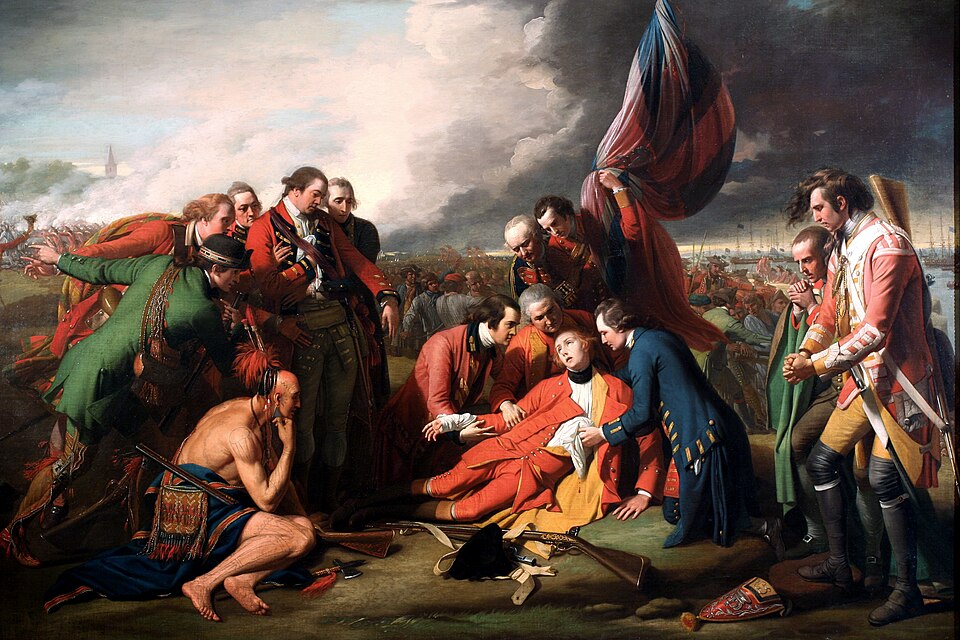
In 1770, in a London studio, the Anglo-American painter Benjamin West set out to capture a moment that had already become legend: the death of General James Wolfe on September 13, 1759, at the Battle of Quebec, also called the Battle of the Plains of Abraham. The battle itself, a pivotal clash of the Seven Years' War that would decide the fate of France's North American colonies, lasted barely fifteen minutes of pitched fighting. Wolfe's British forces held the line and won, but Wolfe himself was struck by several gunshots and died in the moment of victory.
West did not paint a battlefield report. He painted a martyrdom. The composition is triangular, built from the peak of a flag down through the huddled bodies of onlookers, echoing Christian Lamentation scenes in which the dead Christ is cradled by the Virgin Mary. Wolfe lies in a red coat, red waistcoat, red breeches, and a plain white shirt — remarkably simple dress for a commanding officer, though he had gone into battle armed like his own men, save for a musket of finer quality, shown discarded on the ground beside his cartridge box and bayonet.
Around him West arranged fourteen figures, though only four of them were actually present at the battle. Captain Hervey Smythe, who had fought alongside Wolfe during the 1758 Gulf of St. Lawrence campaign, holds the general's right arm. Dr Thomas Hinde, in a blue jacket, presses at Wolfe's wounds — the general would in fact die in this doctor's hands. In the background a runner waves his hat with one hand while carrying a captured French flag bearing the fleur-de-lis in the other, a visual message that the French were being routed even as Wolfe expired. Later versions of the painting even added General Montcalm, France's own mortally wounded commander, falling from his horse in the distance.
One figure has drawn endless discussion: a kneeling Indigenous warrior, chin resting on his fist in a pose long associated in art with deep thought, as in Rodin's The Thinker. Some read the figure as an idealized 'noble savage.' The clothing West used as his model survives today in the British Museum, part of a broader collection of First Nations artifacts he drew upon for this and other paintings.
Other inclusions are pure invention layered onto real names. Simon Fraser, Lieutenant Colonel of the 78th Fraser Highlanders, appears wearing his regiment's tartan — despite the fact that he was recovering from earlier wounds and never set foot on the battlefield that day. Wolfe had reportedly praised Fraser's regiment, which seems to have been reason enough for West to include him.
More from Art

The Painting With No Foreground
A single robed figure stares out at an empty grey sea — and the emptiness itself became a scandal. When it was unveiled in Berlin in 1810, no one knew quite what to do with it.

The Painter Who Chased the Light
For a few purple minutes each evening, an American exile knelt in an English garden and raced the dying sun to paint two little girls lighting lanterns. It took him two years to finish.

When a President Became a God
Look straight up inside the U.S. Capitol dome and you will find George Washington enthroned among the clouds, surrounded by goddesses — the founding father transformed into myth.

Marble Brought Back to Life
A corpse asleep, a wing barely brushing her skin — and marble somehow learns to breathe. This is the moment Antonio Canova dared to carve.

The World Turned Upside Down
Look closely at a sixteenth-century Flemish village and you'll find a man biting a pillar, another carrying daylight in a basket, and a wife slipping a blue cloak over her husband's shoulders. Every gesture is a joke — if you know the language.

The Girl in the Glass Case
She stood two-thirds life size, dressed in a real tutu and human hair — and the critics who saw her in 1881 recoiled as if she were something obscene.