A German Studio, an American River, and a Painting That Made Washington a Myth
An icon of American courage was actually painted on the banks of the Rhine — by a man trying to inspire revolutionaries an ocean and decades away.
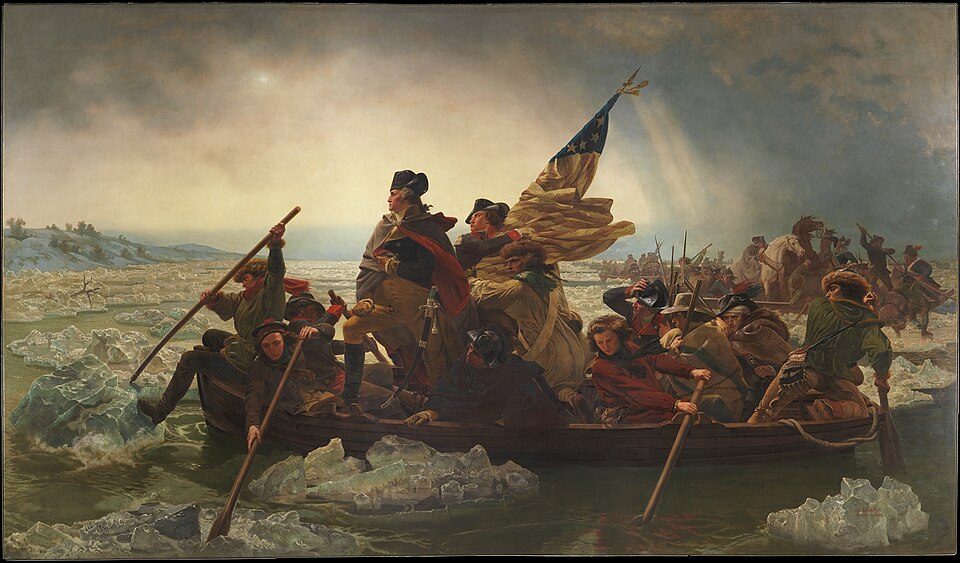
On the night of December 25–26, 1776, General George Washington led the Continental Army across the ice-choked Delaware River, launching a surprise attack that won the Battle of Trenton the next morning. Three-quarters of a century later, that daring crossing would be immortalized not by an American witness, but by a German-American painter working far from the scene, in Düsseldorf, Germany.
Emanuel Leutze had grown up in the United States before returning to Germany as an adult. It was there, amid the Revolutions of 1848, that he conceived Washington Crossing the Delaware. Leutze hoped the image of America's founding struggle would encourage Europe's liberal reformers of his own era. Using American tourists and art students as models and assistants — including Worthington Whittredge and Andreas Achenbach — he completed the first version in 1850.
That original canvas had a troubled life. Shortly after completion it was damaged by a fire in Leutze's studio, then restored and acquired by the Kunsthalle Bremen in Germany. It survived until World War II, when it was destroyed in an Allied bombing raid on September 5, 1942.
Fortunately, Leutze had already begun a second, full-sized replica in 1850. It went on exhibition in New York in October 1851, drawing more than 50,000 viewers. Marshall O. Roberts bought it for $10,000 — an enormous sum, equivalent to roughly $350,000 today. After passing through several owners, it was donated to the Metropolitan Museum of Art by John Stewart Kennedy in 1897, where it remains a centerpiece today. It has traveled only rarely, including a Dallas exhibition in the early 1950s and a stint at a church in Washington Crossing, Pennsylvania, beginning in 1952, near the actual crossing site.
The painting has not been free of incident. In January 2002, a former Metropolitan Museum guard defaced it by gluing on a picture of the September 11 attacks, though no major damage resulted. And for over ninety years, the painting hung in an ordinary frame — until a Mathew Brady photograph from 1864, rediscovered in 2007, revealed its original spectacular eagle-crested frame. Eli Wilner & Company recreated the 12-by-21-foot carved replica, its eagle crest alone 14 feet wide.
More from Art

The Painting With No Foreground
A single robed figure stares out at an empty grey sea — and the emptiness itself became a scandal. When it was unveiled in Berlin in 1810, no one knew quite what to do with it.

The Painter Who Chased the Light
For a few purple minutes each evening, an American exile knelt in an English garden and raced the dying sun to paint two little girls lighting lanterns. It took him two years to finish.

When a President Became a God
Look straight up inside the U.S. Capitol dome and you will find George Washington enthroned among the clouds, surrounded by goddesses — the founding father transformed into myth.

Marble Brought Back to Life
A corpse asleep, a wing barely brushing her skin — and marble somehow learns to breathe. This is the moment Antonio Canova dared to carve.

The World Turned Upside Down
Look closely at a sixteenth-century Flemish village and you'll find a man biting a pillar, another carrying daylight in a basket, and a wife slipping a blue cloak over her husband's shoulders. Every gesture is a joke — if you know the language.

The Girl in the Glass Case
She stood two-thirds life size, dressed in a real tutu and human hair — and the critics who saw her in 1881 recoiled as if she were something obscene.