A Gust of Wind, Caught Forever
On a windy summer day in Argenteuil, a woman and her small son paused on a grassy rise — and Claude Monet turned that fleeting instant into one of the most beloved paintings in the world.
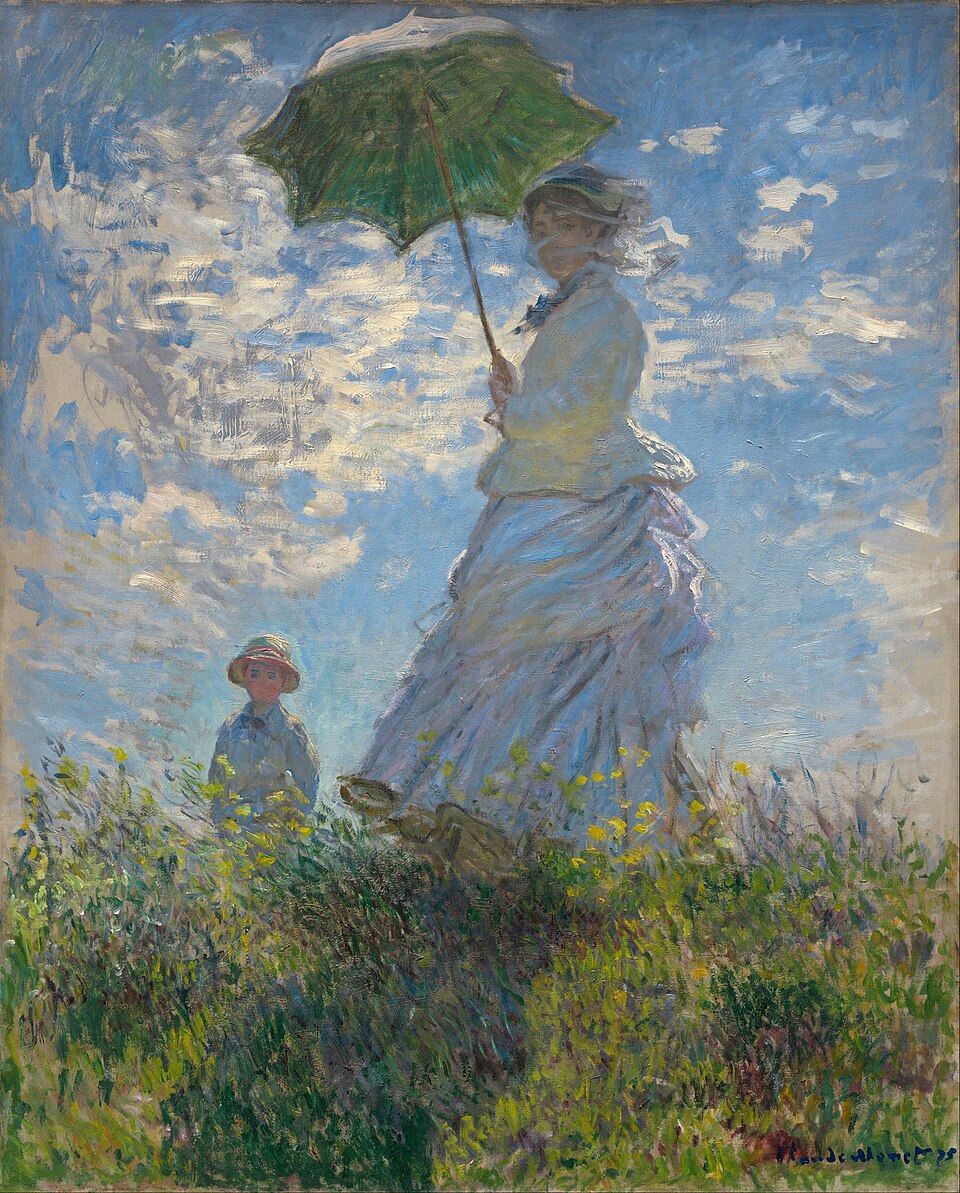
The wind is the first thing you notice. It billows through Camille Monet's white dress, tugs at her veil, and bends the grass of the meadow around her feet, echoed in the green underside of the parasol tilted above her head. This is Woman with a Parasol – Madame Monet and Her Son, painted in 1875 by Claude Monet during the years his family lived in Argenteuil, a town along the Seine where the artist spent much of the 1870s chasing light across water and fields.
The scene is deceptively simple: Camille stands on a small rise, looking down at the viewer from a strong upward angle, framed against fluffy clouds and an azure sky. A short distance away, partly hidden by the slope of the ground, stands their seven-year-old son Jean, visible only from the waist up. The placement creates a sense of depth and distance, as if the viewer is meeting the pair mid-stroll, catching them unposed and unaware.
That impression of spontaneity was intentional. Monet painted the work outdoors, en plein air, likely finishing it in a single sitting of a few hours. His brushwork is loose and quick, built from splashes of colour rather than careful lines, giving the entire canvas an animated, breathing quality. At 100 by 81 centimetres, it was Monet's largest work of the decade, and he signed it plainly in the lower right corner: Claude Monet 75.
Though it is often called The Stroll (La Promenade) because of its subject, that title technically belongs to several other paintings Monet made in the same series. Whatever it's called, this is not a formal portrait — it is a genre scene, a slice of ordinary family life elevated by the accident of wind and weather into something monumental.
The painting made its public debut in April 1876 at the Second Impressionist Exhibition, held at Paul Durand-Ruel's gallery in Paris, one of 18 works by Monet shown there. Among the visitors was a young American painter, John Singer Sargent, who was struck enough by the image that he later created his own homage, Two Girls with Parasols at Fladbury, in 1889.
More from Art

The Painting With No Foreground
A single robed figure stares out at an empty grey sea — and the emptiness itself became a scandal. When it was unveiled in Berlin in 1810, no one knew quite what to do with it.

The Painter Who Chased the Light
For a few purple minutes each evening, an American exile knelt in an English garden and raced the dying sun to paint two little girls lighting lanterns. It took him two years to finish.

When a President Became a God
Look straight up inside the U.S. Capitol dome and you will find George Washington enthroned among the clouds, surrounded by goddesses — the founding father transformed into myth.

Marble Brought Back to Life
A corpse asleep, a wing barely brushing her skin — and marble somehow learns to breathe. This is the moment Antonio Canova dared to carve.

The World Turned Upside Down
Look closely at a sixteenth-century Flemish village and you'll find a man biting a pillar, another carrying daylight in a basket, and a wife slipping a blue cloak over her husband's shoulders. Every gesture is a joke — if you know the language.

The Girl in the Glass Case
She stood two-thirds life size, dressed in a real tutu and human hair — and the critics who saw her in 1881 recoiled as if she were something obscene.