A Night That Refuses to End Beneath a Noon Sky
A streetlamp glows over a house lost in darkness, while directly above, clouds drift through a perfectly ordinary blue afternoon. René Magritte spent decades painting this quiet impossibility.
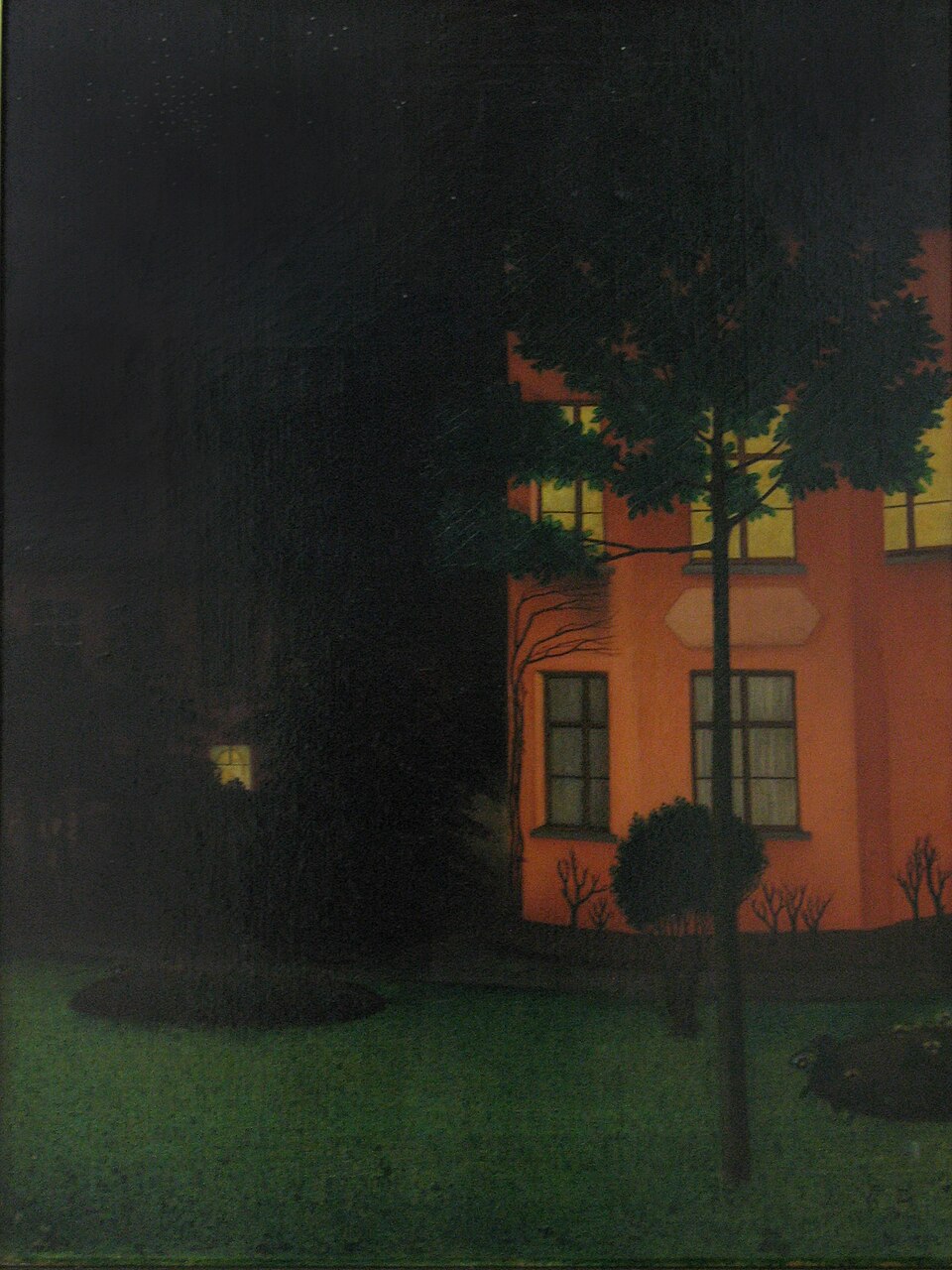
René Magritte called it The Empire of Light — in French, L'Empire des lumières — and the title itself carries an ambiguity he seemed to relish, since it can be read as either singular or plural, an empire of one light or of many. Between the 1940s and the 1960s he returned to the same paradoxical scene again and again: a nocturnal street or house, lit by a lamp, set beneath a daytime sky full of soft clouds. In total he made 27 versions, 17 in oil and 10 in gouache. It was never conceived as a formal series with a plan behind it; the paintings accumulated over years, and to this day they have never all been shown together, and are rarely exhibited even in small groups.
The idea did not appear from nowhere. Some accounts point to John Atkinson Grimshaw, the Victorian painter known for his moody urban sunsets, as an inspiration. More convincingly, historians trace the influence to the Belgian symbolist William Degouve de Nuncques, particularly his painting The Blind House, with its brooding nocturnal atmosphere. The art historian A. M. Hammacher, former director of the Kröller-Müller Museum, noted Magritte's deep interest in the landscapes of the German Romantic painter Caspar David Friedrich. Critics have also drawn comparisons to Max Ernst's frottage work Forest, where a night landscape unexpectedly holds a bright daylight sky, and to Salvador Dalí's gouache Night and Day Clothes and Ernst's later Day and Night.
Magritte had toyed with this same day-night collision earlier than most people realize. A 1939 gouache, now held at the Museum Boijmans Van Beuningen in Rotterdam, shows a twilight horizon lit sharply by a sunset, while the trees and houses in the foreground sit as black silhouettes filled with stars and a crescent moon. A 1973 book on Magritte called this gouache La Bonne Aventure (Good Fortune), but the museum itself lists it as Le poison (The Poison) and credits it as the true first work in the Empire of Light lineage.
The series as the public knows it gained momentum after 1954. Magritte had already painted a few versions by 1953, but a retrospective at the 1954 Venice Biennale included a 1954 version — now in the Peggy Guggenheim Collection — that drew the attention of collectors eager to own one for themselves. To meet the demand, Magritte produced several large, high-quality versions that same year, and he kept returning to the theme, on and off, for the rest of his life.
The motif also found its way into public space. For the Municipal Casino at Knokke-Le Zoute in Belgium, Magritte designed a set of eight easel-sized paintings under the title The Enchanted Domain, weaving together many recurring themes from his career. These were enlarged six times their original size and painted onto the casino's walls as a 360-degree panorama stretching over 236 feet in circumference, completed under his supervision in 1953.
More from Art

The Painting With No Foreground
A single robed figure stares out at an empty grey sea — and the emptiness itself became a scandal. When it was unveiled in Berlin in 1810, no one knew quite what to do with it.

The Painter Who Chased the Light
For a few purple minutes each evening, an American exile knelt in an English garden and raced the dying sun to paint two little girls lighting lanterns. It took him two years to finish.

When a President Became a God
Look straight up inside the U.S. Capitol dome and you will find George Washington enthroned among the clouds, surrounded by goddesses — the founding father transformed into myth.

Marble Brought Back to Life
A corpse asleep, a wing barely brushing her skin — and marble somehow learns to breathe. This is the moment Antonio Canova dared to carve.

The World Turned Upside Down
Look closely at a sixteenth-century Flemish village and you'll find a man biting a pillar, another carrying daylight in a basket, and a wife slipping a blue cloak over her husband's shoulders. Every gesture is a joke — if you know the language.

The Girl in the Glass Case
She stood two-thirds life size, dressed in a real tutu and human hair — and the critics who saw her in 1881 recoiled as if she were something obscene.