A River, an Angel, and Four Seasons of Man
A boat drifts out of a dark cave into golden light — and over four paintings, it carries a single voyager through the whole of a human life.
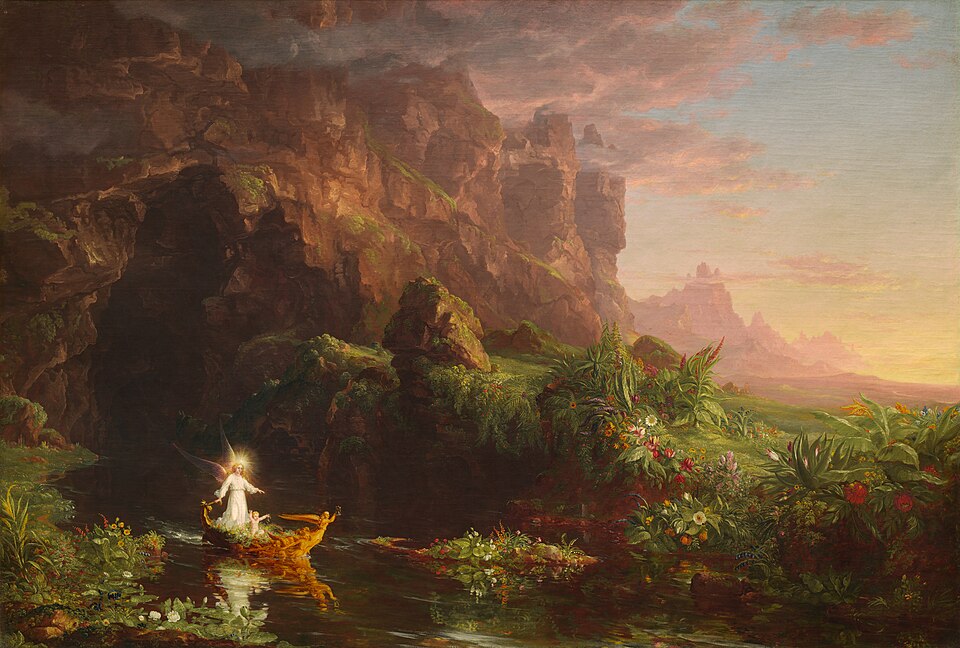
In 1840, the American painter Thomas Cole finished a series unlike anything he had attempted before. Where his earlier masterwork, The Course of Empire, had traced the rise and fall of an entire civilization, this new project turned inward, toward a single soul. He called it The Voyage of Life, and in four canvases — Childhood, Youth, Manhood, and Old Age — he set out to paint the shape of a human existence from birth to death.
The device Cole chose was elegantly simple: a boat, a river, and an angel. In each painting, a voyager rides the River of Life accompanied by a guardian angel, moving through a wilderness landscape that changes with the seasons. The direction of travel reverses from picture to picture, and the surrounding nature — lush spring greenery, wide summer skies, storm-wracked autumn cliffs, bleak winter shores — mirrors the inner state of the traveler at each stage.
In Childhood, an infant glides safely out of a dark, craggy cave, which Cole himself described as emblematic of our earthly origin and the mysterious past. The river is narrow and calm, the landscape warm and sheltering, and the angel guides the boat entirely. A figurehead on the prow holds an hourglass, a quiet reminder that time has already begun its work.
By Youth, the boy has taken the tiller himself. The angel now stands on the shore, waving rather than steering, allowing the young man his independence. Ahead, a shimmering castle hovers in the sky — a beacon of ambition and dreams — and the river seems to lead straight toward it. Only at the picture's far edge can a viewer glimpse what the youth cannot see: the water ahead turning rough, threading toward hidden rocks.
Manhood brings the crisis the earlier paintings foreshadowed. The adult voyager, now alone in a darkened, threatening landscape, has lost control of the boat entirely; the tiller and oars are gone. Cole shows him turning instead to prayer and religious faith as the only anchor against the turbulent waters, with the angel now barely visible, watching from above rather than beside him.
More from Art

The Painting With No Foreground
A single robed figure stares out at an empty grey sea — and the emptiness itself became a scandal. When it was unveiled in Berlin in 1810, no one knew quite what to do with it.

The Painter Who Chased the Light
For a few purple minutes each evening, an American exile knelt in an English garden and raced the dying sun to paint two little girls lighting lanterns. It took him two years to finish.

When a President Became a God
Look straight up inside the U.S. Capitol dome and you will find George Washington enthroned among the clouds, surrounded by goddesses — the founding father transformed into myth.

Marble Brought Back to Life
A corpse asleep, a wing barely brushing her skin — and marble somehow learns to breathe. This is the moment Antonio Canova dared to carve.

The World Turned Upside Down
Look closely at a sixteenth-century Flemish village and you'll find a man biting a pillar, another carrying daylight in a basket, and a wife slipping a blue cloak over her husband's shoulders. Every gesture is a joke — if you know the language.

The Girl in the Glass Case
She stood two-thirds life size, dressed in a real tutu and human hair — and the critics who saw her in 1881 recoiled as if she were something obscene.