A Roomful of Rose Petals
An emperor watches from above as his guests are buried alive in flowers — and a Victorian painter went to absurd lengths to get the petals just right.
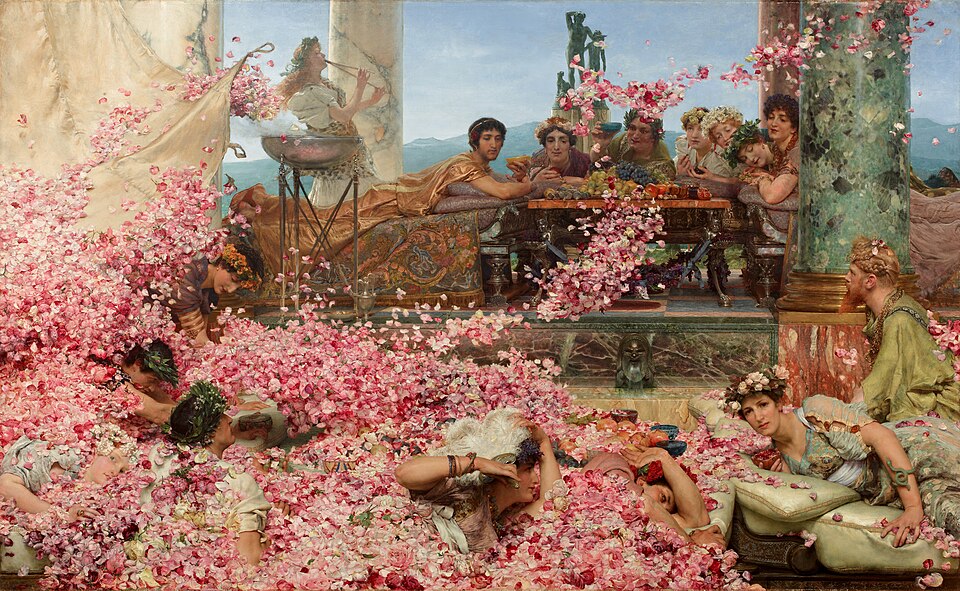
In 1888, the Anglo-Dutch painter Sir Lawrence Alma-Tadema unveiled a canvas depicting one of antiquity's strangest, cruelest rumors: that the teenage Roman emperor Elagabalus once smothered his dinner guests beneath an avalanche of rose petals released from a false ceiling. The painting, titled The Roses of Heliogabalus, measures a sprawling 132.7 by 214.4 centimetres, and it renders the scene with theatrical precision — diners half-buried in pink drifts, unaware of what's happening, while the young emperor reclines on a platform above, dressed in a golden silk robe and tiara, watching with his garlanded companions.
The story itself likely never happened. It comes from the Augustan History, a notoriously unreliable ancient biography, and echoes similar tales told about the emperor Nero and about Trimalchio, the fictional glutton of Petronius's Satyricon, both of whom were said to have had petal-dropping ceilings installed for their feasts. Alma-Tadema, always drawn to the decadence and detail of the ancient world, seized on this apocryphal cruelty and turned it into a lush, unsettling spectacle — a woman playing double pipes beside a marble pillar, wearing a maenad's leopard skin, a bronze statue of Dionysus modeled on the Ludovisi Dionysus standing sentinel over the scene, distant hills visible beyond the columns.
The commission came from Sir John Aird, 1st Baronet, who paid £4,000 for the work in 1888. Getting the roses right became its own obsession. Since the flowers were out of season in Britain, Alma-Tadema reportedly arranged for fresh rose petals to be shipped from the south of France every week for the four months it took him to complete the painting — an extravagant gesture in service of an extravagant subject.
The painting debuted at the Royal Academy's summer exhibition in 1888, and it became one of the defining images of Alma-Tadema's career. After Aird died in 1911, the painting passed to his son, Sir John Richard Aird, 2nd Baronet. When Alma-Tadema himself died in 1912, the painting was shown again at a memorial exhibition at the Royal Academy in 1913 — and then it vanished from public view in Britain for over a century.
What followed was a steep fall from grace. Alma-Tadema's reputation, once considerable, collapsed in the decades after his death, as tastes shifted away from his meticulous Victorian classicism. The 2nd Baronet died in 1934, and the following year his son, the 3rd Baronet, sold the painting for a modest 483 guineas. By 1960, it couldn't even find a buyer at Christie's and was bought back by the auction house itself for a mere 100 guineas.
More from Art

The Painting With No Foreground
A single robed figure stares out at an empty grey sea — and the emptiness itself became a scandal. When it was unveiled in Berlin in 1810, no one knew quite what to do with it.

The Painter Who Chased the Light
For a few purple minutes each evening, an American exile knelt in an English garden and raced the dying sun to paint two little girls lighting lanterns. It took him two years to finish.

When a President Became a God
Look straight up inside the U.S. Capitol dome and you will find George Washington enthroned among the clouds, surrounded by goddesses — the founding father transformed into myth.

Marble Brought Back to Life
A corpse asleep, a wing barely brushing her skin — and marble somehow learns to breathe. This is the moment Antonio Canova dared to carve.

The World Turned Upside Down
Look closely at a sixteenth-century Flemish village and you'll find a man biting a pillar, another carrying daylight in a basket, and a wife slipping a blue cloak over her husband's shoulders. Every gesture is a joke — if you know the language.

The Girl in the Glass Case
She stood two-thirds life size, dressed in a real tutu and human hair — and the critics who saw her in 1881 recoiled as if she were something obscene.