A Town Square Overrun by Children
Look closer at the crowded square and you will not find a single adult in charge — only children, hundreds of them, playing as if the fate of the world depended on it.
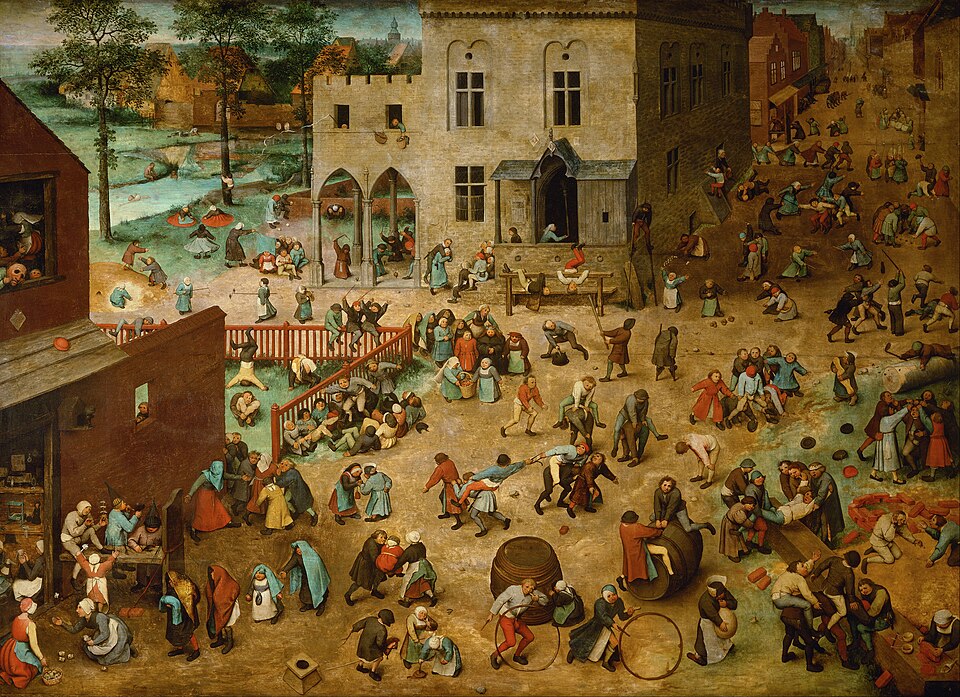
In 1560, the Flemish painter Pieter Bruegel the Elder set down his brush on an oil-on-panel work measuring 118 by 161 centimeters and captured a summer scene unlike anything painted before it. The panel, now known as Children's Games, shows a town square entirely taken over by children — no adults directing them, no one watching from the sidelines. It hangs today in the Kunsthistorisches Museum in Vienna, in the same room as Bruegel's Tower of Babel.
The painting was first mentioned by the writer Karel van Mander in 1604, though it had already been acquired a decade earlier, in 1594, by Archduke Ernest of Austria. Some have proposed that Bruegel intended it as the first in a series representing the Ages of Man, with this canvas standing for Youth. But no other paintings in such a series ever surfaced, and no records mention them, so if that was the plan, it seems to have gone no further than this single work.
What fills the frame is staggering in its density: over 90 different games played by children of the era have been identified within the composition, though a more focused count puts the number of particular games at around eighty. Children roll hoops, walk on stilts, spin tops, ride hobby-horses, stage mock tournaments, play leap-frog and blind man's bluff, do handstands, blow up pigs' bladders, and cradle dolls. Toys made from barrels, barrel hoops, and bones appear throughout, alongside pinwheels and wooden horses. The games can be grouped roughly into three kinds: tests of skill like stilt-walking, rule-based contests like tug-of-war and blind man's bluff, and role-play games like mock weddings and a drunkenness game where children spin in a circle.
The children have also overtaken a large building dominating the square — possibly a town hall or another civic structure — a detail thought to carry a moral weight: that the adults who run civic affairs are, in the eyes of God, no more significant than children absorbed in play. This idea was not new to Bruegel's audience. An anonymous Flemish poem published in Antwerp in 1530 by Jan van Doesborch had already compared mankind to children lost entirely in their foolish games and concerns.
Among the 168 boys and 78 girls Bruegel painted, only two figures read as adults: a woman wearing a bridal veil near the center, and an old woman pouring water over two fighting children in the upper right. Despite the meticulous rendering of contemporary games, the scene resists realism — every child or group is isolated from the others, no one stands apart merely watching, and beyond those two adult figures, no grown-up appears at all.
More from Art

The Painting With No Foreground
A single robed figure stares out at an empty grey sea — and the emptiness itself became a scandal. When it was unveiled in Berlin in 1810, no one knew quite what to do with it.

The Painter Who Chased the Light
For a few purple minutes each evening, an American exile knelt in an English garden and raced the dying sun to paint two little girls lighting lanterns. It took him two years to finish.

When a President Became a God
Look straight up inside the U.S. Capitol dome and you will find George Washington enthroned among the clouds, surrounded by goddesses — the founding father transformed into myth.

Marble Brought Back to Life
A corpse asleep, a wing barely brushing her skin — and marble somehow learns to breathe. This is the moment Antonio Canova dared to carve.

The World Turned Upside Down
Look closely at a sixteenth-century Flemish village and you'll find a man biting a pillar, another carrying daylight in a basket, and a wife slipping a blue cloak over her husband's shoulders. Every gesture is a joke — if you know the language.

The Girl in the Glass Case
She stood two-thirds life size, dressed in a real tutu and human hair — and the critics who saw her in 1881 recoiled as if she were something obscene.