American Gothic: The True Story Behind the Farmer and His Pitchfork
A dentist, a spinster sister, and a flimsy white house in Iowa became the most parodied painting in America. None of them knew it at the time.
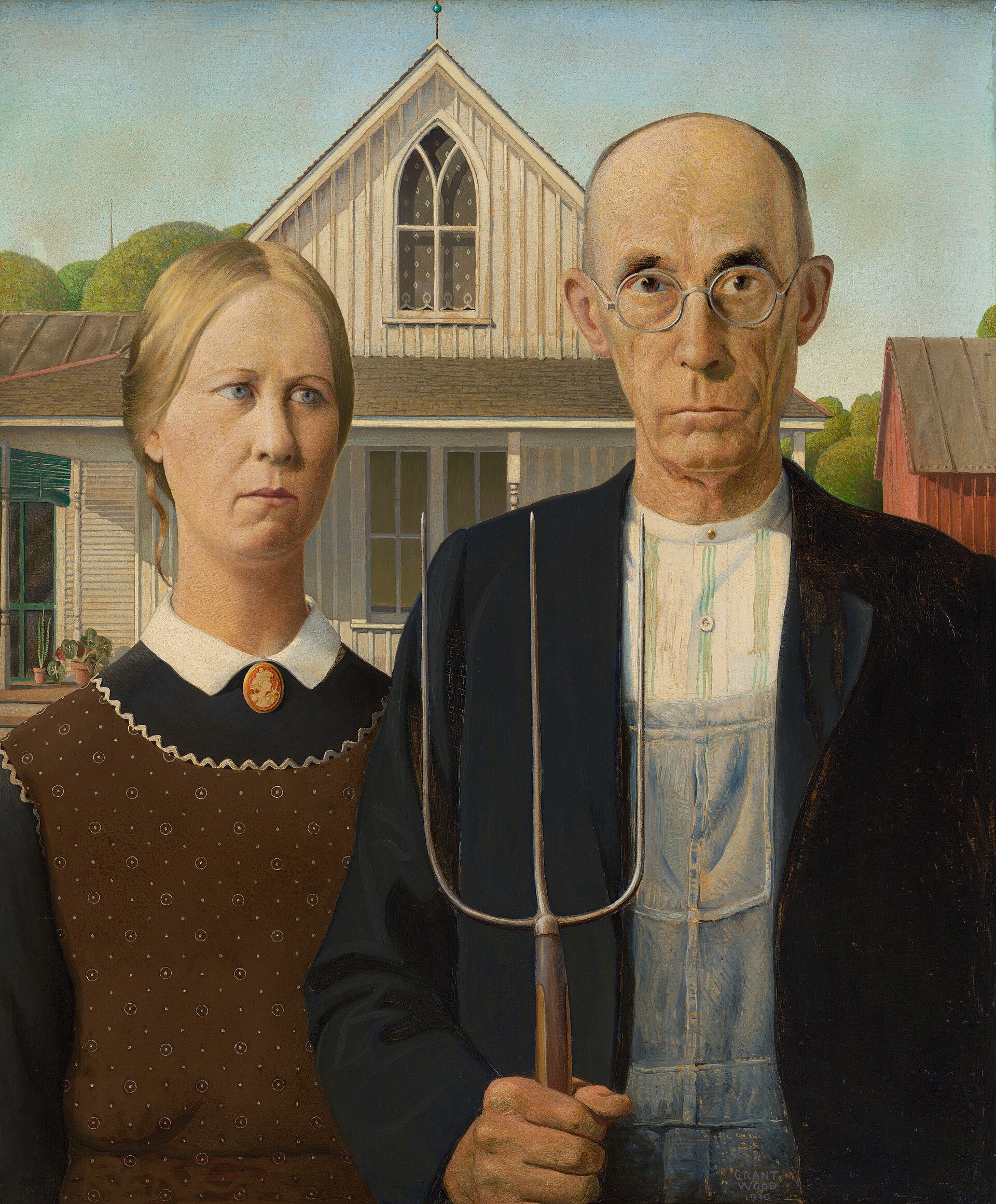
In August 1930, the painter Grant Wood was being driven around the small town of Eldon, Iowa, by a young local artist named John Sharp. Wood, who had trained in Europe, was hunting for inspiration in the unlikely landscape of rural Iowa. As they drove, he spotted a small white house known as the Dibble House, built in the Carpenter Gothic style — a modest, boxy farmhouse dressed up with a single ornate Gothic window, an architectural gesture Wood found almost absurd. He later described such houses as 'cardboardy frame houses on Iowa farms,' but this one, he decided, was 'very paintable.'
According to a story later recounted by Sharp's brother, Wood sketched the house that very day on the back of an envelope. After securing permission from the family who owned it, Selma Jones-Johnston and her family, he returned the next day and made an oil sketch on paperboard from the front yard. That first sketch already exaggerated the house's features — a steeper roof, a longer window, a more pronounced pointed arch — details that would carry through to the finished painting.
Wood's real ambition was not just to paint a building, but to paint, in his own words, 'the kind of people I fancied should live in that house.' For the woman, he turned to his sister Nan Wood Graham (1899–1990) and asked her to make her own apron for the sitting, complete with rickrack trim to evoke a colonial-print, rural American look. Rickrack was no longer sold in stores, so Nan cut trim from their mother Hattie's old dresses to finish the costume herself. For the man, Wood chose an unlikely model: Dr. Byron McKeeby (1867–1950), the Wood family's dentist in Cedar Rapids.
The finished composition placed the two figures shoulder to shoulder in front of the Gothic window, the man gripping an upright three-pronged pitchfork whose shape Wood echoed deliberately in the stitching of the man's overalls, in the window's pointed arch, and in the very structure of his face. Curiously, Wood never returned to Eldon after that initial visit — he painted the figures back in his studio in Cedar Rapids and simply requested a photograph of the house to finish the background. On the porch, he included mother-in-law's tongue and beefsteak begonia, the same plants that appeared in his 1929 portrait of his own mother, Woman with Plants.
When newspapers reproduced the image, it often ran under captions like 'An Iowa Farmer and His Wife.' Nan objected to being cast as an old man's spouse and insisted her brother had intended the pair as father and daughter, not husband and wife. Wood remained vague on the point for years until 1941, when he wrote to a Mrs. Nellie Sudduth confirming that 'the prim lady with him is his grown-up daughter.'
More from Art

The Painting With No Foreground
A single robed figure stares out at an empty grey sea — and the emptiness itself became a scandal. When it was unveiled in Berlin in 1810, no one knew quite what to do with it.

The Painter Who Chased the Light
For a few purple minutes each evening, an American exile knelt in an English garden and raced the dying sun to paint two little girls lighting lanterns. It took him two years to finish.

When a President Became a God
Look straight up inside the U.S. Capitol dome and you will find George Washington enthroned among the clouds, surrounded by goddesses — the founding father transformed into myth.

Marble Brought Back to Life
A corpse asleep, a wing barely brushing her skin — and marble somehow learns to breathe. This is the moment Antonio Canova dared to carve.

The World Turned Upside Down
Look closely at a sixteenth-century Flemish village and you'll find a man biting a pillar, another carrying daylight in a basket, and a wife slipping a blue cloak over her husband's shoulders. Every gesture is a joke — if you know the language.

The Girl in the Glass Case
She stood two-thirds life size, dressed in a real tutu and human hair — and the critics who saw her in 1881 recoiled as if she were something obscene.