An Army of Skeletons Marches Across the Earth
No one is spared — not the king, not the cardinal, not the lovers still lost in each other's arms. In this blackened world, an army of the dead has already won.
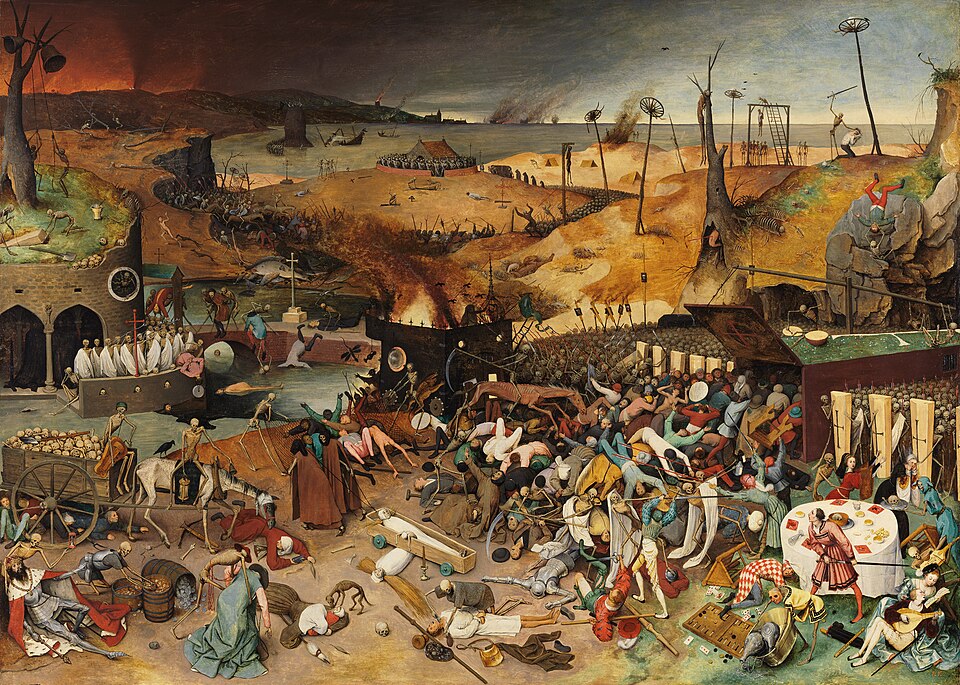
Around 1562, Pieter Bruegel the Elder set his brush to an oak panel and painted the end of everything. The result, The Triumph of Death, now hangs in Madrid's Museo del Prado, where it has resided since 1827 — a scorched panorama in which legions of skeletons overrun a dying world.
The landscape itself is already dead. Fires smolder on the horizon, ships lie wrecked in a poisoned sea, and fish rot along the shore of a corpse-choked pond. James Snyder, the art historian, described it as scorched, barren earth, devoid of any life as far as the eye can see. Bare trees are the only things still standing.
Into this wasteland, Bruegel unleashes his army. Skeletons haul a wagon piled with skulls. Others ring a bell tolling the death knell of the world. The living are herded toward a coffin-shaped trap decorated with crosses, while mounted skeletons — echoes of the Four Horsemen of the Apocalypse — cut them down with scythes. No rank is spared: peasants, soldiers, nobles, a king, even a cardinal, all driven toward the same fate.
Bruegel's eye for grim comedy never lets up. A skeleton plays a hurdy-gurdy while its cart wheels crush a man beneath them, his life apparently worth nothing. A woman falls in the cart's path, a thread in one hand and scissors in the other — Bruegel's version of Atropos, the fate who cuts the thread of life. Nearby, another woman holds a spindle and distaff, classical emblems of life's fragility, evoking Clotho and Lachesis.
Other vignettes sting just as sharply. A starving dog gnaws at a dead child cradled in its dead mother's arms. A cardinal is escorted to his doom by a skeleton mockingly wearing his red hat. A dying king, oblivious to a skeleton brandishing an empty hourglass, still reaches for his looted barrels of gold — miserly and unrepentant to the last. A pilgrim wakes only to have his throat slit for his purse, while skeleton-fishermen haul in human catches with a net overhead.
More from Art

The Painting With No Foreground
A single robed figure stares out at an empty grey sea — and the emptiness itself became a scandal. When it was unveiled in Berlin in 1810, no one knew quite what to do with it.

The Painter Who Chased the Light
For a few purple minutes each evening, an American exile knelt in an English garden and raced the dying sun to paint two little girls lighting lanterns. It took him two years to finish.

When a President Became a God
Look straight up inside the U.S. Capitol dome and you will find George Washington enthroned among the clouds, surrounded by goddesses — the founding father transformed into myth.

Marble Brought Back to Life
A corpse asleep, a wing barely brushing her skin — and marble somehow learns to breathe. This is the moment Antonio Canova dared to carve.

The World Turned Upside Down
Look closely at a sixteenth-century Flemish village and you'll find a man biting a pillar, another carrying daylight in a basket, and a wife slipping a blue cloak over her husband's shoulders. Every gesture is a joke — if you know the language.

The Girl in the Glass Case
She stood two-thirds life size, dressed in a real tutu and human hair — and the critics who saw her in 1881 recoiled as if she were something obscene.