An Old Man's Last Fantasy: Ingres and the Circle of Bathers
An 82-year-old painter, who had never traveled beyond Europe, signed his age onto a canvas of naked women he claimed still made his blood burn like a man of thirty. What he left behind became one of the most argued-over paintings in the Louvre.
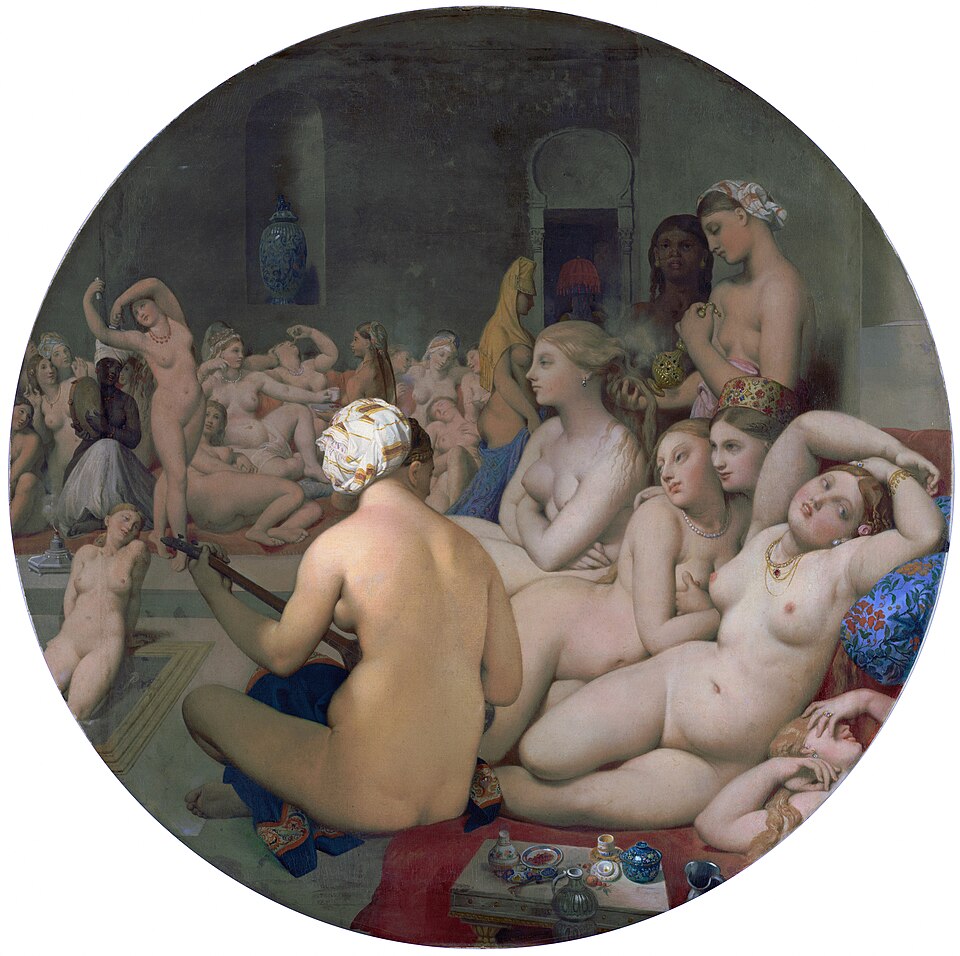
In 1862, Jean-Auguste-Dominique Ingres put his final brush to a painting he had been shaping since at least 1852. He was around eighty-two years old, and rather than hide his age he inscribed it directly onto the work: AETATIS LXXXII — at age 82. He wanted the irony noticed. Years later, in 1867, he told acquaintances he still carried 'all the fire of a man of thirty years.' The painting he made at that advanced age was Le Bain turc, The Turkish Bath — a dense, circular composition of nude women crowded around a pool inside an imagined harem.
Ingres had not started from nothing. He reused figures he had drawn or painted decades earlier as single nudes — bathers and odalisques lifted from his own back catalogue and rearranged into a crowd. The central figure, playing a long-necked instrument likely a saz or bağlama, is almost identical to the woman in his 1808 Valpinçon Bather. A woman in the background holding a cup resembles his sitter from the 1856 portrait of Madame Moitessier. Another, arms raised above her head, echoes an 1818 sketch of his own wife, Delphine Ramel, though her pose is subtly altered. Other bodies, tucked into shadowed corners of the canvas, were borrowed from engravings in a seventeenth-century book called Histoire générale des Turcs.
Originally the canvas was rectangular. But at some point Ingres converted it into a tondo — a circular format — which pulled the composition tighter and gave the viewer the sensation of peering through a keyhole or an oculus at something private. A photograph taken by Charles Marville survives showing the painting in its earlier rectangular state, before this transformation.
The painting's atmosphere depends on pale, almost bloodless skin tones — whites shading into pink, ivory, grey and brown — paired with motifs meant to signal the Orient: vases, running water, fruit, jewels, the implied haze of perfume. Yet Ingres himself never traveled beyond Europe, unlike his contemporary Eugène Delacroix, who had actually visited an Algerian harem. The women in Ingres's bath look more Caucasian and European than Middle Eastern or North African. For him, the setting was less an ethnographic study than a pretext — a socially acceptable wrapper for painting the female nude in a passive, sexual arrangement.
His fascination with this fantasy had deep roots. On his way to Italy in 1806, Ingres copied into his notebooks a florid passage describing the baths of a sultan's seraglio, where women attended a sultana's bathing body. In 1825 he transcribed a passage from Lady Mary Wortley Montagu's Letters from the Orient, describing the women's bath at Adrianople in 1716 — two hundred naked women, some talking, some drinking coffee or sorbet, young slave girls braiding hair into elaborate shapes. Montagu's letters had been reprinted eight times in France between 1763 and 1857, feeding a broader European appetite for imagined Eastern interiors. Critics have since noted that Ingres's finished bath bears little real resemblance to the public scene Montagu described.
More from Art

The Painting With No Foreground
A single robed figure stares out at an empty grey sea — and the emptiness itself became a scandal. When it was unveiled in Berlin in 1810, no one knew quite what to do with it.

The Painter Who Chased the Light
For a few purple minutes each evening, an American exile knelt in an English garden and raced the dying sun to paint two little girls lighting lanterns. It took him two years to finish.

When a President Became a God
Look straight up inside the U.S. Capitol dome and you will find George Washington enthroned among the clouds, surrounded by goddesses — the founding father transformed into myth.

Marble Brought Back to Life
A corpse asleep, a wing barely brushing her skin — and marble somehow learns to breathe. This is the moment Antonio Canova dared to carve.

The World Turned Upside Down
Look closely at a sixteenth-century Flemish village and you'll find a man biting a pillar, another carrying daylight in a basket, and a wife slipping a blue cloak over her husband's shoulders. Every gesture is a joke — if you know the language.

The Girl in the Glass Case
She stood two-thirds life size, dressed in a real tutu and human hair — and the critics who saw her in 1881 recoiled as if she were something obscene.