At Eternity's Gate: Van Gogh's Last Prayer in Paint
An old man buries his face in his fists by a dying fire — Van Gogh painted him twice, eight years apart, the second time just months before his own death.
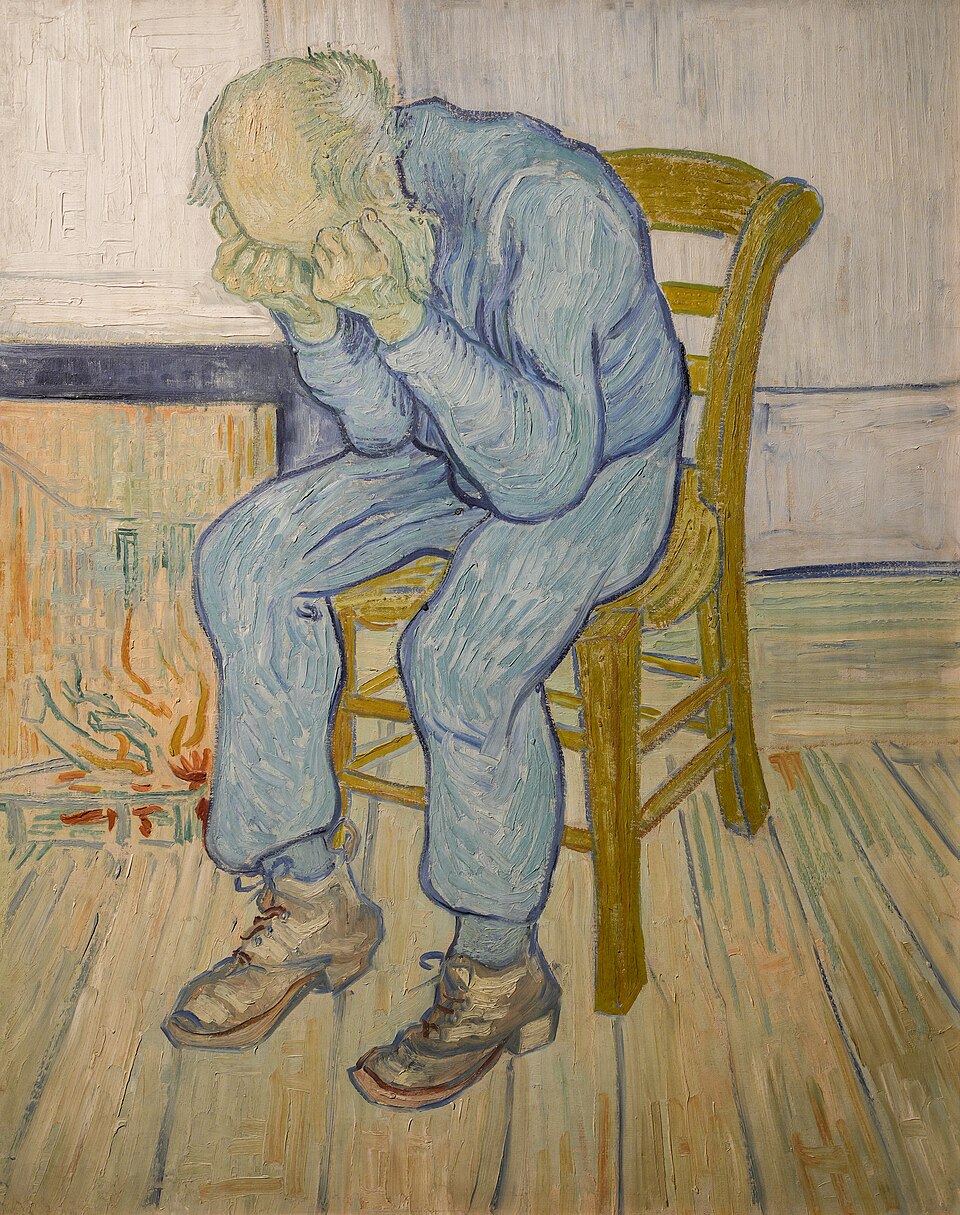
In May 1890, inside the walls of the asylum at Saint-Rémy-de-Provence, Vincent van Gogh picked up a brush he had barely been able to hold for nine weeks. He was recovering from what his fellow patients and doctors would have recognized as the longest, saddest collapse of his adult life — a stretch so severe that in March he could only write to his brother Theo that he was totalement abruti, totally stupefied, unable even to form a letter. Now, convalescing, he turned back to an image that had haunted him since he was twenty-nine years old.
The painting he made was Sorrowing Old Man, better known by the title he himself gave it: At Eternity's Gate. It shows a bent old man seated by a hearth, elbows on knees, face crushed into his fists, fingers clenched. There is no scenery, no distraction — just an old body folded in on itself beside a small fire.
The image had its roots in The Hague in 1882, where Van Gogh made a series of studies of Adrianus Jacobus Zuyderland, a pensioner and war veteran living in a local almshouse. Van Gogh had been struck, he wrote, by 'what a fine sight an old working man makes, in his patched bombazine suit with his bald head,' and he drew Zuyderland with his head in his hands, a pose he had first tried years earlier with a man named Schuitemaker. The composition itself echoed something he had seen in England in 1875: Hubert von Herkomer's print Sunday at the Chelsea Hospital, showing a war veteran slumped in death, which later became the celebrated painting The Last Muster.
Just two days after the drawing, Van Gogh attempted a lithograph of the same figure, and this time he wrote something extraordinary about what he was trying to do. He believed a painter had a duty to put an idea into his work, and here the idea was almost theological: that the unbearably moving expression of an old man sitting quietly by his hearth — a man who may not even be aware of his own dignity — was evidence of 'something on high,' of a God and an eternity that Millet himself had believed in. He insisted this had nothing to do with formal theology. It was simply that even the poorest woodcutter, farmer, or miner could feel, in certain moments, an intimation of an eternal home he was close to.
Van Gogh returned to this same emotional register in other drawings of Zuyderland from that period, showing him reading a Bible and saying grace, explaining that his intention across all these images was to capture 'the special mood of Christmas and New Year' — a sincere religious feeling he said he could share in himself, even without knowing exactly what or who awaited beyond.
More from Art

The Painting With No Foreground
A single robed figure stares out at an empty grey sea — and the emptiness itself became a scandal. When it was unveiled in Berlin in 1810, no one knew quite what to do with it.

The Painter Who Chased the Light
For a few purple minutes each evening, an American exile knelt in an English garden and raced the dying sun to paint two little girls lighting lanterns. It took him two years to finish.

When a President Became a God
Look straight up inside the U.S. Capitol dome and you will find George Washington enthroned among the clouds, surrounded by goddesses — the founding father transformed into myth.

Marble Brought Back to Life
A corpse asleep, a wing barely brushing her skin — and marble somehow learns to breathe. This is the moment Antonio Canova dared to carve.

The World Turned Upside Down
Look closely at a sixteenth-century Flemish village and you'll find a man biting a pillar, another carrying daylight in a basket, and a wife slipping a blue cloak over her husband's shoulders. Every gesture is a joke — if you know the language.

The Girl in the Glass Case
She stood two-thirds life size, dressed in a real tutu and human hair — and the critics who saw her in 1881 recoiled as if she were something obscene.