Baba Yaga: The Witch of the Chicken-Legged Hut
Deep in the thrice-ninth kingdom stands a hut that turns on chicken legs — and inside waits a woman with iron teeth who can smell your blood from a mile away.
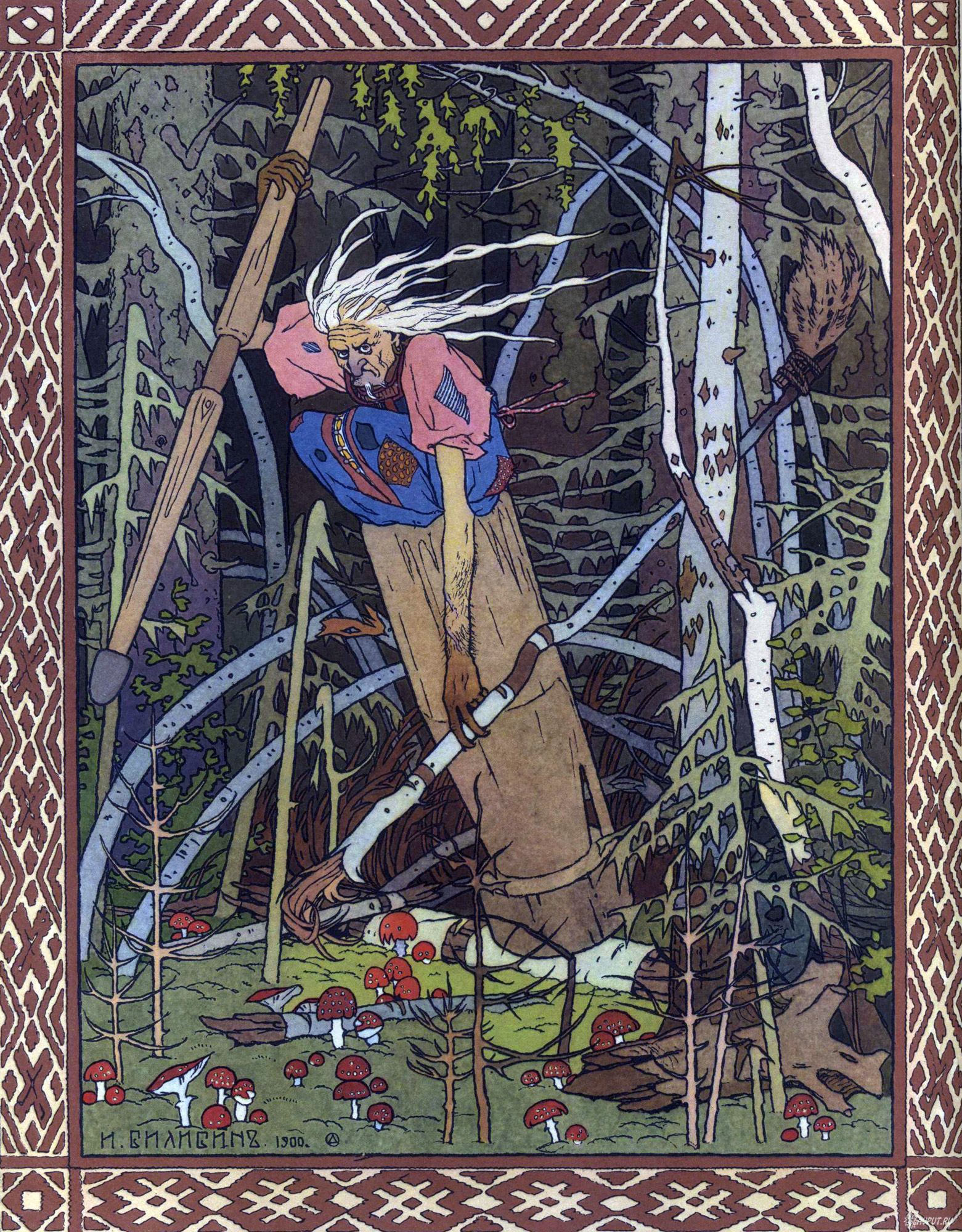
Long before anyone wrote her down, villagers across the Slavic world were already whispering about her: an old woman who lived alone in the deep forest, in a hut that stood on legs like a chicken's and spun to face whoever approached. The first clear written mention of her, as 'Iaga baba', appears only in 1755, in Mikhail Lomonosov's Russian Grammar — a strange place for a witch to make her official debut, tucked into a list of Slavic gods and beings, given no equivalent among the Roman deities beside her. Even in that first record, she stood apart, unclassifiable.
Her name itself resists easy explanation. 'Baba' is simple enough — it means 'grandmother' or 'old woman' in Serbian, Croatian, Macedonian, Romanian, and Bulgarian, though in modern Polish and Russian it can also be a slighting term for a foolish or dirty woman. 'Yaga' is murkier. Nineteenth-century scholar Alexander Afanasyev linked it to the Sanskrit word for serpent. Others point to a web of related words across Slavic and Indo-European languages — Serbian jeza ('shudder'), Old Czech jězě ('witch'), Polish jędza ('fury'), Old English inca ('pain'), Old Norse ekki ('worry') — all circling around dread, sickness, and menace.
Folklorist Vladimir Propp noted that no single, coherent portrait of Baba Yaga exists across the tales; she shifts shape depending on who is telling the story. In some she is monstrous, roasting and devouring children who wander too close. In others, she is gruff but ultimately helpful, testing heroes with impossible chores before rewarding them with fire, a magic horse, or crucial advice. Both versions agree she is a witch, and both dress her in the same eerie trappings.
She is known by grim epithets — 'Baba Yaga bony-leg', or 'Baba Yaga with iron teeth.' Inside her hut, she is said to lie stretched across the stove, her nose sometimes jammed into the ceiling. She can smell a stranger's presence, famously declaring that she catches the 'Russian scent' the moment an outsider crosses her threshold. She travels not on a broomstick alone but flying through the air inside a large mortar, pestle in hand, sweeping away the traces of her passage with a broom.
Sometimes she does not exist alone but as a trio of identical sisters, each bearing the same name. In one tale collected by Afanasyev, a young man named Ivan seeks the way to the 'thrice tenth kingdom' and is passed from one Baba Yaga to the next, each living in an identical chicken-legged hut standing in an open field. The first two send him onward; the third, youngest and hungriest, tries to eat him. Only by blowing three magic horns — summoning a flock of birds, including the firebird — does Ivan escape, leaving the witch behind clutching a fistful of feathers.
More from Mythology

The Doctor Who Sang a Nation Into Being
A country doctor rode into the forests of Karelia armed with nothing but a notebook — and rode out with the soul of a nation.

The Boat That Carried the Sun
Every sunset, the ancient Egyptians believed, the sun climbed into a boat and sailed straight into the realm of the dead — only to fight a monstrous serpent before dawn could return.

The Wild Man of the Snows
At 21,000 feet, a colonel found tracks in the snow that he blamed on a wolf — but his guides knew better, and gave the world a name that would echo for a century.

The Knight Who Went Mad for Love: Orlando Furioso
A hero so devoted to duty he was Charlemagne's greatest paladin loses his mind—not to a sword wound, but to heartbreak. To cure him, a friend must ride a flying horse to the Moon.

The Book That Turned the World Into Myth
A poet condemned to exile spent his final years in Rome finishing a poem that would outlive empires—a poem about nothing standing still, not gods, not lovers, not even the shape of a man.

Paradise Lost: Milton's Rebel Angel
A blind poet, dictating verses in the dark, dared to explain the ways of God to men — and in doing so, made Hell's ruler unforgettable.