Because It's There: The Vanishing of George Mallory
Somewhere above 26,000 feet, two climbers walked into the clouds and never came down. Seventy-five years later, one of them was found frozen where he fell, hundreds of vertical metres below the summit.
George Herbert Leigh Mallory was born on 18 June 1886 at Newton Hall in Mobberley, Cheshire, the son of a rector. Even as a child he was drawn upward: at age seven he climbed the roof of his father's church, and his sister Avie later recalled that he climbed everything it was at all possible to climb, from drainpipes to the stone walls dividing farmers' fields.
His formal path to the mountains began at Winchester College, where he arrived in 1900 as a mathematics scholar and excelled equally in academics and athletics, becoming the school's best gymnast. In 1904, R. L. G. Irving, a Winchester master and Alpine Club member searching for new climbing companions, recruited Mallory for a trip to the Alps. That August, Mallory experienced high-altitude mountaineering for the first time, and a lifelong obsession took root.
Mallory went on to Magdalene College, Cambridge, entering in 1905 to study history. There he formed close, lasting friendships with a circle of future intellectuals and artists, including poet Rupert Brooke, painter Duncan Grant, psychoanalyst James Strachey, and economist John Maynard Keynes among the Bloomsbury Group's orbit. He also became an accomplished rower, serving as captain of boats at Magdalene.
After Cambridge, Mallory taught at Charterhouse School while continuing to climb in the Alps and England's Lake District, pioneering new routes and earning respect within Britain's small but serious climbing community. The First World War interrupted his climbing years, but he returned to the mountains with renewed vigour once the war ended.
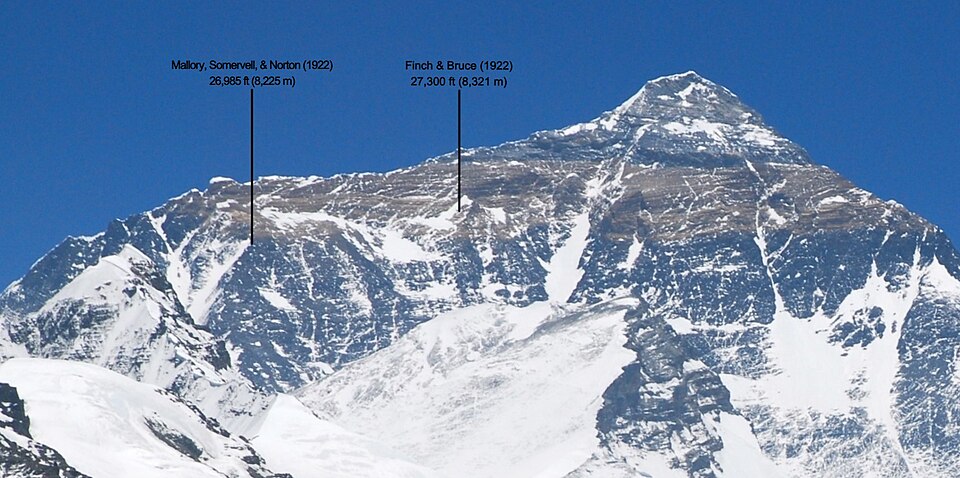
It was Everest that would define him. In 1921, Mallory joined the first British reconnaissance expedition to the mountain, which established the North Col–North Ridge as a viable route toward the summit. The following year, 1922, he returned for a full attempt at the first ascent; his team set a world altitude record of 27,300 feet using supplemental oxygen, an achievement later honoured with Olympic gold medals for alpinism.
More from Explorations

Humboldt: The Man Who Measured the World
A Prussian noble's son, once mocked as a sickly child, would climb a volcano to a world-record height and rewrite how humanity understood nature itself.

The Man Who Named Canada
A Breton mariner planted a wooden cross on a foreign shore and claimed a kingdom he did not understand — then spent a winter frozen into its river, praying a stranger's remedy would save his men.

Sixty Ships Into the Unknown: Hanno's Voyage Down the African Coast
A Carthaginian fleet of sixty ships and thousands of settlers vanished past the Pillars of Hercules to found cities on an unmapped coast — and came home with the skins of hairy, hostile 'gorillas' as proof of how far they had gone.

HMS Challenger: The Voyage That Charted the Deep
A stripped-down warship, its guns torn out to make room for microscopes, set sail from Portsmouth to answer a question no one had ever properly asked: what lies at the bottom of the sea?

Scott's Last Expedition: The Letters Written at the End of the World
Five men reached the bottom of the world only to find a Norwegian flag already planted there. What followed was not glory, but a slow, frozen unraveling that the world would remember for a century.

Marco Polo: In the Court of Kublai Khan
A fifteen-year-old boy meets the father he barely knew — and is soon swept toward the richest court on Earth. Twenty-four years later, he returns home with tales so vast that Venice simply calls him 'Mister Millions'.