Bedroom in Arles: Van Gogh's Sanctuary
A sickbed, a painted room with the shutters closed, and a friendship on the verge of collapse — Van Gogh turned an ordinary bedroom into one of art's most quietly radical statements.
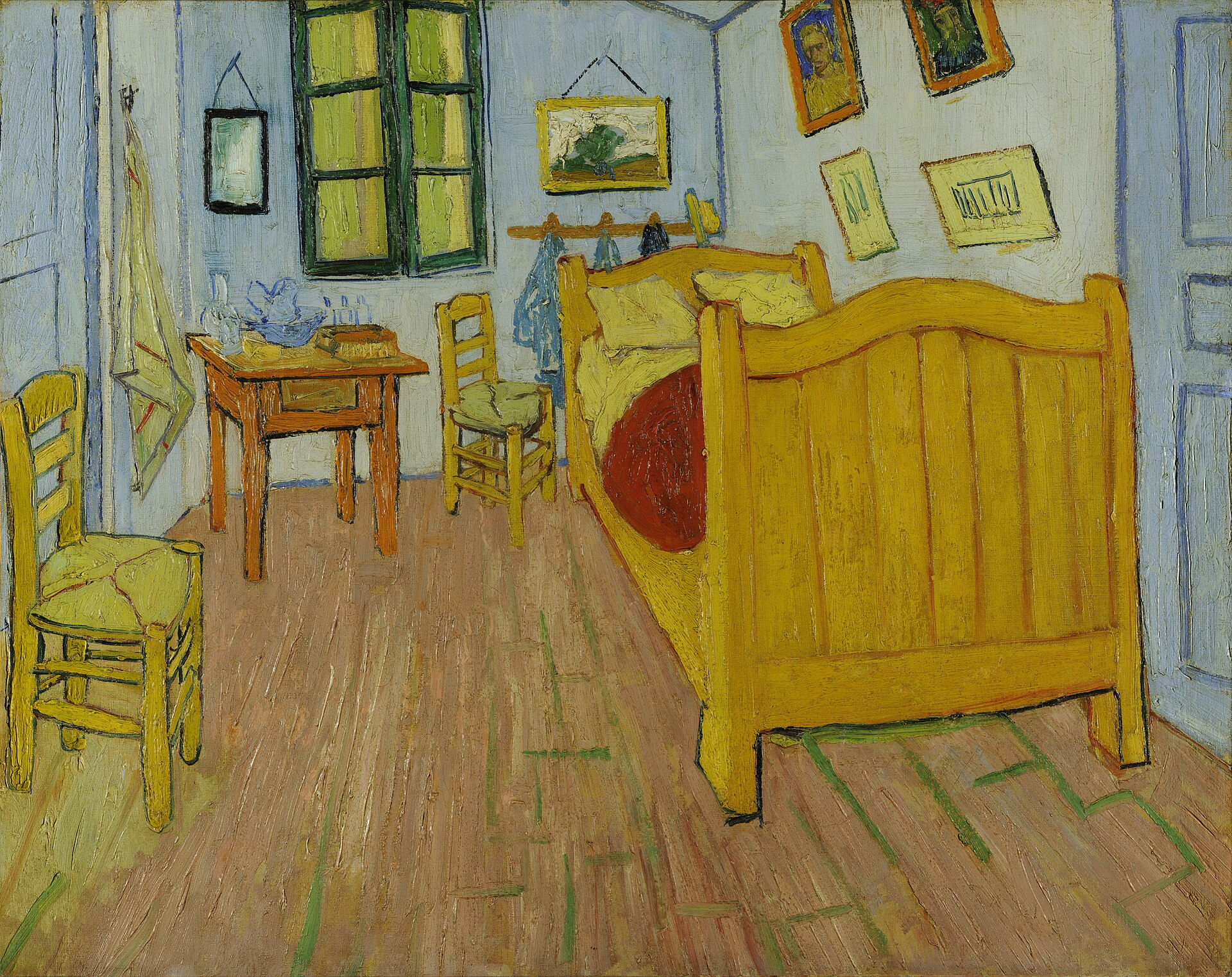
In mid-October 1888, confined to his bed after days of illness in the Yellow House at 2, Place Lamartine in Arles, Vincent van Gogh picked up his brushes and painted the room around him. He called it simply The Bedroom. To his brother Theo he explained that this time the subject was nothing more than his own sleeping quarters — but the color, he insisted, would do all the work.
He described the scheme in careful detail: pale violet walls, a red-tiled floor, a bedstead and chairs in fresh butter yellow, sheets and pillows of bright lemon green, a scarlet blanket, a green window, an orange dressing table with a blue basin, and lilac doors. Nothing else disturbed the room, its shutters drawn against the world. He wanted the solidity of the furniture to express unshakeable repose, the flat, shadowless color to recall Japanese prints, and the whole composition to rest the mind that looked at it — a deliberate answer, he said, to the enforced rest illness had forced upon him.
The room itself was an odd, trapezoid space, its walls meeting at an obtuse angle on the left and an acute one on the right, which gave the painting its strange, tilting perspective. The door on the right led to the staircase and upper floor; the door on the left opened onto the guest room Van Gogh was keeping ready for Paul Gauguin, whom he hoped to welcome as a collaborator. On the wall hung small portraits of his friends Eugène Boch, whom he called The Poet, and Paul-Eugène Milliet, The Lover — miniature echoes of paintings he had made only shortly before.
Gauguin did eventually come to Arles, and the two painters lived and worked together for close to two months. But the arrangement ended in crisis: after a quarrel, Van Gogh injured himself and was later admitted to the hospital in Arles, and eventually to the asylum at Saint-Rémy. It was during his time as a patient that he learned the original canvas had been damaged by a flood of the Rhône. Theo proposed having it relined and returned so that Vincent could copy it.
That copy — a répétition, in Van Gogh's own word, made at the same scale — was painted in September 1889 and sent to Theo along with the original. This second version differs subtly from the first in the color and texture of the floor and wall, and in some of the objects on the small table. It has belonged to the Art Institute of Chicago since 1926, part of the Helen Birch Bartlett Memorial Collection.
More from Art

The Painting With No Foreground
A single robed figure stares out at an empty grey sea — and the emptiness itself became a scandal. When it was unveiled in Berlin in 1810, no one knew quite what to do with it.

The Painter Who Chased the Light
For a few purple minutes each evening, an American exile knelt in an English garden and raced the dying sun to paint two little girls lighting lanterns. It took him two years to finish.

When a President Became a God
Look straight up inside the U.S. Capitol dome and you will find George Washington enthroned among the clouds, surrounded by goddesses — the founding father transformed into myth.

Marble Brought Back to Life
A corpse asleep, a wing barely brushing her skin — and marble somehow learns to breathe. This is the moment Antonio Canova dared to carve.

The World Turned Upside Down
Look closely at a sixteenth-century Flemish village and you'll find a man biting a pillar, another carrying daylight in a basket, and a wife slipping a blue cloak over her husband's shoulders. Every gesture is a joke — if you know the language.

The Girl in the Glass Case
She stood two-thirds life size, dressed in a real tutu and human hair — and the critics who saw her in 1881 recoiled as if she were something obscene.