Blood on White Sheets: Artemisia's Judith
Two women pin down a struggling man in the dark, and one drives a sword through his throat. This is not myth softened for polite viewing — this is Artemisia Gentileschi's Florence.
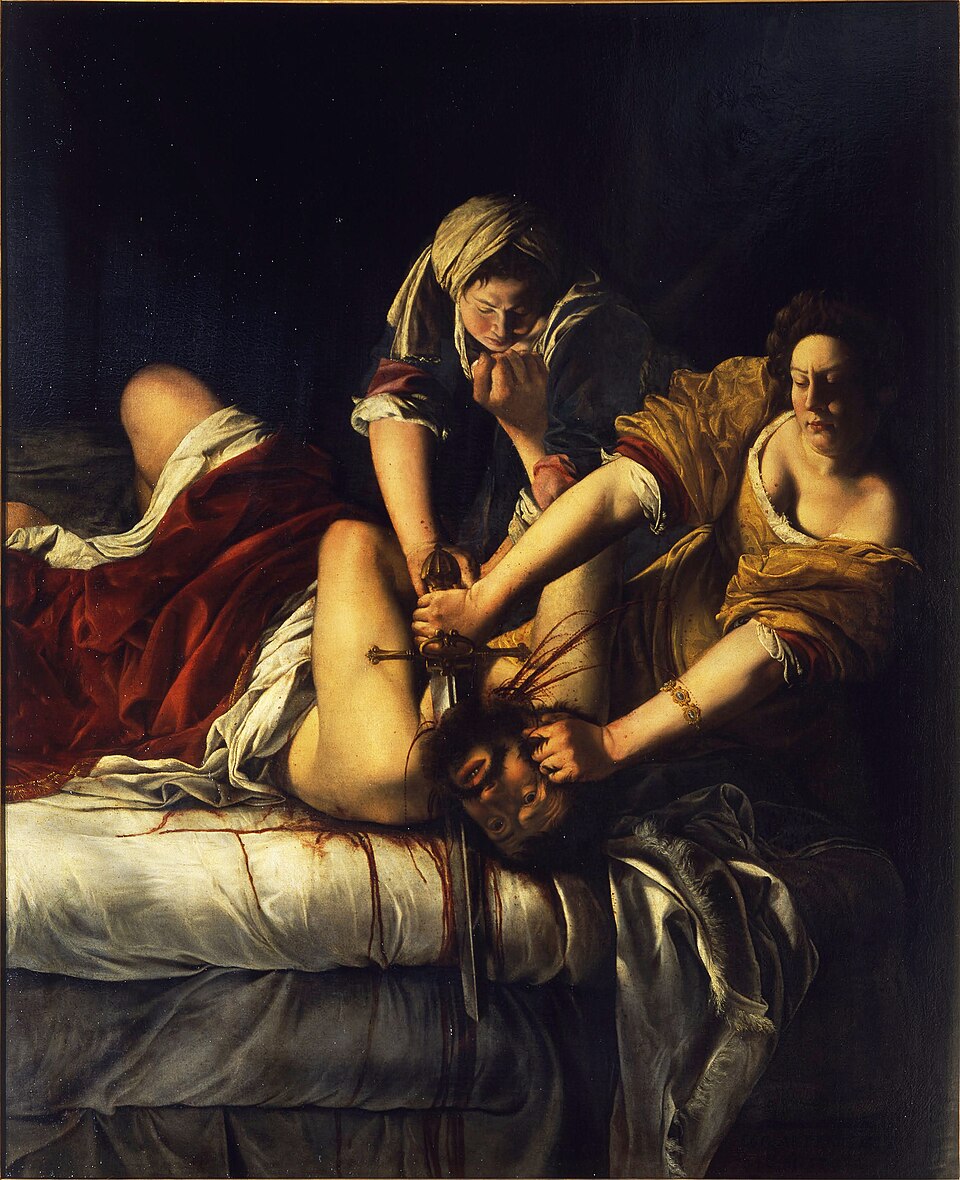
The painting opens on labor, not triumph. Judith and her handmaiden Abra bear down on Holofernes with sleeves rolled up, as though beheading a general were no different from an unavoidable domestic chore. Blood arcs from his severed carotid across the canvas in a violent spray, and the white sheets of his deathbed are stained a deep, spreading red. There is no glory here, only exertion and grim resolve.
The scene comes from the deuterocanonical Book of Judith. Bethulia lay under Assyrian siege, its people on the edge of surrender, when the widow Judith resolved to act. She adorned herself to seduce the enemy general Holofernes, entered his camp with Abra, and was soon invited to a private banquet. Holofernes drank himself into a stupor, believing he had won her. Instead, as he lay senseless, Judith took his own sword and beheaded him in two blows, then fled with Abra back to Bethulia carrying his head in a sack — and with it, the collapse of the Assyrian siege.
Gentileschi painted this version around 1620; it is now at the Uffizi Gallery in Florence. It followed an earlier, equally brutal Judith she had made in Naples around 1612, but the Florence canvas refines the composition and sharpens its detail, showing the hand of a painter now fully in command of chiaroscuro — the dramatic collision of light and dark that defines Baroque art.
Judith drives her sword downward in a strikingly vertical line, its shape faintly evoking a cross, while Abra — depicted here with a youthful face unlike older portrayals of the handmaiden — grips Holofernes's arm as he pushes desperately against her chest. The two women are painted almost as mirrors of each other, united in strength and unflinching purpose.
The subject was hardly unique to Gentileschi. Her own father, Orazio Gentileschi, had painted 'Judith and Her Maidservant with the Head of Holofernes' around 1610, and Caravaggio's 'Judith Beheading Holofernes' from 1598–99 had already shocked viewers with its raw realism. Artemisia absorbed Caravaggio's influence but pushed the violence and physical struggle even further, centering the act itself rather than its aftermath.
More from Art

The Painting With No Foreground
A single robed figure stares out at an empty grey sea — and the emptiness itself became a scandal. When it was unveiled in Berlin in 1810, no one knew quite what to do with it.

The Painter Who Chased the Light
For a few purple minutes each evening, an American exile knelt in an English garden and raced the dying sun to paint two little girls lighting lanterns. It took him two years to finish.

When a President Became a God
Look straight up inside the U.S. Capitol dome and you will find George Washington enthroned among the clouds, surrounded by goddesses — the founding father transformed into myth.

Marble Brought Back to Life
A corpse asleep, a wing barely brushing her skin — and marble somehow learns to breathe. This is the moment Antonio Canova dared to carve.

The World Turned Upside Down
Look closely at a sixteenth-century Flemish village and you'll find a man biting a pillar, another carrying daylight in a basket, and a wife slipping a blue cloak over her husband's shoulders. Every gesture is a joke — if you know the language.

The Girl in the Glass Case
She stood two-thirds life size, dressed in a real tutu and human hair — and the critics who saw her in 1881 recoiled as if she were something obscene.