Branches Against a Turquoise Sky
In a freezing Arles winter, a broken-off almond sprig became Vincent van Gogh's first sign of hope — and it would bloom again, years later, for a newborn who bore his name.
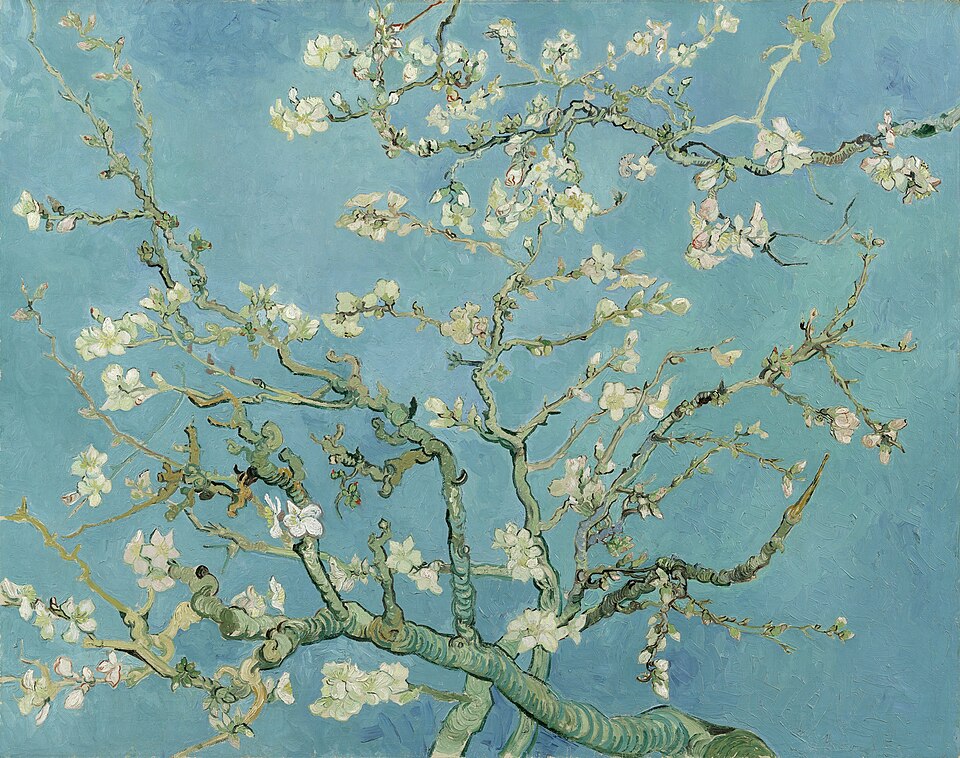
When Vincent van Gogh arrived in Arles in March 1888, snow still lay on the ground, driving him indoors during his first week in the town he would soon call 'the Japan of the South.' Yet the fruit trees in the surrounding orchards were on the verge of flowering, and van Gogh, restless and eager, began looking for signs of the coming season even before he could step outside.
His earliest response came in the form of two small still lifes: Blossoming Almond Branch in a Glass and Blossoming Almond Branch in a Glass with a Book. Writing to his brother Theo, he explained that 'down here it is freezing hard and there is still snow in the countryside,' yet he already had 'two small studies of an almond-tree branch already in flower in spite of it.' A single broken sprig, set simply in a glass, became his first act of springtime observation.
In Blossoming Almond Branch in a Glass, van Gogh used delicate brushstrokes and pastel shades to capture this fragile promise of renewal. Critics have noted how the sprig, highlighted by a red line along a beige wall, sits within lavish empty space, evoking the Japanese art of ikebana in its simplicity. Van Gogh's own name, painted in bright red above the branch, seems to hover like a symbol of hope — a still life that transforms a form associated with death into one focused on life and possibility.
By mid-March, the weather had turned changeable — windy, with turbulent skies — but the almond trees, van Gogh wrote, were 'beginning to flower everywhere.' Within a month of his arrival, he had completed fourteen paintings of blossoming fruit trees: apricot, peach, and plum, painted at a furious pace of nearly one a day. By April 21 he told Theo he would 'have to seek something new, now the orchards have almost finished blossoming' — such was the speed of the season and his response to it.
More from Art

The Painting With No Foreground
A single robed figure stares out at an empty grey sea — and the emptiness itself became a scandal. When it was unveiled in Berlin in 1810, no one knew quite what to do with it.

The Painter Who Chased the Light
For a few purple minutes each evening, an American exile knelt in an English garden and raced the dying sun to paint two little girls lighting lanterns. It took him two years to finish.

When a President Became a God
Look straight up inside the U.S. Capitol dome and you will find George Washington enthroned among the clouds, surrounded by goddesses — the founding father transformed into myth.

Marble Brought Back to Life
A corpse asleep, a wing barely brushing her skin — and marble somehow learns to breathe. This is the moment Antonio Canova dared to carve.

The World Turned Upside Down
Look closely at a sixteenth-century Flemish village and you'll find a man biting a pillar, another carrying daylight in a basket, and a wife slipping a blue cloak over her husband's shoulders. Every gesture is a joke — if you know the language.

The Girl in the Glass Case
She stood two-thirds life size, dressed in a real tutu and human hair — and the critics who saw her in 1881 recoiled as if she were something obscene.