Cologne Cathedral: The 632-Year Dream
A skyline-defining dream, abandoned for three centuries with a crane frozen on its unfinished tower, waited for a king to finish it.
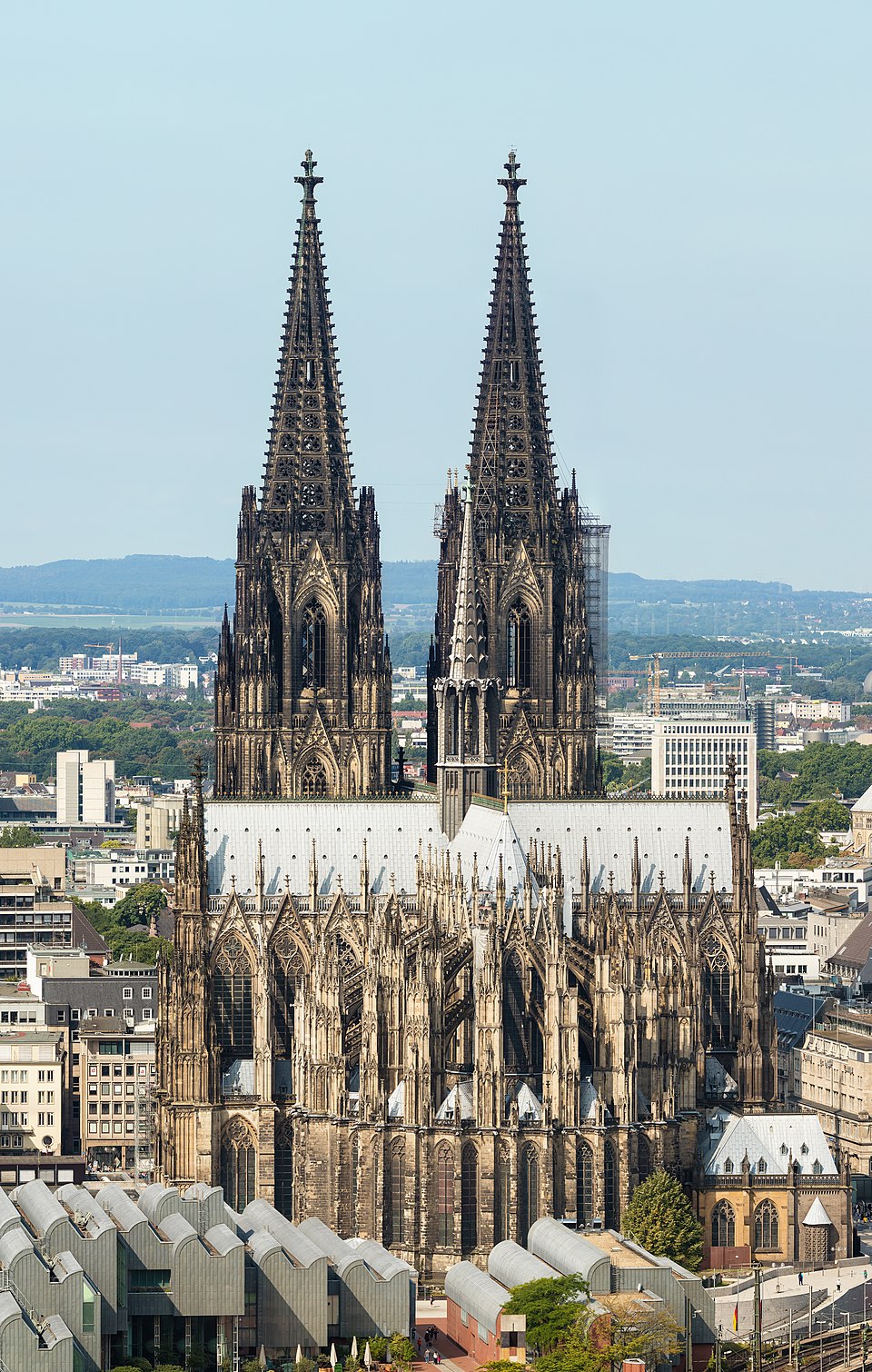
Long before the twin spires of Cologne Cathedral pierced the Rhine sky, the hill beneath it had already hosted centuries of worship. Archaeologists have traced Roman houses from the 1st to 4th centuries under the site, along with an apsidal structure some 30 to 40 metres long from the 4th and 5th centuries, likely the earliest church there. Frankish royal family members were buried nearby in the 530s, and a baptistery from the 6th century, with its distinctive eight-sided piscina, stood just outside this early church.
By the Carolingian era, a grand new structure rose on the hill: Hildebold Cathedral, consecrated in 870 and named for Archbishop Hildebold, a close advisor to Charlemagne who died in 818. At roughly 95 metres long, it was one of the largest Carolingian churches ever built, modeled architecturally and spiritually on Old St. Peter's Basilica in Rome, earning Cologne the nickname 'the St. Peter's Basilica of the North.'
The old cathedral's fame grew enormously in 1164, when Archbishop Rainald of Dassel brought the relics of the Three Wise Men from Milan to Cologne, spoils granted to him by Emperor Frederick Barbarossa. Between 1190 and 1225, the magnificent Shrine of the Three Kings, still regarded as one of the finest goldsmith works of the Middle Ages, was crafted to house these relics, transforming Cologne into a major European pilgrimage destination.
To house this shrine properly and fulfill Cologne's ambitions as a city fit for the Holy Roman Emperor, construction of the present Gothic cathedral began in 1248. Its choir, completed and consecrated in 1322, is considered one of the purest expressions of French High Gothic style built in Germany. Through the 14th and 15th centuries, the nave, transept and the lower sections of the west façade rose steadily.
Then, around the mid-16th century, construction stopped entirely, halted by political and economic pressures. For roughly three centuries, the cathedral stood unfinished, its great west towers left incomplete, a medieval crane frozen atop one of them — a visible symbol of Cologne's unrealized ambition.
More from Architecture

Stonehenge: The Stones That Refuse to Explain Themselves
For more than 4,500 years, a ring of leaning giants has watched the sun rise and set on the same two days each year — and no one alive can say for certain why.

The Dome That Refused to Fall
Two thousand years ago, Roman engineers poured a dome so vast that no one has dared build a bigger one from unreinforced concrete since. It still stands, open to the sky.

A Minaret Rising Over Kingsland Road
On a busy London street better known for shops and buses, the tallest minaret in Britain quietly reaches into the sky. Its story began not in Sinan's sixteenth-century Istanbul, but in 1990s Hackney.

The Bridge That Was Killed Twice
For 427 years it arched over the Neretva like a stone rainbow. Then, in a matter of days in 1993, it simply ceased to exist.

Hoover Dam: The Concrete That Tamed a River
In the scorched depths of Black Canyon, thousands of men built the largest concrete structure the world had ever seen — and finished it two years early, at a cost of over a hundred lives.

Neuschwanstein: The Castle Built for a Ghost
A king who despised his own palace built the most famous fairy-tale castle on earth — and died before he ever truly lived in it.