Eleven Men Against the Current
Eleven exhausted figures strain against leather straps on a riverbank — and one young man refuses to bow. The painting that resulted made a 19th-century Russian artist famous overnight.
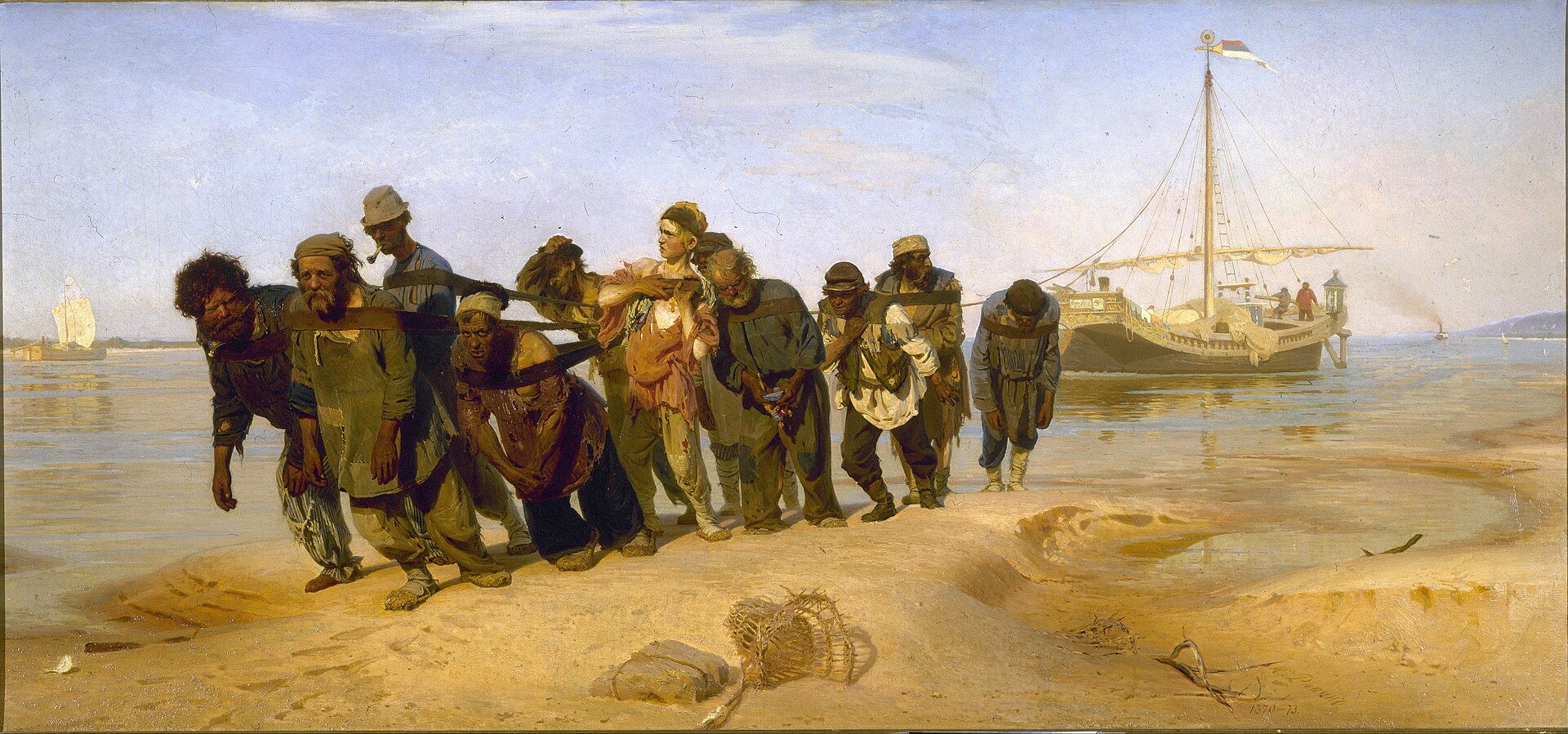
In 1870, a young painter named Ilya Repin traveled along the Volga River, ostensibly on holiday. He had been admitted to the Imperial Academy of Art in St. Petersburg in 1863, an institution so steeped in academic conservatism that it bred quiet rebellion among its more restless students. What Repin witnessed on his travels would change the course of his career: rows of laborers, known as burlaki, dragging heavy barges upstream against the current, bound by leather harnesses, their bodies bent under the weight of the work.
Repin stayed in Shiriaev Buerak, near Stavropol-on-Volga, making numerous preparatory studies in oil — landscapes, river views, and sketches of the haulers themselves. He initially imagined a lighter composition, contrasting carefree day-trippers, people much like himself, with the weary burlaks. But as he came to know his subjects, that plan fell away.
Finding people willing to pose was harder than expected. A folk belief held that once a person's image was captured on paper, their soul might leave the body — even payment could not always overcome this fear. Eventually Repin assembled a group of eleven men to serve as models, among them a former soldier, a defrocked priest, and a painter. Though women also performed this brutal labor, and hauling gangs were typically far larger, Repin chose these eleven to represent a broad cross-section of Russian working society.
One figure struck him more than the rest: a former priest named Kanin, who became the lead hauler in the finished painting, gazing directly outward at the viewer. Repin later wrote that there was something almost Eastern in his face, 'the face of a Scyth,' with eyes of astonishing depth and a broad, wise brow. Despite his rag-wrapped head and threadbare patches of clothing, Kanin carried himself, in Repin's eyes, with the dignity of a saint.
The finished canvas, completed in 1873 after three years of work, shows the eleven men dragging their barge through a scene bathed in a pale, silvery light — critics later called it almost Venetian, a departure from the cooler blue tones of Repin's early studies. The barge itself is pushed to the rear of the composition, diminished; a small steam-powered boat appears in the distance, a quiet hint that industrial machinery might soon render this backbreaking labor obsolete. An inverted Russian flag flutters from the barge's mast, adding an unmistakable note of unease.
More from Art

The Painting With No Foreground
A single robed figure stares out at an empty grey sea — and the emptiness itself became a scandal. When it was unveiled in Berlin in 1810, no one knew quite what to do with it.

The Painter Who Chased the Light
For a few purple minutes each evening, an American exile knelt in an English garden and raced the dying sun to paint two little girls lighting lanterns. It took him two years to finish.

When a President Became a God
Look straight up inside the U.S. Capitol dome and you will find George Washington enthroned among the clouds, surrounded by goddesses — the founding father transformed into myth.

Marble Brought Back to Life
A corpse asleep, a wing barely brushing her skin — and marble somehow learns to breathe. This is the moment Antonio Canova dared to carve.

The World Turned Upside Down
Look closely at a sixteenth-century Flemish village and you'll find a man biting a pillar, another carrying daylight in a basket, and a wife slipping a blue cloak over her husband's shoulders. Every gesture is a joke — if you know the language.

The Girl in the Glass Case
She stood two-thirds life size, dressed in a real tutu and human hair — and the critics who saw her in 1881 recoiled as if she were something obscene.