Eleven Men, One Beam, 850 Feet of Air
They dangle their legs over nothing but sky, pass a bottle, unwrap sandwiches — and somehow nobody in the picture is afraid.
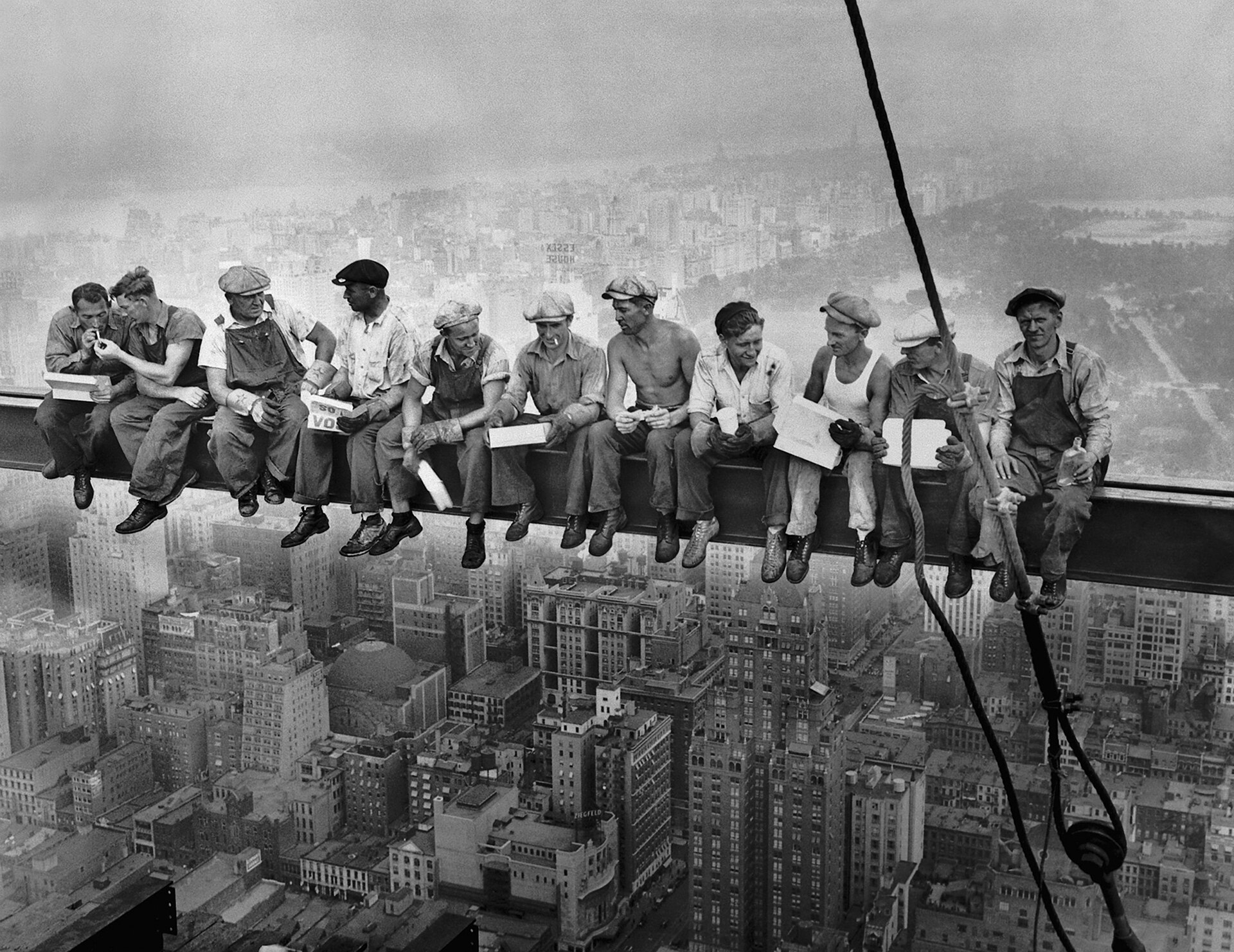
On September 20, 1932, high above the streets of Manhattan, eleven men sat shoulder to shoulder on a steel beam and ate their lunch. Beneath them lay 850 feet of open air, the sixty-ninth floor of the nearly finished RCA Building, the centerpiece of the new Rockefeller Center. Central Park stretched green and small in the distance behind them. No safety harnesses held them in place. They simply sat, as ironworkers did, as though the beam were a park bench.
The photograph was not a candid accident. It was staged, part of a publicity campaign meant to promote the ambitious new skyscraper rising in the middle of the Great Depression. On that same day, photographers captured other images of the same men throwing a football on the girder and pretending to sleep atop it — all designed to turn ironwork into spectacle, danger into charm.
The picture was distributed by Acme Newspictures and began appearing in newspapers by the end of September 1932. It ran in the New York Herald Tribune's Sunday supplement on October 2 under the simple caption 'Lunch Atop a Skyscraper.' For decades afterward, it circulated without a name attached to it — an image everyone recognized and no one could source.
For years the photograph was wrongly credited to Lewis Hine, likely because people confused the RCA Building with the Empire State Building, which Hine had famously documented. The true authorship remained murky. In 1998, Tami Ebbets Hahn, the daughter of photographer Charles C. Ebbets, saw a poster of the image and suspected her father had taken it. It wasn't until 2003 that she contacted Ken Johnston at Corbis, which by then owned the negative through its 1995 purchase of the Bettmann Archive — itself acquired from the Acme Newspictures collection.
Corbis hired a private investigation firm to dig into the mystery. One lead pointed to a photographer named Hamilton Wright, but his family didn't recognize the photo — and it turned out common practice for Wright's staff photographers to have their work credited to him. Ebbets, it emerged, had worked for the Hamilton Wright Features syndicate and had been appointed photographic director for Rockefeller Center in 1932, tasked with publicizing the skyscraper. Hahn produced her father's pay stub, at $1.50 an hour, along with a photo of him holding a camera at what appeared to be the same site. Corbis's Ken Johnston concluded Ebbets was the photographer — though later research showed two other photographers, Thomas Kelley and William Leftwich, were also present that day, leaving the true credit uncertain once more.
More from Art

The Painting With No Foreground
A single robed figure stares out at an empty grey sea — and the emptiness itself became a scandal. When it was unveiled in Berlin in 1810, no one knew quite what to do with it.

The Painter Who Chased the Light
For a few purple minutes each evening, an American exile knelt in an English garden and raced the dying sun to paint two little girls lighting lanterns. It took him two years to finish.

When a President Became a God
Look straight up inside the U.S. Capitol dome and you will find George Washington enthroned among the clouds, surrounded by goddesses — the founding father transformed into myth.

Marble Brought Back to Life
A corpse asleep, a wing barely brushing her skin — and marble somehow learns to breathe. This is the moment Antonio Canova dared to carve.

The World Turned Upside Down
Look closely at a sixteenth-century Flemish village and you'll find a man biting a pillar, another carrying daylight in a basket, and a wife slipping a blue cloak over her husband's shoulders. Every gesture is a joke — if you know the language.

The Girl in the Glass Case
She stood two-thirds life size, dressed in a real tutu and human hair — and the critics who saw her in 1881 recoiled as if she were something obscene.