Eleven Rivers of Stone: How Rome Drank
By 226 AD, a city of a million people drank, bathed, and flushed its streets with water carried across mountains on stone arches. It was an empire's plumbing, and it still astonishes engineers today.
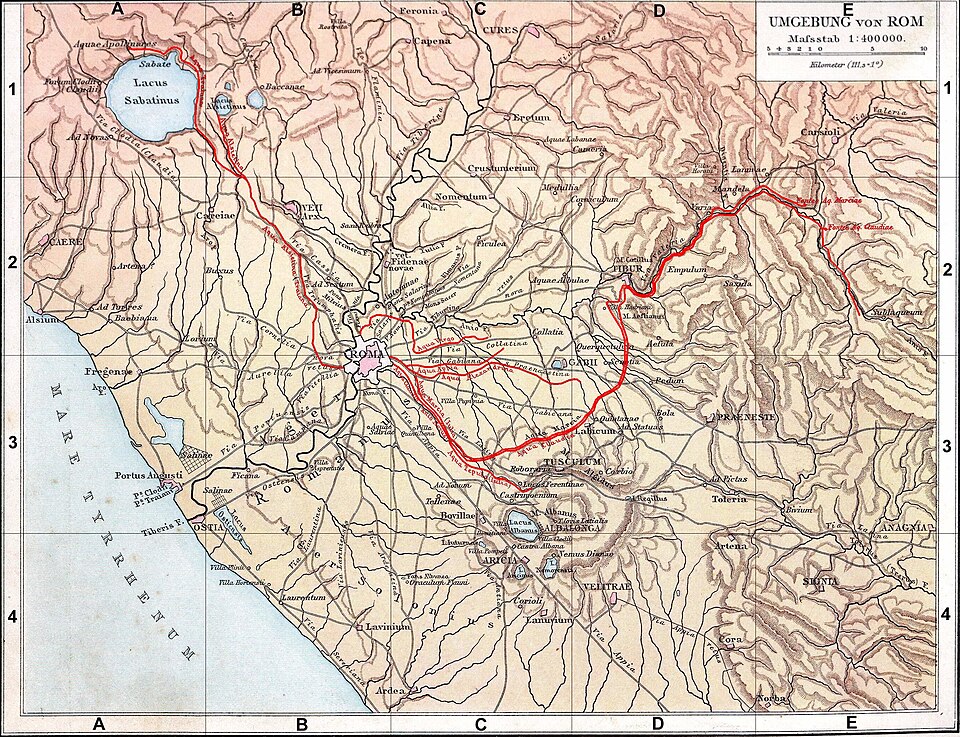
Rome was not built beside a great river the way most ancient cities were. The Tiber alone could never have sustained a metropolis that eventually swelled to a million inhabitants. So the Romans did what they did best when nature fell short: they engineered around it. By 226 AD, eleven aqueducts stretched across the landscape, drawing water from the Aniene river and the springs of the Apennine Mountains and carrying it, often for dozens of kilometers, into the heart of the city.
The scale of what they achieved is staggering even by modern estimates. Scholars have calculated that the combined aqueducts delivered somewhere between 520,000 and 1,127,220 cubic meters of water per day. Even the lower figure would have been enough to sustain fountains, baths, private households, and the ceaseless washing of public streets on a scale unmatched in the ancient world. That water sustained not luxury alone but survival — a dense urban population needed reliable, clean supply to avoid the diseases that overcrowding invites.
Much of what we know about this system comes not from ruins alone but from a Roman administrator named Sextus Julius Frontinus. Serving as Curator Aquarum — the official in charge of the water supply — Frontinus compiled detailed statistics on the aqueducts in the late first century AD, around 97 AD. His records became, and remain, the single most valuable window into how the system actually functioned: which aqueducts fed which parts of the city, how much water each carried, and how the network was managed.
After Frontinus, the historical trail grows thinner. Aqueducts built following his tenure are documented with far less precision, leaving gaps that modern historians and engineers have had to fill with inference and physical investigation of the remains themselves.
And the remains still speak. Modern engineers, skeptical of ancient estimates, have gone so far as to measure the limestone deposits left behind inside the channels of the Anio Novus, one of the eleven aqueducts. These mineral crusts, built up over centuries of running water, let scientists estimate the wetted perimeter and surface roughness of the channel — physical evidence of how fast and how much water actually flowed. Their conclusion was sobering: real flow may have been only about two-thirds of the figures suggested by ancient sources.
More from Architecture

Stonehenge: The Stones That Refuse to Explain Themselves
For more than 4,500 years, a ring of leaning giants has watched the sun rise and set on the same two days each year — and no one alive can say for certain why.

The Dome That Refused to Fall
Two thousand years ago, Roman engineers poured a dome so vast that no one has dared build a bigger one from unreinforced concrete since. It still stands, open to the sky.

A Minaret Rising Over Kingsland Road
On a busy London street better known for shops and buses, the tallest minaret in Britain quietly reaches into the sky. Its story began not in Sinan's sixteenth-century Istanbul, but in 1990s Hackney.

The Bridge That Was Killed Twice
For 427 years it arched over the Neretva like a stone rainbow. Then, in a matter of days in 1993, it simply ceased to exist.

Hoover Dam: The Concrete That Tamed a River
In the scorched depths of Black Canyon, thousands of men built the largest concrete structure the world had ever seen — and finished it two years early, at a cost of over a hundred lives.

Neuschwanstein: The Castle Built for a Ghost
A king who despised his own palace built the most famous fairy-tale castle on earth — and died before he ever truly lived in it.