Even in Arcadia, Death Waits
A group of idealized shepherds gathers around a stone tomb in a sunlit pastoral paradise — and reads words that turn bliss into meditation.
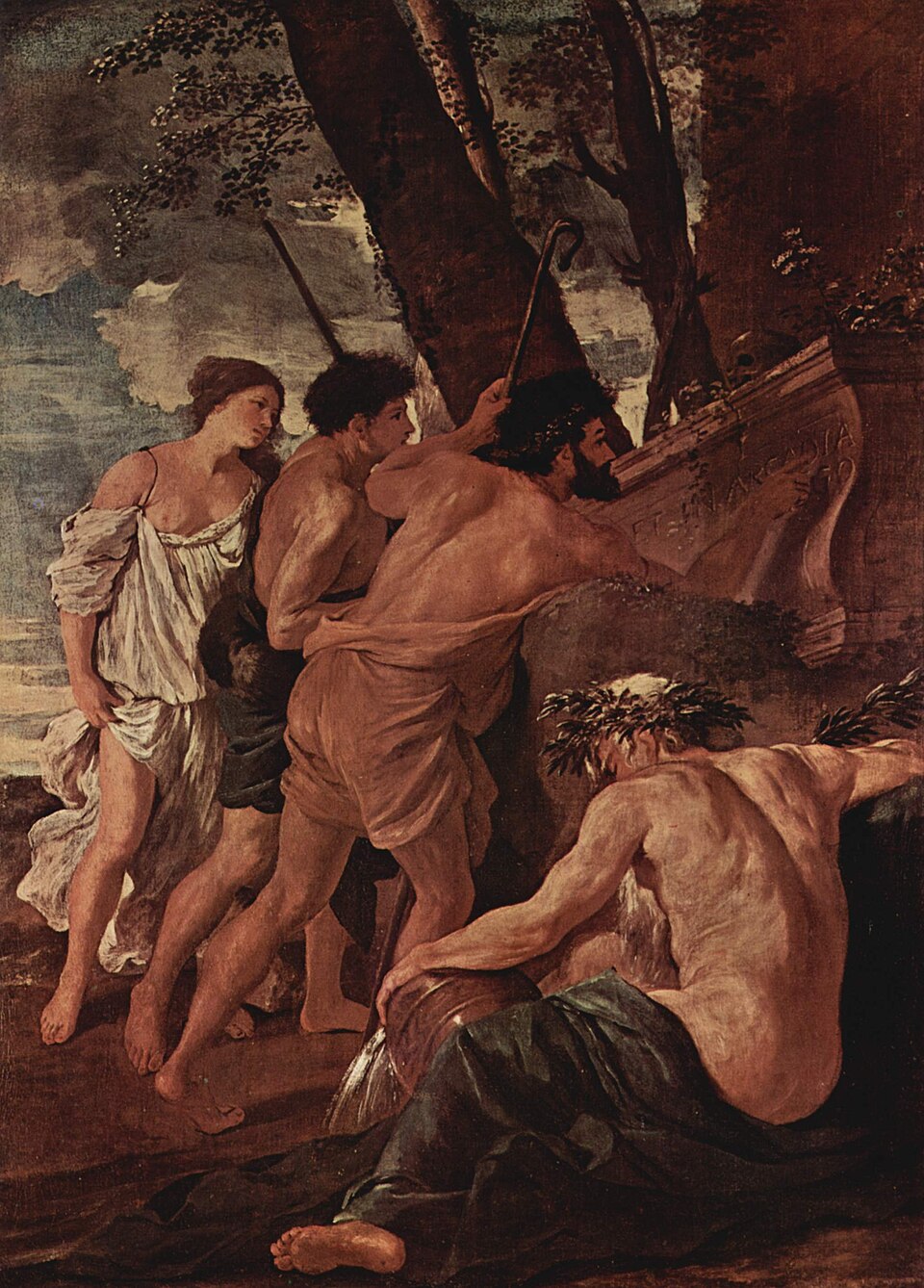
In a shaded corner of a landscape that seems to have no room for sorrow, three shepherds and a stately woman cluster around a plain stone tomb. One kneels, tracing letters carved into the rock: ET IN ARCADIA EGO. This is the scene Nicolas Poussin painted between 1637 and 1638, a work now known by many names — Et in Arcadia ego, Les bergers d'Arcadie, The Arcadian Shepherds — and housed today in the Musée du Louvre in Paris.
The phrase itself, translated variously as 'Even in Arcadia, there am I,' 'Also in Arcadia am I,' or 'I too was in Arcadia,' carries a deliberate ambiguity that has occupied scholars for centuries. Arcadia, in the classical imagination, was no ordinary place. Virgil's Eclogues first described a tomb inscribed to the shepherd Daphnis set within this idyllic, pastoral Greek region, blending Theocritus's idealized Sicilian rustics with a landscape imagined as pure and untroubled.
The theme resurfaced centuries later in the Florentine Renaissance, in the circle of Lorenzo de' Medici during the 1460s and 1470s, and again in 1504 when Jacopo Sannazaro's pastoral work Arcadia fixed the region in the European imagination as a lost world of idyllic bliss, mourned in wistful dirges. The specific memento mori imagery — a tomb bearing the words Et in Arcadia ego — first appeared visually in a painting by Guercino, made between 1618 and 1622 and now held in the Galleria Nazionale d'Arte Antica in Rome. In Guercino's version, a skull sits prominently in the foreground beneath the carved inscription, leaving little doubt about its meaning.
Poussin himself painted the subject twice. His first attempt, from 1627, now hangs in Chatsworth House, England, and was likely commissioned as a response to Guercino's composition. It is more Baroque, more dramatic: the shepherds seem to be discovering the tomb for the first time, half-hidden in overgrowth, their faces full of curious surprise. The woman standing at the left is posed in a manner far more sexually suggestive than in the later work.
The 1637–38 Louvre version is entirely different in temperament. Its composition is geometric, ordered, contemplative. The woman is now modeled on an antique statue known as the Cesi Juno, lending her a classical austerity. Most strikingly, one of the shepherds notices his own shadow falling across the tomb and traces its outline with his finger — an act that, according to Pliny the Elder's Natural History, marks the mythic moment when the art of painting was first invented.
More from Art

The Painting With No Foreground
A single robed figure stares out at an empty grey sea — and the emptiness itself became a scandal. When it was unveiled in Berlin in 1810, no one knew quite what to do with it.

The Painter Who Chased the Light
For a few purple minutes each evening, an American exile knelt in an English garden and raced the dying sun to paint two little girls lighting lanterns. It took him two years to finish.

When a President Became a God
Look straight up inside the U.S. Capitol dome and you will find George Washington enthroned among the clouds, surrounded by goddesses — the founding father transformed into myth.

Marble Brought Back to Life
A corpse asleep, a wing barely brushing her skin — and marble somehow learns to breathe. This is the moment Antonio Canova dared to carve.

The World Turned Upside Down
Look closely at a sixteenth-century Flemish village and you'll find a man biting a pillar, another carrying daylight in a basket, and a wife slipping a blue cloak over her husband's shoulders. Every gesture is a joke — if you know the language.

The Girl in the Glass Case
She stood two-thirds life size, dressed in a real tutu and human hair — and the critics who saw her in 1881 recoiled as if she were something obscene.