Excalibur: The Sword That Made a King
A blade in an anvil, a hand rising from a lake — the story of Excalibur is really two swords wearing one legend.
Long before Excalibur became a household word, it was Caledfwlch — a name carved into Welsh tales like Culhwch and Olwen centuries before anyone in France or England wrote of Arthur pulling a sword from stone. The word itself is built from caled, 'hard', and bwlch, 'breach' or 'cleft', and scholars have long noticed its kinship with Caladbolg, a sword wielded by heroes of Irish mythology. Whether one name borrowed from the other or both sprang independently from an ancient shared idea of what a legendary sword should be called, no one can say for certain.
It was the Welsh cleric Geoffrey of Monmouth who first gave the sword a form that later ages would recognize, Latinising it as Caliburnus in his Historia Regum Britanniae around 1136 — possibly nodding to the Latin word for steel, chalybs, itself borrowed from Greek. Geoffrey Gaimar, writing his Old French chronicle Estoire des Engleis in the years just after, called it Caliburc, tying it to Arthur and his nephew Constantine. Then came Wace, whose Roman de Brut scattered a dizzying array of spellings across its manuscripts — Caliburn, Calabrun, Escalibor — a linguistic sword passed hand to hand until it settled, centuries later, into the familiar Excalibur.
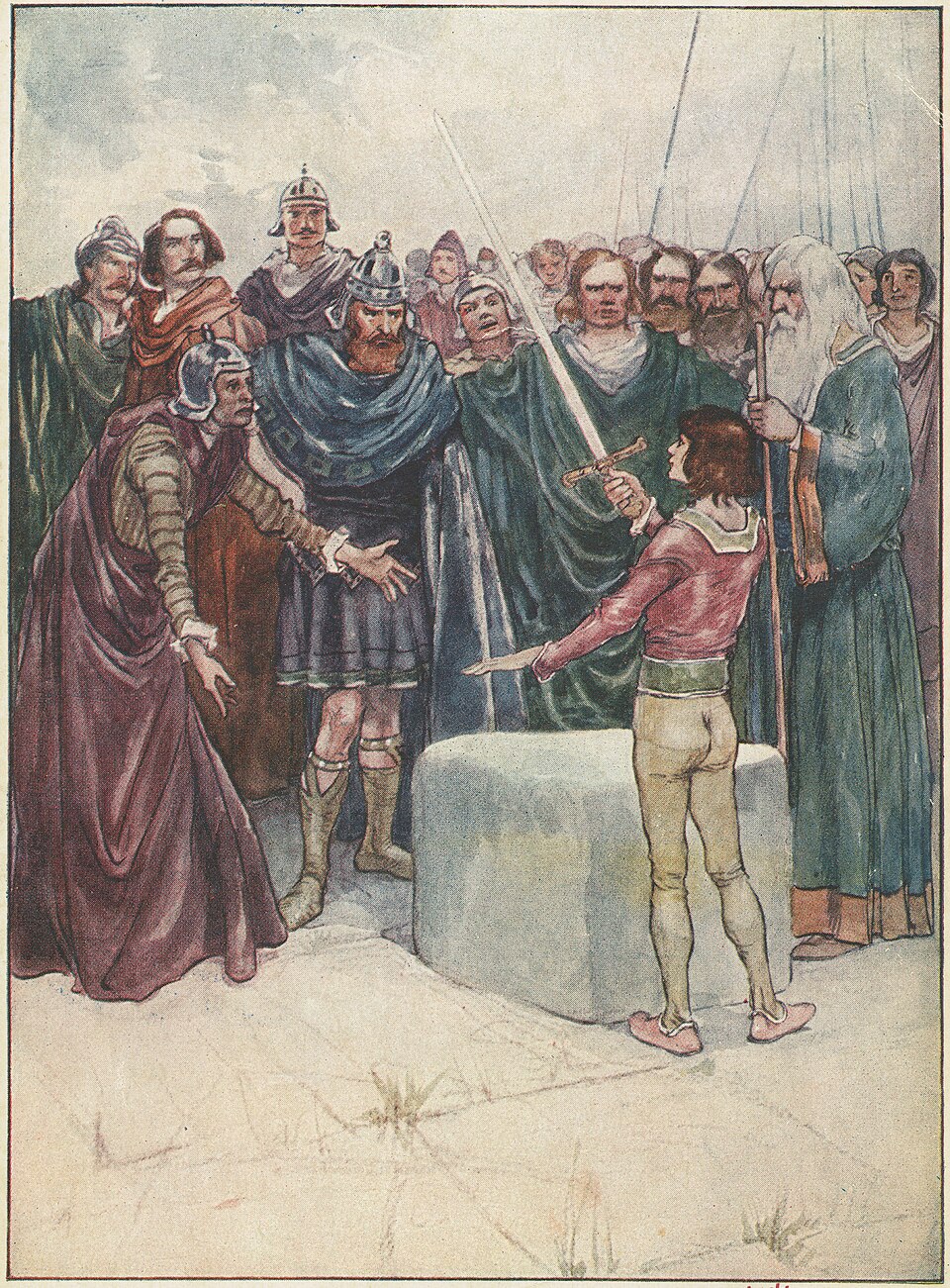
But a name is not yet a legend, and the legend's most famous scene belongs to a different French poet. Around 1200, Robert de Boron wrote Merlin, the first known account of a sword lodged in a stone atop an anvil, appearing mysteriously in a churchyard on Christmas Eve. Merlin had prophesied that only the true, divinely appointed heir of Uther Pendragon could draw it free. Nobles tried and failed. Thomas Malory, writing his own version centuries later in Le Morte d'Arthur, put the promise plainly: whoever pulled the sword from stone and anvil was rightful king of all England.
Arthur, in this telling, had no idea he was Uther's son. Raised believing himself the child of Ector, he came to the churchyard only as squire to his foster brother Kay — and pulled the sword free without effort, almost by accident, unseen by anyone. He replaced it, then drew it again in public once Merlin arrived to reveal his true parentage. It was the Prose Merlin, part of the sprawling thirteenth-century Lancelot-Grail cycle, that finally named this stone-sword explicitly as Excalibur.
Yet the story does not end with a coronation. In the same cycle's finale, the Vulgate Mort Artu, a dying Arthur orders his knight Griflet to hurl Excalibur into a nearby lake. Griflet, unwilling to discard so great a weapon, tries twice to deceive his king before finally obeying. A hand rises from the water to catch the blade; Morgan then arrives by boat to carry Arthur away to Avalon. Later English tradition would shift this final act from Griflet onto the more familiar Sir Bedivere.
More from Mythology

The Doctor Who Sang a Nation Into Being
A country doctor rode into the forests of Karelia armed with nothing but a notebook — and rode out with the soul of a nation.

The Boat That Carried the Sun
Every sunset, the ancient Egyptians believed, the sun climbed into a boat and sailed straight into the realm of the dead — only to fight a monstrous serpent before dawn could return.

The Wild Man of the Snows
At 21,000 feet, a colonel found tracks in the snow that he blamed on a wolf — but his guides knew better, and gave the world a name that would echo for a century.

The Knight Who Went Mad for Love: Orlando Furioso
A hero so devoted to duty he was Charlemagne's greatest paladin loses his mind—not to a sword wound, but to heartbreak. To cure him, a friend must ride a flying horse to the Moon.

The Book That Turned the World Into Myth
A poet condemned to exile spent his final years in Rome finishing a poem that would outlive empires—a poem about nothing standing still, not gods, not lovers, not even the shape of a man.

Paradise Lost: Milton's Rebel Angel
A blind poet, dictating verses in the dark, dared to explain the ways of God to men — and in doing so, made Hell's ruler unforgettable.