Ferhat and Shirin: The Love That Carved a Mountain
A young craftsman falls in love with a princess he glimpsed inside a color-changing pavilion — and spends decades trying to earn her with nothing but a chisel and a mountain.
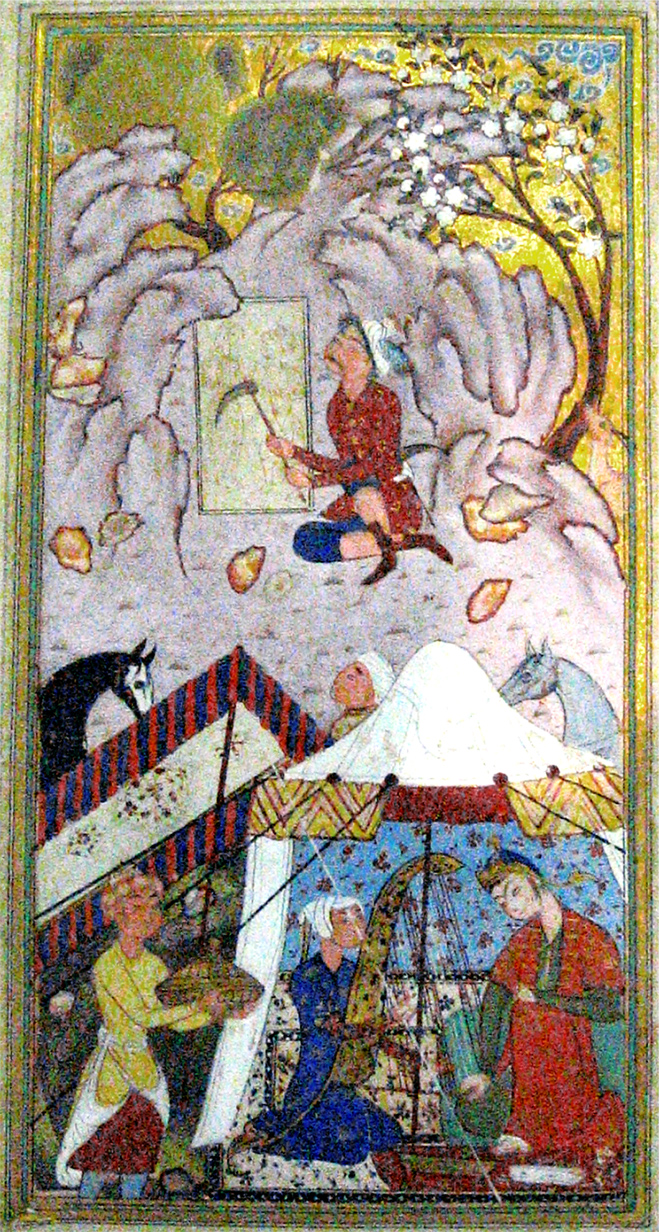
In the region of Azerbaijan, in the city of Erzen, a female ruler named Mehmene Banu had a wondrous pavilion built for her niece Shirin, a girl of thirteen or fourteen already famed for her beauty. The pavilion was designed with seven colors that shifted according to the stars, and to decorate it Mehmene Banu turned to the finest ornamental craftsman of the land, a master named Behzat, and his son Ferhat. It was during this work that Shirin came to see the pavilion and laid eyes on Ferhat. The two looked at each other, and love struck them both at once.
Behzat and Ferhat continued their labor, next working on a smaller second pavilion Mehmene Banu had commissioned nearby. During this project, her handmaidens discovered a spring of water, and the idea arose to channel it into the pavilion grounds. Ferhat, seeing an opportunity, asked for a reward far beyond ordinary pay: he requested a position of authority within the palace in exchange for bringing the water through. Depending on which version of the tale is told, he accomplished this feat — cutting through a mountain with nothing but devotion and effort — in forty days, or in some tellings, forty years.
The story of Ferhat and Shirin did not emerge from nowhere. Its roots reach back to the tale of the Sasanian king Khosrow II, who reigned from 590 to 628 CE, and his beloved Shirin, ruler of the city of Barda in Azerbaijan. Historical sources say little definite about who Shirin and Ferhat truly were or what roles they played in their era, but the romantic legend around Khosrow and Shirin took on a life of its own, retold across Persian, Turkish, and Azerbaijani literature for centuries as a mesnevi, a narrative poem form.
The earliest literary seeds were planted in the 10th century, when Firdausi wove the story into his Shahnameh. In the 12th century, the Persian poet Sanai gave it independent literary treatment, and the Azerbaijani poet Nizami Ganjavi shaped it into the definitive classical version that later poets would draw from. It was the Turkic poet Ali Shir Nava'i who made the decisive shift: instead of centering the king Khosrow, he placed at the heart of his version an abstract hero of love — Ferhat — and titled his work 'Ferhad u Shirin,' giving the story a markedly different flavor from its Persian ancestor.
From there, the tale left the courtly world of divan literature and entered Turkish folk tradition under the same title, its historical and geographical setting reimagined onto Anatolian soil, producing many regional variants. Among ordinary people it became beloved: Shirin came to symbolize beauty itself, and Ferhat, patience and endurance. Unlike typical Turkish folk tales performed with a saz, this one was read aloud to listeners from written text, its verse passages composed in the classical aruz meter. It found a place in the repertoires of Eastern Anatolian folk poets such as Behçet Mahir, Mevlüt İhsanî, Yaşar Reyhanî, and Çıldırlı Âşık Şenlik, and was even adapted into the shadow-puppet tradition of Karagöz, relocated to Istanbul and given, notably, a happy ending.
More from Mythology

The Doctor Who Sang a Nation Into Being
A country doctor rode into the forests of Karelia armed with nothing but a notebook — and rode out with the soul of a nation.

The Boat That Carried the Sun
Every sunset, the ancient Egyptians believed, the sun climbed into a boat and sailed straight into the realm of the dead — only to fight a monstrous serpent before dawn could return.

The Wild Man of the Snows
At 21,000 feet, a colonel found tracks in the snow that he blamed on a wolf — but his guides knew better, and gave the world a name that would echo for a century.

The Knight Who Went Mad for Love: Orlando Furioso
A hero so devoted to duty he was Charlemagne's greatest paladin loses his mind—not to a sword wound, but to heartbreak. To cure him, a friend must ride a flying horse to the Moon.

The Book That Turned the World Into Myth
A poet condemned to exile spent his final years in Rome finishing a poem that would outlive empires—a poem about nothing standing still, not gods, not lovers, not even the shape of a man.

Paradise Lost: Milton's Rebel Angel
A blind poet, dictating verses in the dark, dared to explain the ways of God to men — and in doing so, made Hell's ruler unforgettable.