Five Canvases, One Warning: Thomas Cole's Course of Empire
A single boulder watches over a valley for centuries — as a wilderness becomes a marble empire, and the empire becomes rubble. Thomas Cole painted the whole rise and fall in five acts.
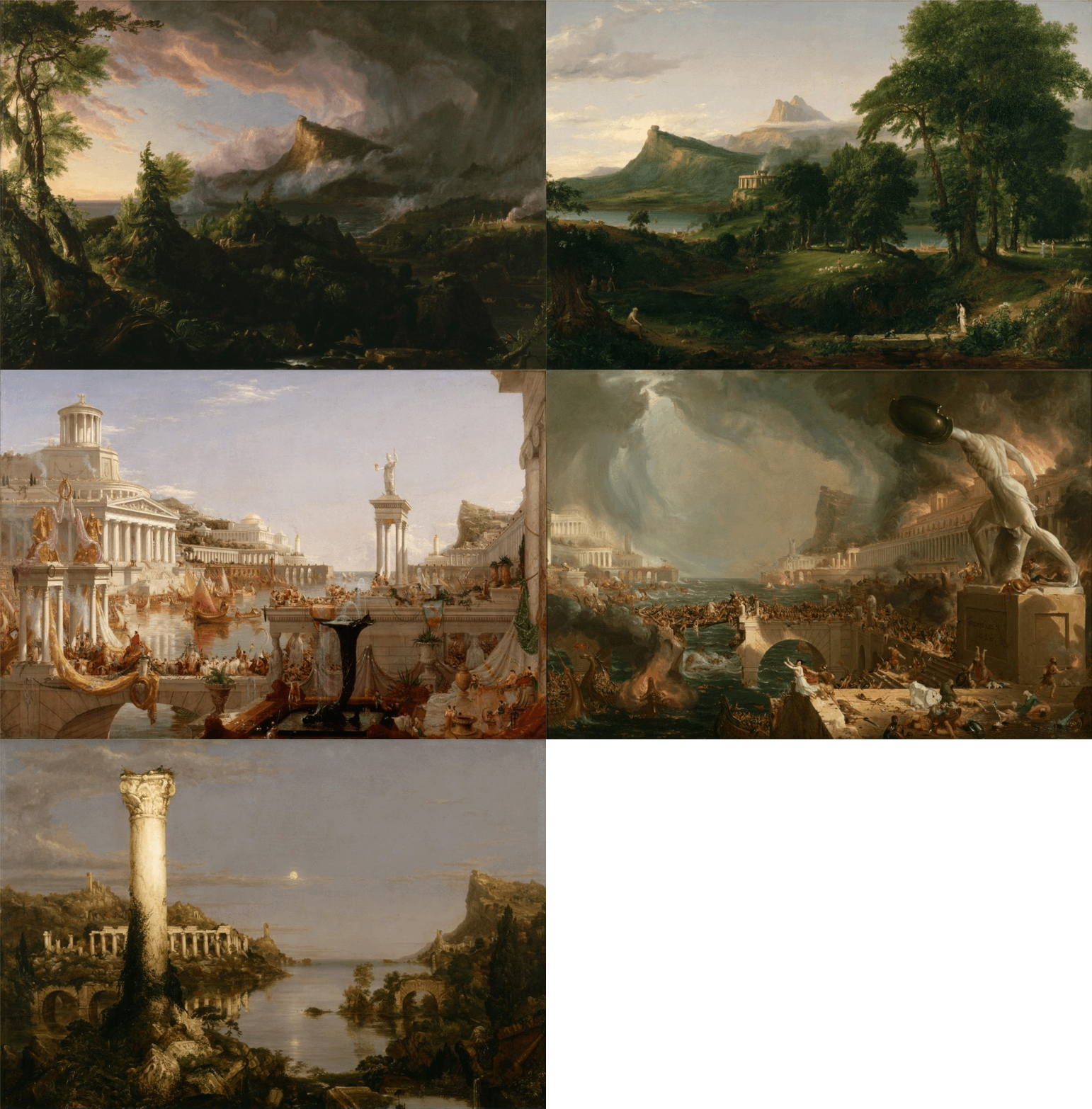
On a stormy dawn, a hunter clad in skins chases a fleeing deer through mist and rock. Canoes cut across a river; on the far shore, tipis cluster around a fire, the first embers of a civilization not yet born. This is The Savage State, the opening panel of a series Thomas Cole painted between 1833 and 1836, and it is deceptively simple: rocks, mountains, a bay of ocean, and one unmistakable landmark — a large boulder perched atop a crag — that will reappear in every painting that follows, unmoved while everything around it changes.
That boulder is the key to the whole series. Cole used it to anchor five paintings depicting an imaginary city near a river valley's meeting with the sea, shifting the viewer's vantage point from canvas to canvas while the crag remains identifiable throughout. Critics have long read this as deliberate: the immutability of the earth set against the transience of human ambition. In the second painting, The Arcadian or Pastoral State, the storm has cleared. Fields are plowed, sheep are herded, boats are built, and an old man sketches a geometric problem in the dirt. A megalithic temple sends up smoke from a bluff. It's an idealized vision of early Greece — peaceful, ordered — but Cole plants a warning in the frame: a warship under construction, and a mother watching uneasily as her child draws a soldier.
By the third panel, The Consummation of Empire, the wilderness has vanished entirely. Marble colonnades, crowded harbors, and triumphant processions fill a scene of imperial splendor — the largest canvas in the series, as if grandeur itself demanded more room. Then comes Destruction, viewed from nearly the same vantage point: the same city engulfed in violence, its monuments broken, its people fleeing or falling. And finally, Desolation, set decades later, where the boulder still stands sentinel over ruins reclaimed by moss and birds, the empire's ambitions reduced to broken columns under a darkening sky.
Cole wasn't inventing a specific city. The architecture, clothing, and sculpture throughout are unmistakably Greco-Roman, and the arc of the series loosely tracks the history of Rome. But the choice wasn't incidental — revived classical architecture had become the default style for American public buildings, Washington DC especially, which meant contemporary audiences could read the series as more than history. It could be read as prophecy.
He found his literary scaffolding in Lord Byron. In newspaper advertisements promoting the series, Cole quoted lines from Childe Harold's Pilgrimage: 'First freedom and then Glory — when that fails, Wealth, vice, corruption.' A line often attached to the series, from Bishop Berkeley, captures the same anxious momentum: 'Westward, the course of empire takes its way.' The paintings arrived at a moment when many Americans idealized pastoral life as civilization's healthiest phase, wary that empire building led inevitably to gluttony and collapse.
More from Art

The Painting With No Foreground
A single robed figure stares out at an empty grey sea — and the emptiness itself became a scandal. When it was unveiled in Berlin in 1810, no one knew quite what to do with it.

The Painter Who Chased the Light
For a few purple minutes each evening, an American exile knelt in an English garden and raced the dying sun to paint two little girls lighting lanterns. It took him two years to finish.

When a President Became a God
Look straight up inside the U.S. Capitol dome and you will find George Washington enthroned among the clouds, surrounded by goddesses — the founding father transformed into myth.

Marble Brought Back to Life
A corpse asleep, a wing barely brushing her skin — and marble somehow learns to breathe. This is the moment Antonio Canova dared to carve.

The World Turned Upside Down
Look closely at a sixteenth-century Flemish village and you'll find a man biting a pillar, another carrying daylight in a basket, and a wife slipping a blue cloak over her husband's shoulders. Every gesture is a joke — if you know the language.

The Girl in the Glass Case
She stood two-thirds life size, dressed in a real tutu and human hair — and the critics who saw her in 1881 recoiled as if she were something obscene.