Five Figures, One Endless Circle
A Russian merchant wanted a staircase filled with joy — what he got was one of the most radical paintings of the twentieth century.
In March 1909, Henri Matisse sat before a canvas and sketched five nude figures joined hand to hand in a circle, painted in pale, tentative colors. He called this preliminary study Dance (I), a compositional experiment rather than a finished statement. Yet even in its unfinished state, Matisse held it in high esteem, later describing it as 'the overpowering climax of luminosity.' That early panel would eventually find its way to New York, donated by Nelson A. Rockefeller in honor of Alfred H. Barr Jr. to the Museum of Modern Art, where it remains today.
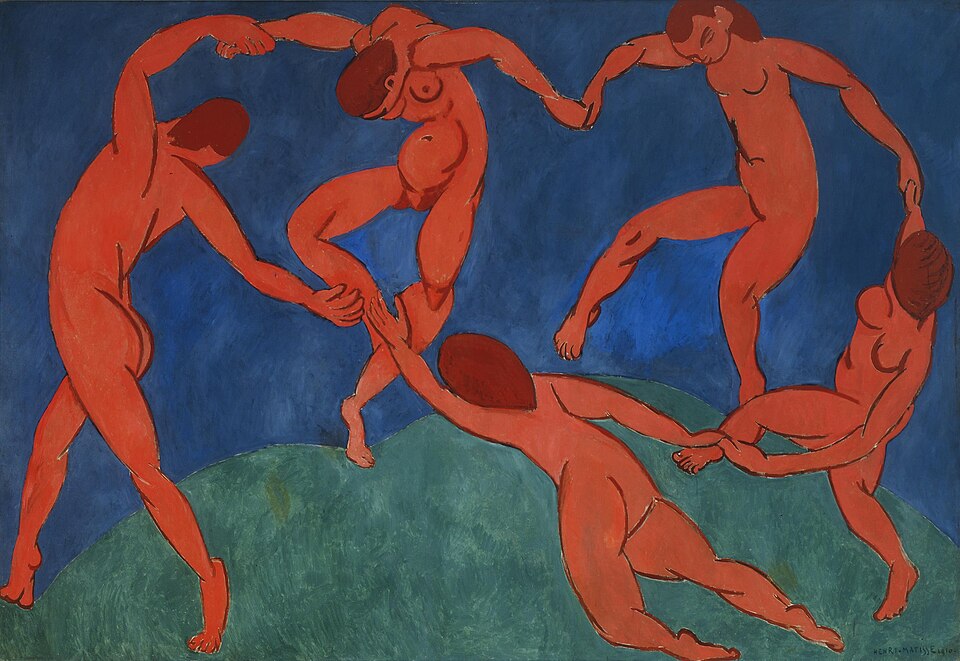
The true commission came from Sergei Shchukin, a Russian businessman and art collector who had built a long relationship with Matisse and wanted large decorative panels for the staircase of his Moscow mansion. Matisse delivered two companion works: Dance and Music. Painted in 1910, Dance depicted the same five figures, now rendered in a strong, saturated red, set against a stark green landscape and a deep blue sky — a composition stripped of ornament, pushed toward pure emotional force.
The painting made its public debut at the Salon d'Automne of 1910, held at the Grand Palais des Champs-Élysées in Paris, running from October 1 to November 8. Audiences accustomed to more restrained academic painting encountered instead five bodies caught mid-motion, locked in a rhythm that seemed to spill beyond the canvas edges.
Until the October Revolution of 1917, Dance and Music hung together on the staircase of Shchukin's Moscow home, exactly as intended — a private, domestic monument to movement and sound. The upheaval of revolution eventually separated the paintings from their original setting, and they were bequeathed to the Hermitage Museum in Saint Petersburg, where they remain displayed side by side to this day.
What makes Dance so striking is its palette and simplicity. The intense red of the figures against the cool blue-green backdrop follows a classic Fauvist logic, but here Matisse pushes it toward something almost primal. Art historians have noted his incipient fascination with what was then called 'primitive art,' and the rhythmic succession of dancing nudes has been read as an expression of emotional liberation and hedonism.
More from Art

The Painting With No Foreground
A single robed figure stares out at an empty grey sea — and the emptiness itself became a scandal. When it was unveiled in Berlin in 1810, no one knew quite what to do with it.

The Painter Who Chased the Light
For a few purple minutes each evening, an American exile knelt in an English garden and raced the dying sun to paint two little girls lighting lanterns. It took him two years to finish.

When a President Became a God
Look straight up inside the U.S. Capitol dome and you will find George Washington enthroned among the clouds, surrounded by goddesses — the founding father transformed into myth.

Marble Brought Back to Life
A corpse asleep, a wing barely brushing her skin — and marble somehow learns to breathe. This is the moment Antonio Canova dared to carve.

The World Turned Upside Down
Look closely at a sixteenth-century Flemish village and you'll find a man biting a pillar, another carrying daylight in a basket, and a wife slipping a blue cloak over her husband's shoulders. Every gesture is a joke — if you know the language.

The Girl in the Glass Case
She stood two-thirds life size, dressed in a real tutu and human hair — and the critics who saw her in 1881 recoiled as if she were something obscene.